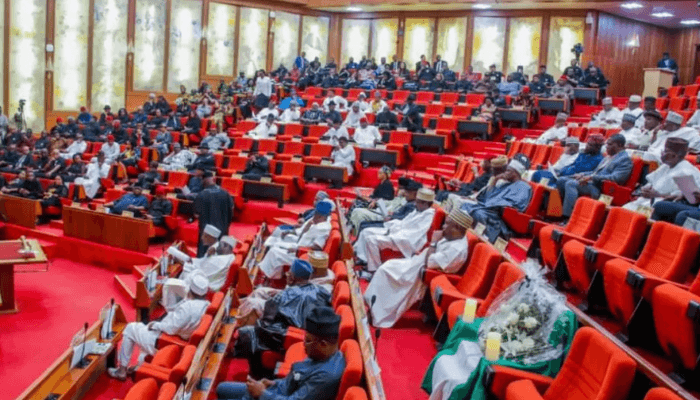
…as Senate assures stakeholders of acceptable law
The Federal Government and the Nigeria Social Insurance Trust Fund (NSITF) on Monday threw their weight behind a new Social Security Trust Fund Bill, which seeks to harmonise the existing NSITF Act and the Employees’ Compensation Act (ECA) 2010 to enhance efficiency and improve service delivery.
This came as the Senate, through its Committee on Employment, Labour and Productivity, assured stakeholders at a public hearing that their concerns would shape a “very acceptable law for all.”
Sponsored by Senator Cyril Fasuyi (Ekiti North), the Bill aims to expand the mandate of the NSITF into broader social security functions by merging the NSITF Act of 1993 and the ECA 2010, effectively transforming the Fund into the Nigeria Social Security Trust Fund (NSSTF).

Presenting NSITF’s position, Oluwaseun Faleye, the Managing Director and Chief Executive Officer, praised the Senate for what he described as a “strategic and forward-looking legislative intervention.”
Read also: How we invest employees’ contributions — NSITF
He explained that the new Bill marks a major step toward modernising Nigeria’s social security framework, aligning it with global standards, particularly the International Labour Organisation (ILO) Social Security (Minimum Standards) Convention, 1952 (No. 102), and the Tripartite Consultation Convention, 1976 (No. 144).
Faleye said one of the most critical aspects of the Bill is the repeal of both the NSITF Act of 1993 and the ECA 2010.
Their concurrent existence, he noted, had created operational ambiguities, especially after the Pension Reform Act (PRA) 2014 reassigned contributory pension functions from NSITF to the National Pension Commission.

“The consolidation of the two Acts into a single, coherent statute is timely, necessary, and commendable.
“It eliminates duplication, resolves conflicts, and strengthens the legal framework of the Fund.
“The Bill’s expansion of social security coverage to include informal sector workers and self-employed persons is a historic step towards inclusive protection for all categories of working Nigerians,” he said.
However, despite backing the Bill, Faleye flagged concerns about what he called the “misapplication” of the word Board throughout the draft.
He cautioned that using the term to simultaneously describe governance, oversight, and administrative duties could create confusion.
“The Board meets quarterly, while daily operations are under the Managing Director. “The Bill must distinguish clearly between the Governing Board as oversight body, Management as administrators, and the Agency as the implementing institution,” he said.
He recommended the adoption of clearer definitions similar to those in the Federal Inland Revenue Service (FIRS) Act, where the Board’s functions are distinct from those of the Executive Chairman, who serves as Chief Executive and Accounting Officer.
Faleye reaffirmed the NSITF’s full support for the Bill, describing it as “progressive, timely, and aligned with global best practices.”
Speaking earlier, Muhammadu Dingyadi, the Minister of Labour and Employment, commended the Senate’s initiative, describing the proposed law as a “very beautiful idea.”
He urged the Committee to arrive at a balanced and acceptable outcome for all parties by ensuring an appropriate alignment between the powers of the management team and those of the Board.
Although the Nigeria Labour Congress (NLC) and the Nigeria Employers’ Consultative Association (NECA) initially opposed the Bill, the NLC, led by Joe Ajaero, its President, later softened its stance.
According to him, “we are not here for we no go gree, we no gree.”
He added, “Since many of the other critical stakeholders have supported the bill, NLC is not hellbent in opposing it.
“But the grey areas we identified during presentation should be addressed by the committee.”
After extensive deliberations, Diket Plang, the Committee Chairman, (Plateau Central), assured the public that the Senate would deliver a widely acceptable law on the Social Security Trust Fund “very soon.”