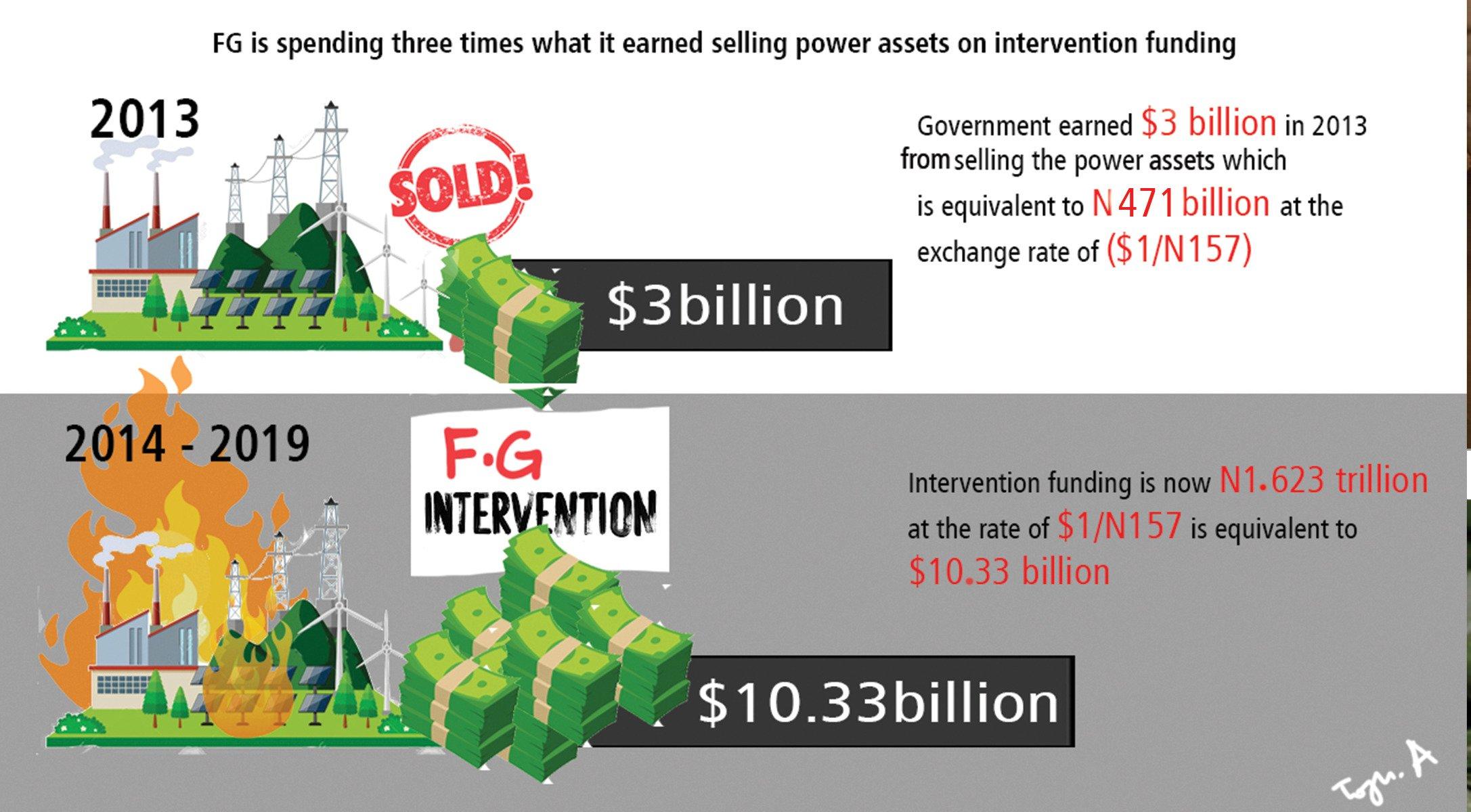
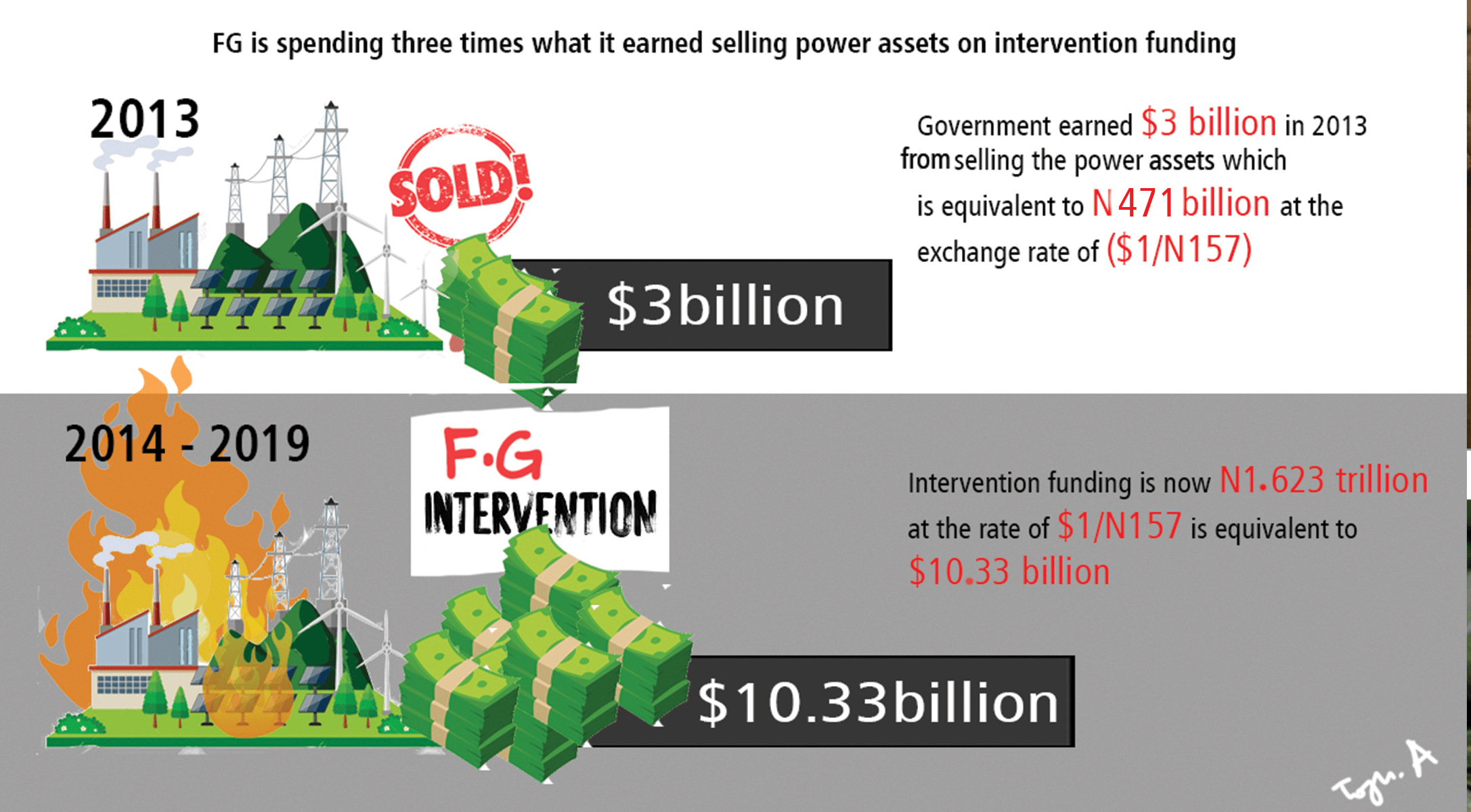
The Federal Government has so far approved N1.623 trillion on various intervention funding since it privatised the power sector in 2013. This amount is over three times what the Federal Government earned selling the assets, BusinessDay calculations show.
Due to the absence of measurable impact of these bailouts, the Central Bank of Nigeria (CBN) is hesitant about disbursing the new N600bn bailout funds approved by the Federal Government to plug gaps in the power market.
Two sources present at the Power Sector Meeting with stakeholders and the regulator, which held in Lagos on September 9, said the CBN representative berated the power sector players over their inability to show tangible progress for the bailouts already collected.
Using the prevailing exchange rate of $1/N157, Nigeria earned N471 billion or about $3 billion from selling the power sector assets including 11 electricity distribution utilities and five power plants in 2013.

However, the government has so far spent N1.623 trillion on intervention funding or three times the naira value of the assets sold.
Analysts say this pattern of bailouts poses system risk to the economy because it excludes other critical sectors where funds can be more efficiently deployed to achieve measurable impact.
“Giving out these bailouts without evaluating the impact they are having is like pouring water into a bottomless pit,” said Chinwendu Enechi, senior manager, oil, gas and power at Anderson Tax.
Enechi said unless Nigeria wakes up to the real issue which is fixing the electricity market by having a cost-reflective tariff in place, these bailouts funds would halt efforts to diversify the economy and reduce funding for critical sectors including agriculture.
While the bulk of these intervention funding has been termed loans, there are no clear signs towards repayment by these cash-strapped power companies with current market shortfalls and huge debts.

An analysis of the 2017 financial statements of 10 Nigerian power distribution companies (DisCos) shows combined accumulated losses or retained earnings of N713.63 billion, from N288.85 billion as at December 2016.
In accounting, a firm with negative retained earnings has recorded more losses than it has made profit since its existence.
Nigeria’s power sector privatisation is modelled after India’s electricity reform in early 2000s. The distribution companies were also burdened by debt and poor governance structures.
Therefore, the country’s power sector kept over 300 million in darkness, according to a 2014 World Bank study, and power sector debt reached Rs 3.5 trillion (US$77 billion) – 5 percent of India’s GDP – in 2011.
The study found that the continued flow of funds from lenders to “insolvent distribution companies” reduced their willingness to make urgently-needed performance improvements.
“Unless utilities are permitted to function as commercial entities, service delivery will not get the attention necessary and the financial sustainability of utility operations will remain an after-thought, leading to periodic bailouts,” Sheoli Pargal, economic adviser in the World Bank Group’s South Asia Infrastructure Department and one of the report’s authors, said at the time.
Following the recommendations of the study, the government embarked on reforms and began demanding measurable progress with each intervention funding. The target was to progressively invest in the network to cut down commercial, collections and technical losses.
The state regulatory bodies were given autonomy and were held accountable for their performance. Over the course of seven years, the utilities cut down losses as intervention funding gradually declined.
Unlike India, Nigeria’s intervention funding has often fallen short of achieving its purpose because “they are based on needs not on design”, said an official of one of the DisCos who asked not be mentioned.
The Federal Government does not enforce obligations to repay or follow through on commitments made before these funds were disbursed and they are usually poorly structured, the official said.
Bailouts to the power sector in the past five years are two times more than Nigeria’s 2019 education and health budget. The power sector got its first intervention fund of N213 billion as Power Sector Market Stabilisation Fund at concessionary interest rate below market rate to DisCos and GenCos in November 2014.
Three years later, the Federal Government approved the first tranche of N701 billion assurance guarantee for the gas suppliers to enable generation companies stay afloat due to declining revenues from DisCos.
In 2018, the Federal Government said it has taken advantage of the new Meter Asset Provider (MAP) regulations to give a grant of N37 billion to a private sector operator to supply meters to interested DisCos.
Later that year, the Federal Government said it was investing N72 billion for procurement of equipment and installation to help get the 2,000 MW of stranded power to consumers.
The bailout funds notwithstanding, the DisCos say the Federal Government’s ministries and departments including security formations owe over N5 billion monthly in unpaid bills.
The industry regulator, NERC, has directed all DisCos to meter government ministries and departments to cut down on unpaid bills.