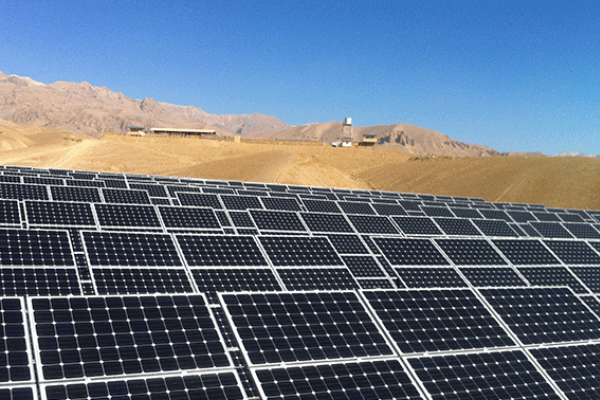
Nigeria’s tertiary education sector received a boost recently as the Federal Government of Nigeria commissioned Africa’s largest off-grid solar hybrid power plant (7.1MW) at the BayeroUniversity, Kano. STEPHEN ONYEKWELU writes that this will improve education and research with spin-off social and economic development impact.
Over fifty-five thousand students and 3, 077 members of staff of the Bayero
This is part of President Muhammadu Buhari-led administration’s effort to supply clean power to 37 Federal Universities and seven University Teaching Hospitals across the country through the Energising Education Programme (EEP), implemented by the Rural Electrification Agency, which is tasked with the electrification of un–served and underserved communities.
The project includes the provision of an independent power plant, upgrading existing distribution infrastructure, street lighting to improve security within the universities’ campuses, as well as the development of a best practice training centre on renewable energy for each university. This programme is being deployed in three phases and funded by the Federal Government of Nigeria, the World Bank and the African Development Bank. On September 3, Federal Government of Nigeria commissioned Africa’s largest off-grid solar hybrid power plant at the BUK.

Bayero University, Kano is the second project to be commissioned under Phase 1 of the EEP that will deliver clean and sustainable energy using solar hybrid coupled probably with gas-fired captive power plants. The BUK commissioning included the launch of 11.41 kilometres of street lighting as well as a world class renewable energy training centre.
A major highlight of the event was the graduation of 20 female students who participated in the female science, technology, engineering and mathematics (STEM) students’ internship programme. The female students, who received practical training during the course of the project construction, were awarded certificates of completion.
“The Energising Education Programme is strategic to fulfilling Nigeria’s commitment to the Paris Agreement on Climate Change as it aims to reduce Nigeria’s carbon footprint using renewable energy technologies, in line with the Federal Government’s mandate and unwavering efforts to increase renewable energy,” Yemi Osinbajo, vice president of the Federal Republic of Nigeria said during the commissioning. He noted that this was part of the Next Level Roadmap.
Osinbajo pointed out that the installed 7.1MW decentralised solar hybrid power plant funded by the FGN’s green bond will supply over 58,000 students and staff with clean, safe and reliable electricity. “I am sure that the entire student body, management and staff of Bayero University are proud to be beneficiaries of this, most especially as the only Federal University in Kano State and one of the longest standing ones.”
Nigeria plans to reduce carbon emissions by 20 percent unconditionally and 45 percent with international support by 2030 to limit the damaging effects of climate change. Leveraging of renewable energy technologies is in line with the Federal Government’s mandate and related activities.

“The ultimate goal is to increase access to modern technical education in safe and illuminated learning environments, empower the girl child, and create jobs in the power sector value chain, amongst others,” Osinbajo said.
The project at BUK has created 182 energy related jobs from power system engineers to electricians as well as trained 20 young female STEM students with the skills to contribute to strengthening the energy sector.
Sale Mamman, the minister of power and coincidentally an alumnus of BUK noted that he was delighted to be part of the historic moment. Mammansaid the Ministry Power’s policy specifically targets education to ensure that all federal universities, to begin with, have access to reliable electricity.
Notably, the Energising Education Programme was designed to involve students from project inception for project sustainability. “I am delighted to be back at my Alma Mater as we commission this 7.10 MW solar hybrid power plant, world class workshop and training centre and solar powered streetlights under the EEP. It was just a few years ago that I, too, was a student here without access to reliable electricity,” Mamman said. “I am privileged to take on this mantle to ensure that the policies established to promote electricity access in our country bring forth impactful and sustainable results.”
Damilola Ogunbiyi, managing director of the Rural Electrification Agency said it was a privilege to commission another university project, under Phase 1 of the Energising Education Programme (EEP), at Bayero University, Kano (BUK). “The EEP project at BUK is the second to be commissioned as we recently commissioned the first project – a 2.8MW solar hybrid plant at Alex Ekwueme Federal University, Ndufu-Alike Ikwo, and Ebonyi State on the 2nd of August 2019. It is noteworthy that this particular project here at Bayero University with an installed capacity of 7.1MW, is the largest off-grid solar hybrid power plant in Africa.” This furthers President Buhari-led administration’s Economic Recovery and Growth Plan (ERGP).
According to Ogunbiyi, the Ministry of Power has focused on nurturing this emerging off-grid sector with the right policy initiatives aimed at providing access to power across Nigeria in rural communities, economic hubs and, in this case under the EEP, federal universities and university teaching hospitals.
“Under my leadership, the Rural Electrification Agency’s mandate under the Energising Education Programme is clear: to provide clean, reliable, safe and sustainable electricity to selected federal universities and teaching hospitals. We must rehabilitate existing electricity distribution infrastructure, illuminate university campuses for improved security and construct renewable energy training centres,” the REA boss said.
Ogunbiyi was glad that 20 BUK female students under the Female STEM Internship Programme under the tutelage of solar energy developers received hands-on field and classroom training through the course of the project’s implementation. She equally praised President Buhari for driving the initiative.
The Governor of Kano State, Abdullahi Umar Ganduje
“I commend this initiative of the federal government because energising education is energising the youth and once the youths are energised you are de-energising armed robbery, bandits, kidnapping and etcetera. There is no doubt that it will have a multiplier effect on the social economic and will provide a conducive environment for the academic community.”
The Governor believes the STEM training facilitated by REA has impacted on female students in the state and erased the notion that women are not good in technical education. “This has boosted their morale to see themselves of being capable in any field,” he said.
Ganduje commended the Rural Electrification Agency for its dedication in ensuring the project was delivered in its full capacity. “Now our students can study round the clock without fear of power failure or insecurity within the university campus, thanks to the reliable electricity and installation of 11.4km of streetlights across the campus. This is a testament to the Buhari Administration’s Next Level Roadmap which is delivering results through best practice infrastructure development.”
In his brief remarks, Muhammad Yahuza Bello
Bello said the Energising Education Programme supports BUK’s mission to address developmental challenges in Nigeria, through cutting-edge research, knowledge transfer and training. “This is a joyous moment for not just our university, but also for Kano State, Nigeria’s second largest industrial centre. I am very excited for the expected positive impact this initiative will have in transforming the way we teach, learn, and live on our campus. Also, under the EEP, students will be responsible for the project’s sustainability thanks to the technical and practical training our students received through construction.”
Evangelos Kamari, Managing Director, METKA West Africa Limited, the EPC contractor said the BUK solar hybrid power plants installations are state-of-the-art and “will result in carbon dioxide savings of 108,875,120Ibs, a feat we as green contractors are proud of.”