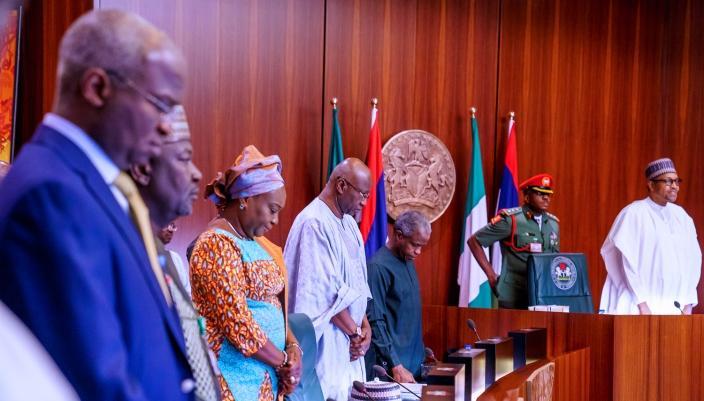
The Federal Executive Council (FEC) on Wednesday approved a five-year (2021-2025) National Development Plans (NDP), where governments across the three tiers seek investment of N348.7 trillion over the next five years.
The approved plan also targets an annual Gross Domestic Product (GDP) growth rate of five percent over the next five years.
The approval signals the return of the five-yearly plan, as a successor to the current Economic Recovery and Growth Plan (ERGP) which will expire in December 2021.
Minister of state for budget and national planning, Clement Agba, while briefing the State House journalists after the FEC meeting presided over by Vice President Yemi Osinbajo, on Wednesday, said the development plan was structured around six concepts, to ensure total coverage.

The concepts include economic growth and development, infrastructure, public administration, human capital development, social development and regional development, which forms part of the micro economy framework which projects average GDP growth of five percent over the next five years.
Read Also: FEC approves federal roads, bridges tolling policy
Federal Executive Council (FEC)
“The plan has been costed to have an investment size of N348.7 trillion over a five-year period”
The government under the plan is targeting that investment size will be contributed by the public sector at N49.7 trillion representing 14.3 percent and the private sector at N298.3 trillion representing 85.7 percent.

This is as the public sector expenditure component of N49.7 trillion will be contributed by the federal government as well as the states.
Similarly, the federal government expenditure component is N29.6 trillion representing 8.5 percent of the total expenditure size while the state governments will contribute N20.1 trillion representing 5.8 percent.
The minister stated that the funding strategy for the plan has also been identified and this includes broadening the tax base and expanding the capacity of the private sector through creating investment opportunities and delivering quality engagements and incentives.
The government also intends to explore domestic and concession financing sources and strengthening, as well as setting up financial investments vehicles and public-private partnership as well as the Nigerian investment
“The plan requires the establishment of a strong implementation mechanism and framework that promotes performance and accountability which is necessary for the implementation of the plan.
“There will also be a development plan implementation unit that will report to the National steering committee which will be headed by Vice President with the minister of finance, budget and national planning as vice-chair.
The establishment of the plan development implementation will be in the planning arm of the ministry to ensure that the ministries, departments and agencies, state governments and private sector organizations are all working in a coordinated fashion.
The plan also has a specific concentration to deliver within the five-year period and immediately we get this plan launched. We’ll be continuing to work on longer-term planning on Nigeria Agenda 2050.
“This is to make sure we don’t have a vacuum going forward now that we have a medium-term plan for five years and the long term plan which is Nigeria Agenda 2050.
The long-term plan which is Nigeria Agenda 2050 will continue immediately we launch this medium-term plan. Going forward, the annual national budget will be derived from the plan, detail of which has been posted and all ministries, departments, and agencies will be required to draw their programmes and projects from the detailed plans that they themselves have submitted during this process.
“The National Development Plan 2021- 2022 has been approved today by the Federal Executive Council for implementation as a successor plan to the elapsed Economic Recovery Growth Plan 2017-2020, he said.
He disclosed that the government had taken into consideration, the previous plan, including the ERGP, “with a view to seeing what the criticisms were; what did we do well? And one of the downsides that we learnt from the ERGP or complaints that came from people was that: it wasn’t inclusive enough, it wasn’t participatory enough, and that people saw it as a federal government plan.
“So, deliberately, for this National Development Plan 2021-2025, the issue of no one being left behind was key.
“We have to make sure it’s national enough. That is to say that it should be prepared by the federal, state, local governments, and more importantly, the organised private sector.
“That is why in terms of governance structure that was approved by Mr President, we have two co-chairs. One is from the private sector, Atedo Peterside, and one from the public sector, Zainab Ahmed.
The federal government had earlier announced the composition of a National Steering Committee with 42 members, including key ministers, members of Manufacturers Association of Nigeria (MAN), and other organs of organised private sector, while the state, had six governors representing each of the geo-political zones.
“We have ALGON represented by their President. ALGON also nominated members in the Central Working Group. The Nigeria Governors Forum (NGF) was also part of the Central Working Group. Then, we ensure that the Technical Working Group, which has 26 members, has youth representation in each of those thematic areas. We also have the inclusion of women in each of these 26 Technical Working Groups.
“The chair of Central Working Group is also a woman. We went over and beyond to ensure that this plan is not just seen as a plan of this government but the plan of the nation, including the three political parties at the Senate level. The APC, PDP, and APGA were all invited to participate at the National Steering Committee level.
“The religious groups were not left out, as the heads of Christian Association of Nigeria (CAN) and Muslims organization were involved. The physically challenged were also part of it.
“When the zero plan of the plan was put together, it was again circulated among these groups for review. It went through National Economic Council (NEC) and today it now passed through the Federal Executive Council for approval” he said.
Minister of health, Osagie Ehanire said the council also approved the procurement of oncology and radiotherapy center for the Federal Medical Center Katsina at the cost of N1.026b
“The FEC today considered three memos from the Ministry of Health, and all of them were in respect of procurements.
“First was the memo from the Federal Medical Center, Katsina for oncology and radioterapy center, to be able to handle cancer cases. The projected award was to a company for N1 billion and twenty-three million, five hundred thousand, six hundred and sixty-eight naira, eighty-six kobo for the completion period of 42 weeks and is going to be executed by a Nigerian company.