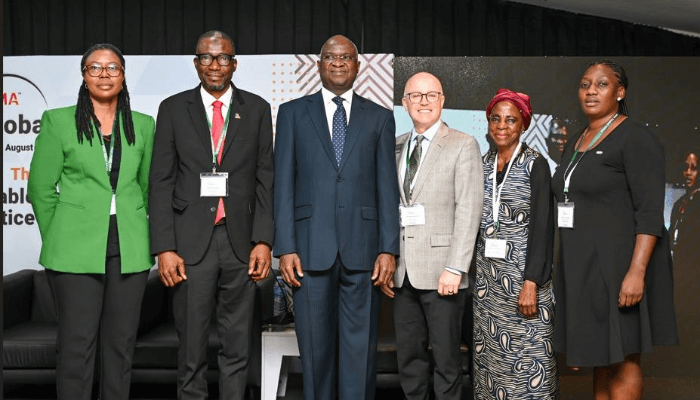
Babatunde Raji Fashola, former minister of Works and Housing, has called for legislation to make facility management and maintenance compulsory for public and private buildings across Nigeria.
“Sustainability is not a buzzword. It is now a global requirement embedded in policy, financing and credit. Nigeria must pay attention if we are to prepare for rapid urban growth,” Fashola stated in a keynote address delivered during the recent International Facility Management Association (IFMA) Global Africa conference 2025 in Lagos.
Prior to the conference, an executive c-suite round table on circular economy was held with key stakeholders in public and private sectors to understand how circular economy can enable growth and impact in facility management across Africa.
The two-day conference, themed ‘Enabling Sustainable Facility Management Practice in Africa,’ with technical sessions on circular economy, sustainable technology, artificial intelligence, innovative solutions and public infrastructure management.

Fashola stated that while building construction employs only about 30 percent of professionals in the industry on a short-term basis, over 70 percent derive long-term employment from the operation and maintenance of facilities.
He argued that budgeting for infrastructure should go beyond construction to include maintenance contracts for schools, hospitals, roads, bridges, water facilities and government offices.
Michael Geary, president, IFMA Worldwide, stated that the future of facility management is linked to sustainability, which is more vital in Africa.
According to him, the continent’s rapid growth presents a unique opportunity for facility managers to build and manage infrastructure that is not only efficient and resilient but also environmentally and socially responsible.
“By enabling sustainable FM practices, we are not just optimizing buildings—we are building a more prosperous and sustainable future for communities across Africa and setting a global standard for what is possible,” Geary stated.

Christa Dodoo, IFMA, global chair, Dodoo stated that Africa must prepare for an unprecedented wave of urbanisation, with Lagos projected to become the world’s largest city by 2100 with an estimated 100 million residents.
She commended Nigerian and Ghanaian chapters for their role in professionalising FM in Africa, noting that Nigeria’s membership recently recorded a 200 percent growth.
“A skilled workforce must operate and maintain these facilities, holding them to the highest standards of efficiency, safety and functionality. This opens great potential for FM, but also makes it a huge asset for Africa’s economy and future,” she stated.