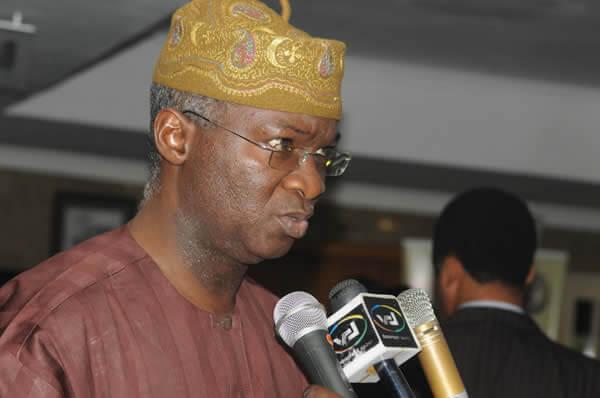
For the second year running, the Ministry of Power, Works and Housing, headed by Babatunde Fashola and the Ministry of Transportation, headed Rotimi Amaechi, are getting the biggest share in the country’s budget.
Fashola’s ministry has been allocated N529 billion in the 2017 budget to help execute critical infrastructure projects. Amaechi will get N262 billion of which N213.14 billion is counterpart funding for the Lagos-Kano, Calabar-Lagos, Ajaokuta-Itakpe-Warri railway, and Kaduna-Abuja railway projects. President Buhari said his administration is keen on a fast-track modernisation of the rail system.
Presenting the budget yesterday, President Buhari said government plans to spend a total of N2.24 trillion (inclusive of capital in Statutory Transfers), or 30.7% of the total N7.3 trillion 2017 budget as capital expenditure.
“This reflects our determination to spur economic growth. These capital provisions are targeted at priority sectors and projects” Buhari said.

The president also explained that substantially higher allocations were made for infrastructural projects “which will have a multiplier effect on productivity, employment and also promote private sector investments into the country.”
Key capital allocations include; Special Intervention Programmes:N150 billion. Defence: N140 billion; Water Resources: N85 billion; Industry, Trade and Investment: N81 billion; Interior: N63 billion; Education: N50 billion; Universal Basic Education Commission: N92 billion;Health: N51 billion; Federal Capital Territory: N37 billion;
Niger Delta Ministry N33 billion; and Niger Delta Development Commission: N61 billion.
Buhari also disclosed that N100 billion has been provided in the Special Intervention Programme, as seed money into the N1 trillion Family Homes Fund which will underpin a new social housing programme.
“This substantial expenditure is expected to stimulate construction activity throughout the country.”

He also disclosed that “a sum of N50 billion has been set aside as Federal Government’s contribution for the expansion of existing, as well as the development of new, Export Processing and Special Economic Zones. These will be developed in partnership with the private sector, as we continue our efforts to promote and protect Nigerian businesses.”
Buhari’s further disclosed that despite shrinking oil revenues, the government was able to generate a total of N2.17 trillion revenues as at end September 2016, representing 75 percent of total projections for this fiscal year.
Releases so far for capital and recurrent expenditures presently amount to N3.58trillion, representing 79percent of the prorated figures in the budget.
President Buhari, presenting the N7.298 trillion proposed 2017 budget to a joint session of the National Assembly, said the releases which have been made so far, were despite the fact that government’s aggregate revenue inflow were below projections.
“As at 30 September 2016, aggregate revenue inflow was N2.17 trillion or 25percent less than prorated projections.
Similarly, N3.58 trillion had been spent by the same date on both recurrent and capital expenditures, Buhari said, adding that this was equivalent to 79percent of the pro rated full year expenditure estimate of N4.54 trillion, as at the end of September 2016.”
He said despite huge financial challenges faced by the country, debt service obligations and personnel costs have been met, while overhead costs have been largely covered.
In his speech shortly before presenting the 2017 budget estimates, Buhari said the releases for capital projects are by far the highest in recent history.
“Although capital expenditure suffered as a result of project formulation delays and revenue shortfalls, in the five months since the 2016 Budget was passed, the amount of N753.6 billion has been released for capital expenditure as at the end of October 2016.
“It is important to note that this is one of the highest capital releases recorded in the nation’s recent history. In fact, it exceeds the aggregate capital expenditure budget for 2015” Buhari said at the National Assembly.
The 2016 Budget of change was predicated on a benchmark oil price of US$38 per barrel, oil production of 2.2 million barrels per day and an exchange rate of N197 to the US dollar.
On the basis of these assumptions, aggregate revenue was projected at N3.86 trillion, while the expenditure outlay was estimated at N6.06 trillion. The deficit of N2.2 trillion, about 2.14% of the GDP was expected to be mainly financed through borrowing.
The implementation of the 2016 Budget, assented to in May this year has been largely hampered by a combination of relatively low oil prices in the first quarter of the year, and disruptions in crude oil Production, leading to significant shortfalls in projected revenue.
This, according to the President, negatively affected revenue collections by the Federal Inland Revenue Service and the Nigerian Customs Service.
The President explained that the 2016 N6.06trillion budget of change was prepared on the principles of zero-based budgeting to ensure resources were prudently managed and utilised solely for the public good.
The same principles were used in the preparation of the 2017 budget, he said.
On efforts to reflate the economy, Buahri said government would continue to focus on the stabilisation of sub-national government finances as a key objective to stimulate the economy.
He recalled that in June 2016, a conditional Budget Support Programme was introduced, which offered state governments N566 billion to address their funding shortfalls. To participate, state governments were required to subscribe to certain fiscal reforms centered around transparency, accountability and efficiency. For example, states as part of this programme, were required to publish audited accounts and introduce biometric payroll systems with the goal of eliminating ghost workers.
Cost cutting measures which include restricted travel costs, reduced board members’ sitting allowances, conversion of forfeited properties to government offices to save on rent and elimination of ghost workers, the President said, would lead to savings of close to N180 billion per annum, which will be applied to critical areas including health, security and education.
He said work has also resumed on a number of stalled infrastructure projects, such as the construction of new terminals at the country’s four major airports. While major road projects, key power transmission projects, and the completion of the Kaduna – Abuja railway have also commenced.
Elizabeth Archibong