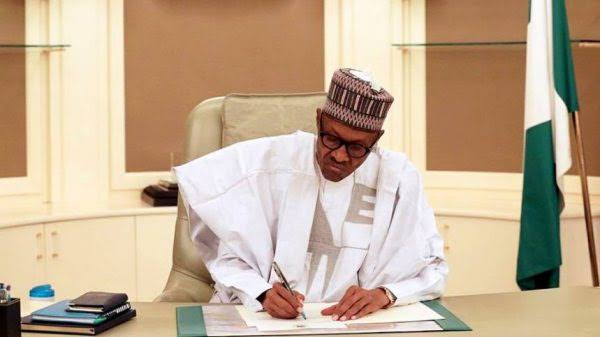
The Economic Advisory Council took off Wednesday, October 9, with an additional task that represents a tall order. At the inauguration, President Muhammadu Buhari dismissed existing data on Nigeria and charged them to develop data that would reflect more accurately happenings in the economy. The president deemed the collation and publication of this data as “the most important national assignment” of the times.
President Buhari stated: “As you develop your baseline study, I would like you to focus on primary data collection. Today, most of the statistics quoted about Nigeria are developed abroad by the World Bank, IMF and other foreign bodies. Some of the statistics we get relating to Nigeria are wild estimates and bear little relation to the facts on the ground. This is disturbing as it implies we are not fully aware of what is happening in our own country. We can only plan realistically when we have reliable data.”
He boasted of the achievements of the government he leads in its self-perception. “As you are aware, as a government, we prioritised agriculture as a critical sector to create jobs and bring prosperity to our rural communities. Our programs covered the entire agricultural value chain from seed to fertiliser to grains and ultimately, our dishes. As you travel in some rural communities, you can clearly see the impact. However, the absence of reliable data is hindering our ability to upgrade these programmes and assure their sustainability”, President Buhari stated.
The President also dismissed claims and data of aid agencies working with the Internally Displaced Persons (IDP) in the troubled North-East. He asserted, “Today, we hear international organisations claiming to spend hundreds of millions of dollars on IDPs in the North-East. But when you visit the camps, you rarely see the impact. In 2017, when the National Emergency Management Agency took over the feeding of some IDPs in Borno, Yobe and Adamawa, the amount we spent was significantly lower than the claims made by these international organisations. Therefore, actionable data is critical to implement effective strategies to address pressing problems such as these humanitarian issues. I, therefore, look forward to receiving your baseline study as this will help us shape ideas for a sustainable and prosperous future,” President Buhari said.

At the heart of the President’s statements are matters of philosophy, perception and reality. The federal government has consistently claimed achievements, particularly in agriculture, that vary with the facts that citizens see. The government also quarrels with the data shared by the National Bureau of Statistics (NBS), one of the most respected bureaucrat organs of Nigeria. The claims sometimes tend towards the ludicrous such as the assertion by the former Minister of Agriculture Audu Ogbeh that rice mills in Indonesia shut down because of reduced demand arising from higher rice production in Nigeria. The ambassador of that country debunked the claims.
It is understandable for the government to seek positive narratives. Such narratives must, however, be congruent with the experiences and realities that operators of the economy and citizens can see. Patriotism does not change economic facts.
It is as well that the president has laid down this significant marker for the EAC. The presidential council is similar to the Economic Advisory Council to the Prime Minister of India. Members of the EAC are reputable economists with names to protect, individually and collectively. The perception is that Mr President appointed them for their independence, objectivity, strength of character and adherence to the facts.
Chairman of the PEAC, Doyin Salami, affirmed the independence of the body and its focus at the event. He said the EAC’s focus is “Nigeria first, Nigeria second, and Nigeria always.” They would prioritise the Nigerian people rather than mere numbers. Salami stated: “Our goal is that the economy grows in a manner that is rapid, inclusive, sustained and sustainable so that Nigerians will feel the impact.”
Nigerians look to the EAC for facts and figures that speak truth to the situation of the country without any fairy tales. It is what the economy needs and what Nigerians deserve in these hard times.