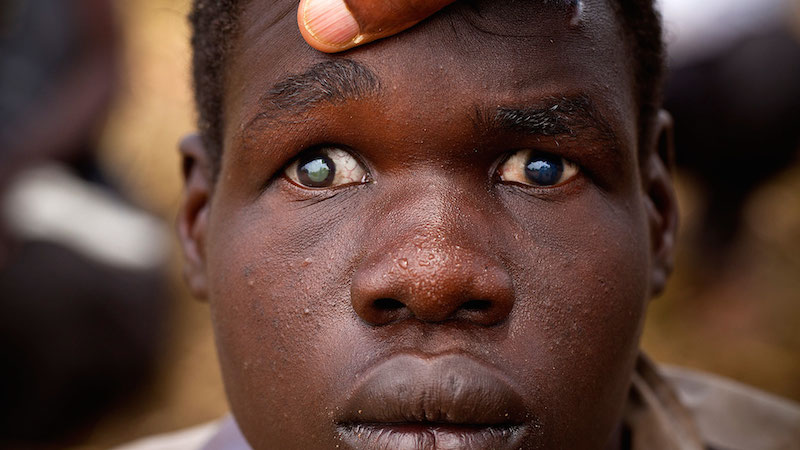
Some medical experts have claimed that the prevalence of eye diseases, particularly glaucoma and cataract is higher in Nigeria than in other countries across the world.
According to these experts the rising prevalence is due to ignorance, poor access and unavailability of eye care services and the high cost of treatment most patients cannot afford.
Deepak Kumar, a consultant ophthalmologist at the Tulsi Chanrai Foundation Eye Hospital, says this is most common in teenagers and patients not older than 10, which is rare in other countries. He says higher numbers of patients with these diseases are in need of surgery and warn that the diseases when not diagnosed early and treated result in blindness.
“Glaucoma prevalence in Nigeria is more than what we see in other countries. In other parts of the world, like in India, we see a very rare case of a patient with glaucoma below the age of 30 years, but in Nigeria, very frequently we see a patient at the age of 10 and 15 years having glaucoma,” Kumar states at a press meeting in Abuja.

The causes, according to Kumar, are the late diagnosis, poor understanding and awareness of the diseases among the populace and the high cost of medication. “They cannot afford it some start but cannot continue throughout their whole life,” he says.
While noting the diseases cannot be prevented, the ophthalmologist advised that Nigerians go for regular eye screening especially those who are prone to it, which includes diabetic patients and those with a family history of glaucoma and cataract; so that the disease can be detected early before it becomes complicated.
However, Kannan Narayanan, director at the eye foundation said due to the huge gap in accessing affordable eye care services in Nigeria, Tulsi Chanrai Foundation Eye Hospital was built with a key target to reach the indigent patients in Nigeria. He said the hospital which was formally inaugurated by President Muhammadu Buhari on 15th January 2019 has reached 34,000 persons.
The director added that the speciality eye hospital has also performed more than 700 highly subsidized eye surgeries, treated more than 20,000 outpatients and conducted 96 rural eye camps where it screened no fewer than 14,000 persons during its one year of existence.
Narayanan said the objective of the hospital is to offer services at a subsidized cost to those who can pay and offer services absolutely free to the poor. He said the subsidized tariff from those who pay are used to fund services for the poor.

“We conduct surgeries completely free for the poor, provide life transforming services and we do it with the kindness of heart. It is free from their doorstep back to their doorstep, we pick them up, accomodate them, provide them with good food, give them the medicine and take them back. 30 days after the surgery we go back for a review.
“Services we give to the poor is exactly the same for the paying patient there is no distinction and the feedback has been very encouraging”, he said.
Overall, Narayanan said the Tulsi Chanrai Foundation (TCF) was formed in 1992 to help the less privileged of Nigeria with interventions in three areas to include primary health care, water rehabilitation and eye care. He said the TCF since inception has conducted 124,000 surgeries to the poor and 70 percent of its operations free.
He however noted that 1.8 million Nigerians are blind and many still needs to be reached and called for more support and donations.
GODSGIFT ONYEDINEFU, Abuja