…How NIMASA splashed N300bn to train seafarers without vessels
…Blue economy without blue waters
…How newsmen can use their fast fingers to wealth
Mounting a dinner night in Port Harcourt at a time such as this (state of emergency) could be explosive on its own, but when it is by Journalists, it attracts even more sensitivity.

When the dinner night started, it drew flaks and bombs. How would anybody reveal how a big FG agency splashed N300bn to train seafarers when it did not even own a vessel?
Before anybody would swallow that, another bombshell dropped, pointing to the likely futility of attempting a blue economy in polluted or coloured waters. The call went out that the oil region must be cleaned up before the states embark on any meaningful blue economy programme. Clean up? $12bn was quoted.
Then, journalists were called intelligent fingers. They must find use for such attribute.

These seem to be the highpoints of the Correspondents Press Week which took place in the second week of April 2025.
It usually marks a week for members of the Correspondents Chapel of the Rivers State Council of the Nigeria Union of Journalists (NUJ).

The Week allows the Correspondents and their friends and families to come together, examine critical issues, and unwind at a night with dinner.
At the dinner which took place at the NBA Hall, Ofon Okon, the Executive Secretary of the Institute of Export Operations and Management (IEOM), called on the federal government to implement the 30% rebate request put before the government to boost the underutilized eastern ports, warning that failure to take action will leave Nigeria’s maritime economy in decline while other nations race ahead.
He bemoaned the poor state of eastern ports such as Calabar, Rivers, Onitsha, Onne, Warri and Koko ports, describing them as ‘idle assets’ wasting away due to years of policy neglect and lack of infrastructure investment.

“For the eastern ports to work, there should be 30% rebate and you will see all the eastern ports open. Calabar Port is like a swimming pool today. Koko Port is a forgotten project,” he lamented.
Udofia stressed that unlocking the potential of the blue economy begins with strategic investments and policies that encourage trade through neglected maritime corridors.
He challenged the University of Port Harcourt, Uniport, and other institutions in Rivers State to rise to the occasion. He wants them to start courses in Blue Economy so in near future, the region would be centre of blue economy civilization.
“If you don’t do something on time, others will take over from you. Why is Uniport not offering blue economy as a course, to make Rivers State the centre of blue economy?”
Highlighting the role of media professionals in promoting trade, he proposed an NUJ Export Entrepreneurial Programme, with a focus on the eastern ports. According to him, journalists are uniquely positioned to succeed in the export sector due to their reach, access, and research skills.
Read also: How Rivers may seize lead role in Nigeria’s $200bn blue economy – expert at journalists’ forum
“Journalists can do brokerage by linking buyers to sellers all over the world and make a lot of money. You journalists have thinking fingers; there is no corner in Nigeria that you cannot enter and come out. You must wake up and export your service. When writing your news stories, look at the environment — there are so many products in Nigeria that are highly valued and highly priced abroad.”
Udofia linked Nigeria’s persistent insecurity to mass unemployment, emphasizing that the export value chain could be a powerful tool for job creation and economic stability.
“See the issue of insecurity in this country is fueled by unemployment. Anyone who is gainfully employed cannot go into kidnapping or banditry. Export value chain is a sector that can curb unemployment in Nigeria,” he stated.
Taking a swipe at what he described as ‘cosmetic approaches’ to training and capacity building in the sector, he criticized the practice of issuing export licenses to individuals with no formal export knowledge.
He wondered why anyone going into export would not be required to train and be certified before getting the certificate.
“Nigeria is the only country in the world where people are given an export license without having any knowledge of export. You don’t learn export in seminars,” he argued.
Citing a recent report, Udofia took a swipe at the Nigerian Maritime Administration and Safety Agency (NIMASA) and questioned the rationale behind NIMASA’s investment in seafarer training, despite Nigeria lacking a national fleet.
“I read in the news that NIMASA paid N300 billion to train 3,000 seafarers, a country without any vessel or shipping line. So, after their training, where will you place them?” he asked.
He also noted that Nigeria’s current university curriculum is outdated and not designed to build entrepreneurs or solve practical problems.
“Our university curriculum is certificate-based. It was designed for people to graduate and work in the civil service, not to solve problems or create wealth.”
On global trade dynamics, he said recent policies under U.S. President Donald Trump, particularly those that reduced dependence on Chinese imports, should be seen as an opportunity for Nigerian exporters.
“What Trump is doing is not a problem but an opportunity for countries like Nigeria to go into export and to increase our export capacity,” he said.
Blue economy, Nigeria’s future – Essien
On the opening day, the subject matter was thoroughly examined by experts. The keynote speaker was Ubong Essien, the founder and CEO of the Blue Economy Academy and dean of School of Eloquence. He was one of the members of the think-tank in NIMASA that formulated the Blue Economy Scheme before the present administration adopted the concept into a project with a ministry to drive it.
Essien however warned that Nigeria is a “sea-blind nation” and Rivers State risks squandering its coastal advantage if it fails to develop a coherent Blue Economy strategy.
Delivering a keynote address virtually at the opening ceremony, Essien issued a scathing critique of the state’s failure to harness its maritime potential, calling for urgent action and journalist-led advocacy to reverse decades of neglect.
“You can’t live next to the Atlantic and remain indifferent to it. You can’t report from Port Harcourt and act like you’re inland. You can’t be coastal and clueless,” Essien said in his address themed “Blue Economy – Starting Steps for Rivers State.”
He described Nigeria’s failure to develop its ocean assets as ‘ocean amnesia,’ despite the country’s 853km coastline, rich biodiversity, and geo-strategic maritime position in West Africa.
“Nigeria is a sea-blind nation. Our obsession with oil has blinded us to an even greater wealth: the Blue Economy.”
Citing a sharp drop in U.S. oil imports from Nigeria — from nearly one million barrels per day to just 5,000 barrels per day in 2020 — Essien said the economic warning signs were clear, but ignored. “That should’ve been our wake-up call to diversify. But we hit snooze,” he said.
Turning attention to Rivers State, Essien said the state must shed its passivity and assume leadership in ocean-based development, stressing that geography has given it both an opportunity and a responsibility.
“Rivers State should be Nigeria’s Blue Economy headquarters; home to ports, pipelines, mangroves, fisheries, and floating opportunities. But without the media playing its part, this opportunity will float away,” he said.
As part of a proposed action plan for Rivers State, he outlined a five-point blueprint including to Launch a state-wide ocean literacy campaign and Blue Economy policy;
Facilitate blue-friendly infrastructure; Empower coastal communities, especially youth and fisherfolk; Invest in youth upskilling and marine-based entrepreneurship; Mobilize media-led public enlightenment.
He charged journalists in the state to reposition themselves not only as reporters but as ‘rescuers of national awareness.’
“Every journalist in Rivers State worth his or her salt — no ocean pun intended — must carry two beats, and one of them must be the ocean,” Essien said.
He explained that the Blue Economy intersects with every journalistic beat: pollution is a health story, port congestion is economic, maritime insecurity is national security, and coastal erosion is a climate crisis.
“Ocean journalism is not a niche. It’s a necessity,” he said, calling for a rethinking of how riverine areas are viewed and covered.
“The phrase ‘riverine areas’ has become a synonym for poverty and neglect, instead of opportunity and investment. We must reprogram our perception,” Essien stressed.
Essien challenged journalists in the state to become champions of what he called ‘Ocean Journalism,’ insisting that the media must do more than just report—it must rescue public awareness about maritime potential.
“Every journalist in Rivers State worth his or her salt—no ocean pun intended—must carry two beats, and one of them must be the ocean. Pollution is a health story. Port congestion is an economic story. Artisanal fishing is a livelihood story. Coastal erosion is a climate story. The ocean runs through every other beat.”
The former Special Adviser on Strategy and Communications to the Director General of NIMASA laid out a five-point blueprint for Rivers State to embrace the blue economy. These include a state-wide ocean literacy policy, coastal infrastructure upgrades, empowering riverine communities, youth upskilling, and media-led public enlightenment.
He emphasized the critical role of journalists in shaping the future, stating: “You are not bystanders. You are the bridge between strategy and society. You are the Fourth C in the 4 Cs of maritime progress—Collaboration, Cooperation, Coordination, and Communication.”
Linking the blue economy to journalist welfare, Essien argued that this emerging sector presents fresh storytelling opportunities and income streams. “There is a role for maritime journalists, port correspondents, blue economy writers, ocean climate reporters, and sustainability media professionals,” he said. “Journalists can monetize expertise, provide consultancy, build niche brands, and diversify income.”
He warned that the biggest threat to progress is not a lack of resources but a lack of vision. “The single most important thing Rivers State can do is launch an all-out war against its greatest internal enemy: ocean blindness,” Essien said.
“It’s the inability to see the economic potential, environmental leverage, innovation frontier, and human capital opportunity that the ocean represents.”
He also called for a shift in perception of riverine communities, often treated as marginal. “Riverine should not be a disadvantage. It should be a strategic designation—a signal to invest, empower, develop, and prioritize.”
As a next step, Essien proposed the launch of a Blue Economy Media Forum in partnership with the Correspondents’ Chapel before the end of 2025, aimed at strengthening journalist involvement in ocean awareness and policy advocacy.
“This is not just a keynote. It is a kickoff. Let this moment be the end of sea-blindness and the beginning of sea-boldness. The ocean is no longer scenery—it is strategy.”
Clean up the Niger Delta first – professor
As the propositions for a blue economy kick-start was beginning to climb to a crescendo, a clincher came in from a professor of economics and strong financial experts and ex-banker.
He halted the conversation around the Blue Economy in Rivers State and the Niger Delta, saying it is unrealistic without first addressing the widespread environmental pollution and degradation caused by decades of oil exploration, an expert has warned.
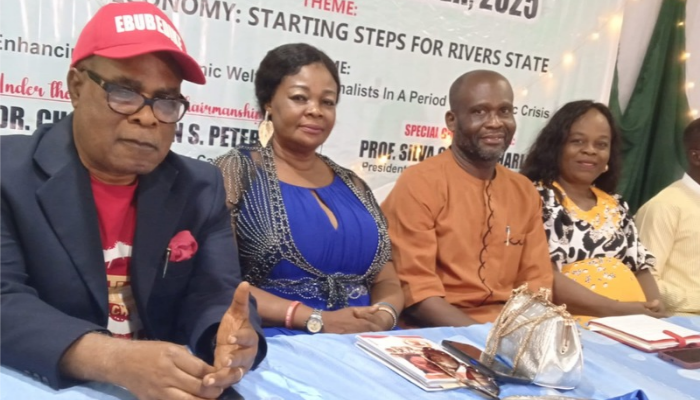
The professor, Silva Opuala-Charles, who is President of Garden City Premier Business School and former Bayelsa State Commissioner for Finance, said the Niger Delta cannot genuinely pursue a blue economy when its waters are still stained by oil spills and its marine life is devastated by pollution.
Opuala-Charles spoke at the opening ceremony as special guest of honour: “We say Blue Economy, but what is blue about our waters? The waters are dark, oily, and toxic. The creeks are dead zones. Our fishermen bring back nothing but stories of hardship. Before we can talk about tapping into the ocean economy, we must clean up the mess first.”
Harping on the theme: “Blue Economy: Starting Steps for Rivers State”, he cited United Nations data showing that 13 million barrels of oil have been spi spilled in over 7,000 incidents in the Niger Delta since 1958.
“You cannot talk of aquaculture when the fishes are dead. You cannot speak of marine tourism when your waters reek of crude oil. We must tell ourselves the truth – this is not a blue economy, this is a red economy soaked in pollution,” he stated.
Opuala-Charles referenced a 2023 Reuters report which estimated that it would take $12 billion and 12 years to clean up the entire Niger Delta region. He said any government or agency speaking about the Blue Economy must first prioritize a comprehensive clean-up campaign, starting with the most affected riverine communities.
“We should not start with policy documents and media launches. We must start with a mop. Clean the rivers, clean the creeks, restore the mangroves, then talk about growth,” he emphasized.
He also criticized the absence of a tailored Blue Economy policy framework for Rivers State, warning that relying on federal policies alone will sideline the peculiar environmental and socio-economic needs of the region.
“Where is the policy? Where is the structure? Where is the funding plan? A Blue Economy agenda must not be a cut-and-paste from the federal level. We need a Rivers-specific approach that puts clean-up and restoration at the center,” he said.
In terms of potential, Opuala-Charles acknowledged that Rivers State is richly endowed with vast inland waterways, untapped marine biodiversity, and aquaculture potential, but stressed that environmental neglect continues to cripple economic opportunities.
He proposed that the state government should launch a State Blue Economy Council involving stakeholders from oil host communities, academia, private sector, and civil society; Prioritize aquaculture training and investment for young people in coastal areas; Develop a sustainable marine transportation master plan; Allocate budgetary provisions to environmental remediation and coastal protection; Lobby for international funding to support clean-up projects in areas affected by oil spills.
“Let us move from dependency on dirty energy to sustainable economic alternatives. But let’s not pretend. There is no Blue Economy without a green environment. No fish can thrive in poisoned waters. No investor will build a resort on a polluted shoreline. The first step is clean-up,” he concluded to a round of applause from journalists and media executives present.
He further took aim at the lack of a defined Blue Economy policy for Rivers State, warning that vague talk without concrete action plans and a clear-cut structure would only create more confusion.
“Rivers State cannot afford to piggyback on federal documents that do not address our unique environmental damage. We need a locally tailored strategy – one that puts cleanup, coastal protection, and community participation at the center,” he said.
Opuala-Charles recommended that the state urgently establish a Rivers State Blue Economy Council made up of representatives from riverine communities, academia, private sector experts, and civil society groups. The Council, he said, should oversee all activities tied to the Blue Economy, from budgeting to monitoring and accountability.
He also called for direct investments in sustainable aquaculture, training of youths in marine-based enterprises, revival of the artisanal fishing industry, and a state-wide campaign to restore degraded creeks and wetlands.
“Rivers State has the potential to be the aquaculture hub of West Africa. We have the coastline, the population, and the maritime culture. But we have failed to leverage that because we have ignored the environment. If you kill your ocean, you kill your economy,” he warned.
The Correspondents’ Week was attended by top media executives, academics, experts, government officials, and civil society stakeholders.
At the dinner, Jossy Nkwocha, reputation capital specialist and head, corporate affairs division of Indorama Nigeria, said the Correspondents have a shown a knack to get journalists out of lack and want. He said journalists covering the oil region sat on goldmine without knowing it, saying they could write exciting books and become authorities on issues of militancy, oil pollutions, political crisis, etc. He gave examples with his own life story.
Speaking at various times in the Press Week, Amaechi Okonkwo, chairman of the Correspondents’ Chapel, praised the theme of the week’s events and called for sustained reporting on the blue economy and maritime issues in the Niger Delta and beyond.
“Blue economy has the huge potential to boost Rivers State economy. Let us not stop writing on the blue economy as the weekends, but let’s continue the discussions,” Okonkwo urged.
He also used the opportunity to honor departed members of the Chapel who passed on within the year and extended gratitude to supporters of the 2025 Correspondents’ Week, including NLNG, NDDC, HYPREP, Indorama, Rivers State Education Champions League, Port Harcourt Chamber of Commerce, Industry, Mines and Agriculture, PHCCIMA, Chamberlain Peterside of the Rivers State Investment Promotion Agency, and all members of the Correspondents’ Chapel.
“We must appreciate God who has helped us this far. I also want to thank those who have made this week successful.”
Paul Bazia, state chairman of the NUJ, commended the Correspondents Chapel and all journalists that worked hard for the week to go well, saying the entire state council was one.
Susan Serekara-Nwikhana, Rivers State chairperson of the National Association of Women Journalists (NAWOJ), also commended the Correspondents Chapel for steadily raising apt topics and issues for discuss.