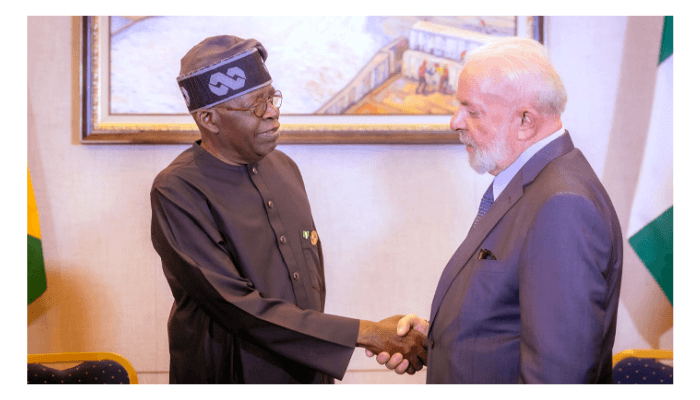
Nigeria and Brazil recently signed Bilateral Air Service Agreement (BASA) which is expected to open fresh avenues for trade, tourism, investment, people-to-people exchanges, enhance stronger economic integration, facilitate cultural ties and improve diplomatic cooperation between both nations.
President Bola Tinubu witnessed the signing of the Memorandum of Understanding (MoU), having led a delegation in company of senior cabinet members, including Olawale Edun, the Minister of Finance and Coordinating Minister of the Economy; Bianca Ojukwu, the Minister State for Foreign Affairs; Festus Keyamo, the Minister of Aviation and Aerospace Development and Abubakar Kyari, the Minister of Agriculture and Food Security, among others.
Tinubu was received in Brasília by President Luiz Inácio Lula da Silva of Brazil, marking a step in strengthening bilateral ties between the two large economies in their respective continents.
However, BusinessDay’s checks show that this is not the first time Nigeria is signing BASA with Brazil as almost
every government that comes in, visit Brazil and immediately after the signing Memorandum of Understandings (MOUs) nothing happens.

However stakeholders have argued that this recent BASA is different is because it immediately led to the announcement of direct flight between Nigeria and Brazil which would be operated by Nigeria’s largest carrier, Air Peace.
Read also: Nigeria, Brazil draw closer as Air Peace launches historic direct service
Odds against Nigerian airlines
Concerns have being raised that while Brazil has no national or flag carrier currently operating into Nigeria, the rule of reciprocity would not apply and Air Peace may be left at the mercy of Brazilian government and may be forced to abide by wherever rules the country sets, whether profitable or not.
Also the odds which have always given Nigerian airlines short lifespan and kept several airlines away from international routes are still against them with little or no efforts from government to address these challenges.

For instance, high operating and maintenance costs are asphyxiating domestic airlines, putting pressure on their long-term sustainability.
Nigerian airlines are highly exposed to the foreign exchange as most of their transactions are carried out in dollars. And with the foreign exchange crunch in Nigeria, airlines appear to be struggling to keep their planes in the sky.
Cost of operations are high, particularly as aircraft maintenance is done outside Nigeria. Coupled with this is multiple taxation from government agencies, which are affecting airlines’ bottom-lines.
BusinessDay’s findings show that aviation fuel currently takes about 45 percent of operating cost; labour, 17 percent; aircraft rent and ownership, 8.5 percent; non-aircraft rents and ownership, 7 percent; professional services, 4.5 percent; landing fees, 2 percent; food and beverage, 1.5 percent; maintenance materials, 13 percent, and transport related, 1.5 percent.
Past attempt
BusinessDay’s findings show that Varig was the first airline founded in Brazil, in 1927. From 1965 until 1990, it was Brazil’s leading airline and virtually its only international one.
Varig launched the Lagos–Brazil route in 1977, connecting Nigeria and Brazil directly.
Direct flights between Nigeria and Brazil in the 1990s ended mainly because of problems with the Brazilian carrier Varig, which had been the only airline operating that route:
By the early 1990s, Varig was under severe financial strain—rising fuel costs, heavy debt, and competition forced it to scale back its long-haul network.
In 1994, as part of a broader restructuring, Varig withdrew from Lagos and other African destinations, labeling them unprofitable.*l
Once Varig pulled out, no other airline stepped in to sustain the link, so direct flights between Nigeria and Brazil stopped.
However some have argued that the stoppage of Varig wasn’t due to political or diplomatic issues but was essentially a business decision tied to Varig’s financial troubles and route rationalization.
Stakeholders have said that for Air Peace to sustain the route, it must focus on profitability and not charity.
Read also: Nigeria, Brazil deepen defence ties
Stakeholders express mixed feelings
While some stakeholders have described the BASA as a game changer and one that would ignite economic integration, others have expressed concerns that the factors that should spur sustainability are missing for Nigerian carriers in the value chain.
Samuel Caulcrick, the former Rector of the Nigerian College of Aviation Technology (NCAT), told BusinessDay that as America’s air routes introduce hurdles for Nigeria’s potential as a major passenger hub, an incredible opportunity emerges on the horizon.
Caulcrick said the BASA between Nigeria and Brazil is poised to be a game-changer, igniting economic integration, deepening cultural connections, and amplifying diplomatic ties between these two vibrant nations.
He noted that this agreement comes at a perfect time, aligning with the evolving trends in global tourism, and it paves the way for a surge in trade, investment, and travel between Nigeria and Brazil.
“Direct flights: A good opportunity to say goodbye to layovers! This agreement launches direct flights between bustling cities like Lagos, Abuja, São Paulo, and Rio de Janeiro, making travel seamless and convenient for passengers.
“Economic boost: With enhanced air connectivity, we should expect an exhilarating uptick in bilateral trade, investment, and tourism—fueling economic growth in both Nigeria and Brazil,” he explained.
He noted that increased air travel will spark vibrant cultural exchanges, foster people-to-people diplomacy, and open doors for educational collaborations, highlighting the rich tapestry of Nigerian Brazilians.
“The agreement is set to bolster trade and investment flows, creating a wealth of new opportunities for businesses eager to explore this dynamic partnership.
“Direct flights will not only boost tourism but will also bring to life Brazil’s captivating culture and Nigeria’s diverse attractions, enticing travellers from around the globe,” he said.
On the other hand, Olumide Ohunayo, industry analyst and director of research at Zenith Travels, told BusinessDay that while the BASA agreement is a win-win for all the agencies as regards the avia increase in income from taxes and requisite charges will be paid to the agencies, there are still grey areas.
“Almost every government that comes in, visit Brazil and immediately after signing the MOU nothing happens maybe because the two countries do not have national carriers that could help subsidise operations,” Ohunayo said.
He said in putting an airline on the Lagos-Brazil route, Nigeria needs to be ready and ensure he economics add up.
“How many Nigerians travel to Brazil, although I hear people say it is an African village. But where is the transit airport and commercial partnership that would make the Nigerian airline sustain operations on the route ? And take those African passengers beyond Lagos to their destinations ?
“I’m not excited about the BASA and I don’t see it getting any traction for now. Maybe the cargo but then there must also be increased business transactions and implementation of recent agreements but for the passenger side, it seems more like a talk than a work,” Ohunayo explained.