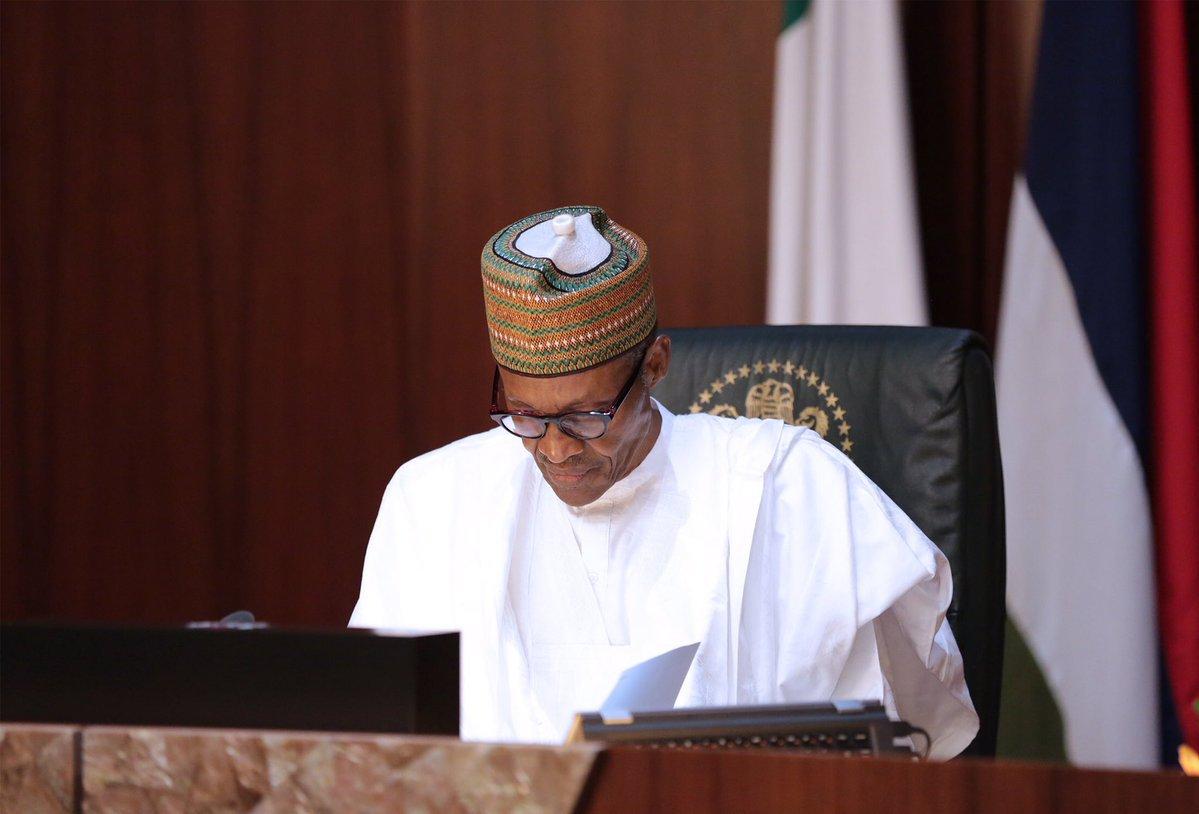
The National Minimum Wage challenge resonates strongly Tuesday as National Council of State meet at the Presidential Villa, try to meet the intractable demands for a new wage structure Federal government tripartite committee has pegged at N30,000.
Recall that Federal Government last Thursday resolved to refer the matter to the National Council of States, as the National Economic Council, NEC, a body comprising Federal government and 36 State Governors, chaired by Vice President Yemi Osinbajo failed to agree on a common wage structure for the country
One of the issues before the National Council of States is to also advise on the review of the revenue sharing formula between the Federal, States and Local governments.
Under the current sharing formula, the Federal Government is allocated 52.68 per cent of revenue from the Federation Account, while states are allocated 26.72 per cent and the 774 local governments 20.60 per cent.

But following persistent pressures from states for the an upward review in their favour, as a precondition for payment of the new N30,000 Minimum Wage by states, the matter was referred to the National Council of State
Executive Director, Civil Society Legislative Advocacy Centre CISLAC, Auwal Musa, who spoke with BusinessDay in Abuja in the issue, urged the Council to see the Minimum Wage as a “human rights issue that will reduce corruption and up productivity “ adding that “government should pay workers realistic wage to guarantee survival under the current economic situation “
“ it should not be seen as a favor to the workers, but something that will encourage workers to be committed and that will discourage corruption. It will enhance discipline, commitments to work and increase productivity”
“It is really about compensating them for their time. Right now productivity and commitments are lacking due to poor wage”
“The essence of working is to be able to meet responsibilities, but when this is not done, low productivity ensure” he said.

He called for the scraping of security votes, over bloated government and legislative aides and allowances adding that funds saved from such should be Channelled to paying workers.
“Why should we spend money in areas that don’t add values to the national economy? “ he asked
Foremost politician and former member of the House of Representatives, Junaid Mohammed also called on government to work on reducing the current poverty levels in the country through sound economic policies that will make life easy for the poor.
He advocated the introduction of enhanced welfare packages including health insurance, exemption of certain categories of the work force from taxation, under the new wage policy, to make life easier for the workers.
“ Workers below a particular threshold should not be made to pay tax, they should be entitled to insurance policy”
Mohammed berated the Legislature for not doing enough to protect the interest of workers, a problem he blamed on “ greed “
“A lot of problems goes to the root of corruption in the National Assembly.”
“There is a certain level of poverty, insecurity, education and health care we should not tolerate”
He also called on Nigerians to elect responsible leaders with the right capacity to manage the resources of the country, ahead of the 2019
Ogho Okiti, who also spoke on the issue, called for true Federalism adding that there is no country, where every part must operate at equal levels.
No country in the world where everything has to be uniform. Here, we want the same pay for all law makers in the State Houses of Assembly, the same pay across board for University Lecturers, Teachers in Schools and workers across the 36 states.
“Every state must be allowed to develop at its pace , while we should set a minimum standards”
“Let each Lecturer have a contract with their own university.
“Leave the wage at a level that the poorest state can pay. You do not need to have this collective bargaining. It doesn’t happen anywhere in the world”
The Council consists of the current President, who is the Chairman; Vice-President, who is the Deputy Chairman; All former Presidents of the Federal Republic of Nigeria and all former Heads of the Government of the Federation; Serving and former Chief Justices of Nigeria; President of the Senate, Speaker of the House of Representative, as well as former Senate Presidents and past Speakers of the House of Representatives who were not impeached
The body also have all the 36 State Governors and the Attorney-General of the Federation and Minister of Justice.
BusinessDay also gathered that the move to involve the National Council of State was sequel to threats from the organised labour to shut down the economy on January 28, if President Muhamamdu Buhari fails to send the Minimum Wage BIll to the National Assembly on Wednesday January 23rd as he earlier promised.
Minister of Labour and Employment, Chris Ngige, has however described the Minimum Wage issues as “work in progress”
This is just as he assured that government is “ ready to transmit it to the National Assembly in consonance with our agreement with Labour that we will transmit the new bill on or before the 23rd of January.”
Ngige however said discussions on the N30,000 are still ongoing adding that “ it will terminate on 22nd when we meet with the Council of State”
BusinessDay recalls that the National Council of State last held their meeting about 11 months ago, on February 22, 2018 to deliberate on Nigeria’s economy, security and 2019 elections.
The body advises the incumbent President in the exercise of his powers with respect to the: National population census and compilation, publication and keeping of records and other information concerning the same; Prerogative of mercy; Award of National honours; The Independent National Electoral Commission (including the appointment of members of that Commission); The National Judicial Council (including the appointment of the members, other than ex-officio members of that Council); and The National Population Commission (including the appointment of members of that Commission).
Recall that while the Governors had continued to insist on paying N22,500, while the federal government initially settled for N24,000 until the national tripartite committee chaired by former Minister of Housing and Urban Development, Ama Pepple agreed on N30,000.
Tony Ailemen, Abuja