…as University of Lagos’ DLI holds fourth international colloquium
As Nigeria grapples with challenges in delivering equitable and accessible education, experts are calling for increased investment in Open, Flexible, and Distance Learning (OFDL) infrastructure.
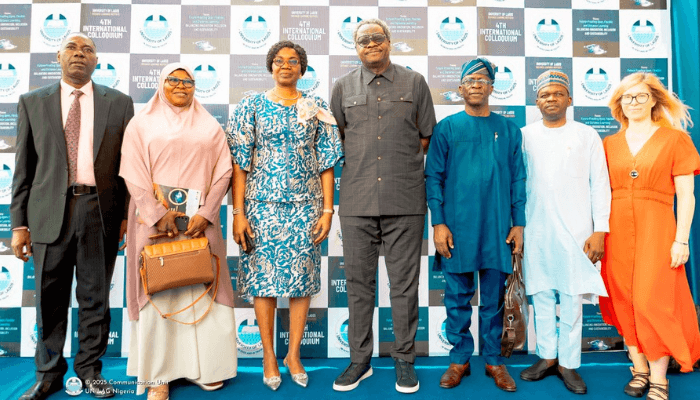
Education stakeholders at the fourth international colloquium of the Distance Learning Institute (DLI) of the University of Lagos (UNILAG) held on Thursday, September 11, at its Akoka campus argued that strengthening this mode of learning is essential to bridge the educational divide, especially for marginalised and underserved communities.
Rusikat Dauda, the director of the UNILAG’s Distance Learning Institute in her speech emphasised the need for Nigeria to firmly establish its vision for OFDL’s future, said that the future of the country’s education is not just about gadgets and policies, but about lives transformed, potentials unlocked and a nation empowered through learning.

“Nigeria should firmly establish its vision for OFDL’s future in the Nigerians narratives. The Benue farmer who uses an SMS-based network to learn new planting techniques, the banker from Lagos who uses online MBA to advance her career.
“Radio schooling gives the conflict-displaced young child in Maiduguri hope once more. These tales serve as a reminder that OFDL is about people, their challenges, aspirations and future. It’s not just theoretical,” she said.
By enhancing OFDL systems, she expressed confidence that Nigeria can make significant strides toward achieving inclusive, lifelong learning opportunities for all.
Dauda reiterated that Nigeria must strike a balance between sustainability, inclusion and innovation to future-proof OFDL.
“In a world that is changing quickly, innovation makes sure we stay relevant. No Nigerian is left behind thanks to inclusion.

“Sustainability guarantees that the things we create today will last tomorrow,” she noted.
The university don highlighted that the theme: Future-Proofing Open, Flexible and Distance Learning: Balancing Innovation, Inclusion and Sustainability, as the hybrid event (physical and virtual mode) will provide an excellent opportunity for robust dialogue, networking, and collaboration among academics and professionals.
Folasade Ogunsola, the vice-chancellor of the University of Lagos said Nigeria has a huge responsibility to ensure that its teeming population is educated, hence, the more reason OFDL is a window to achieving such a goal.
Ogunsola, emphasising on the need to ensure that everyone is educated irrespective of location, said, “We’re beginning to feel Africa’s reminisce, we’re beginning to come out of the shackles of colonialism. Education helps us to decide who we really want to achieve as a people.”
Chukunoye Ochonogor, a professor extraordinaire of Science/Chemistry Education at Tshwane University of Technology, Pretoria, South Africa, speaking on the theme: “Understanding Future-Proofing Open, Flexible and Distance Learning: Balancing Innovation, Inclusion and Sustainability” emphasised that open, flexible, and distance learning removes traditional barriers to learning through the provision of education remotely to enable all persons of different ages, location, economic and qualification background to learn and acquire higher skills and qualifications at their own pace.
Ochonogor buttressed the empirical role of OFDL in ensuring learning inclusivity, for investment in infrastructure, and training of educators in inclusive and sustainable digital pedagogy, among others.
“Invest in infrastructure for equitable access, train educators in inclusive and sustainable digital pedagogy. Toolkit for faculty training in inclusive online instruction should be encouraged,” he said.
Besides, he emphasised that as the world is rapidly evolving into a digitally interconnected society, primarily shaped by the ‘Generation Z’ and Generation Alpha cohorts and the ongoing technological revolutions; that the adaptive teacher is needed to impact on the students by encouraging them as follows, fostering their critical thinking and problem-solving skills.
Moreover, he said there is a need for the promotion of self-regulated learning among the students; supporting their social and emotional development.
Ochonogor, who is an alumni of UILAG’s Distance Learning Institute reiterated that the importance of balancing innovation, inclusion, and sustainability continues to be the pillar for future-proofing OFDL.
“Future-proofing OFDL is not just about technology, it’s about empowering learners for a changing world,” he noted.
Buttressing his thoughts on the importance of boosting learning through OFDL, he revealed how South African universities adapted student support services during the pandemic to address digital exclusion and mental health, using virtual private network (VPN), among others.
He said a study in Türkiye found that students with positive attitudes toward flexible learning showed stronger self-regulation and engagement.