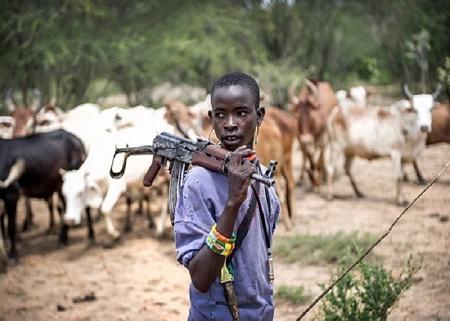
The government of President Muhammadu Buhari cannot continue to pretend to be helpless regarding how to resolve the escalating deadly conflicts between herdsmen and farmers in many parts of Nigeria, particularly in the most affected states of the Middle Belt. The government’s response to these conflicts has been suspect, but even worse, the idea of cattle colonies suggests there may be ulterior motives. Even if well-intentioned, the choice of the word ‘colony’ in the 21st century is most unfortunate. President Buhari, if he is sincere, must do everything within his powers to disabuse the minds of many Nigerians who see the tardiness with which he has handled these conflicts not as a sign of ineptitude but as glaring indicators of his tacit acquiescence to the activities of the killer herdsmen.
READ ALSO: A generation without future explodes in Nigeria’s protest
For a government that is serious to permanently resolve these conflicts, there are several reports to study while adopting temporary measures to contain further escalation. Some of these reports were commissioned by successive governments while some have been produced by independent groups.
In this regard, I think the International Crisis Group, a transnational non-profit, non-governmental organization that carries out field research on violent conflicts and advances policies to prevent, mitigate or resolve them, has done a good job of tracing the root causes, evolution, impact and implications of these conflicts as well as recommending measures to end them. The report, ‘Herders against Farmers: Nigeria’s Expanding Deadly Conflict’, produced in September 2017, “is based on interviews conducted in September 2016 and July 2017 with a range of actors and stakeholders, including leaders and representatives of pastoralist and farmer organisations, officials of federal and state governments, security officers, leaders of civil society organisations and local vigilante groups, as well as victims of the violence in Adamawa, Benue, Borno, Ekiti, Enugu, Kaduna and Nasarawa states”.
Regarding the principal causes and aggravating factors behind the escalating conflicts, the Group identifies climatic changes (frequent droughts and desertification); population growth (loss of northern grazing lands to the expansion of human settlements); technological and economic changes (new livestock and farming practices); crime (rural banditry and cattle rustling); political and ethnic strife (intensified by the spread of illicit firearms); and cultural changes (the collapse of traditional conflict management mechanisms), but also a dysfunctional legal regime that has allowed crime to go unpunished and, consequently, has encouraged both farmers and herders to take laws into their own hands.
To resolve these conflicts, the International Crisis Group suggests five steps which include, in the short term:
“Strengthen security arrangements for herders and farming communities especially in the north-central zone: this will require that governments and security agencies sustain campaigns against cattle rustling and rural banditry; improve early-warning systems; maintain operational readiness of rural-based police and other security units; encourage communication and collaboration with local authorities; and tighten control of production, circulation and possession of illicit firearms and ammunition, especially automatic rifles, including by strengthening cross-border cooperation with neighbouring countries’ security forces;
“Establish or strengthen conflict mediation, resolution, reconciliation and peacebuilding mechanisms: this should be done at state and local government levels, and also within rural communities particularly in areas that have been most affected by conflict;
“Establish grazing reserves in consenting states and improve livestock production and management in order to minimise contacts and friction between herders and farmers: this will entail developing grazing reserves in the ten northern states where governments have already earmarked lands for this purpose; formulating and implementing the ten-year National Ranch Development Plan proposed by a stakeholders forum facilitated by the UN Food and Agriculture Organization (FAO) in April 2017; and encouraging livestock producers’ buy-in through easier access to credit from financial institutions.”
In the longer term, it suggests the federal and state governments should consider the following:
“Address environmental factors that are driving herders’ migration to the south: this will require stepping up implementation of programs under the Great Green Wall Initiative for the Sahara and the Sahel, a trans-African project designed to restore drought-and-desert degraded environments and livelihoods including in Nigeria’s far northern belt; and developing strategies for mitigating climate change impact in the far northern states;
“Coordinate with neighbours to stem cross-border movement of non-Nigerian armed herders: Nigeria should work with Cameroon, Chad and Niger (the Lake Chad basin countries) to regulate movements across borders, particularly of cattle rustlers, armed herders and others that have been identified as aggravating internal tension and insecurity in Nigeria.”
These recommendations, in my view, contain no ambiguity. The government should put them in a basket, together with other such recommendations, like the report of the Gabriel Suswam-led Committee on Grazing Reserves set up by former President Goodluck Jonathan’s government in April 2014, and even by committees set up by the Buhari government, weigh them, sieve the chaff and implement the substance.
Being that desertification is a major driver of herders’ southward movement, what should the government be doing? The International Crisis Group mentions the Great Green Wall Initiative for the Sahara and the Sahel, which initially called for planting a 15km wide belt of trees, running 7,775km across nine African countries from Senegal to Djibouti, but was later broadened to include building water-retention ponds and other basic infrastructure, establishing agricultural production systems, and promoting other income-generating activities. There is also the National Agency for the Great Green Wall, which aims to rehabilitate 22,500 sq km of degraded land by 2020 but whose impact thus far has not been felt.
But an individual Nigerian – Dr. Newton Jibunoh, environmental activist and founder of Fight Against Desert Encroachment (FADE) – once achieved a milestone in this regard, with adequate support. I recently had the privilege of interviewing Jibunoh, whom CNN called ‘Sahara explorer taming the desert’, and he spoke about how he began early enough, after his exploration of the Sahara, to cry out about the devastating effects desert encroachment would have on Nigeria if it was not tackled headlong. To demonstrate that it could be done, he went to the Kano State government and asked to be given areas of the state most affected by the desert, and from there to Ben-Gurion University in Israel to study the science of desertification.
“When I returned, I had to do a pilot project to show Nigerians how they can drive back the desert and get back the grazing fields for the nomadic Fulani. British High Commission gave me money, International Energy gave me money, Kano State government chipped in money, and I started. It took me four years to bring back grazing fields in Makoda, and people that migrated out returned,” Jibunoh said in the interview.
“I used that to show what could be done because the whole of Israel was recovered from the Negev Desert. If Israel could do that, why can’t we do it Nigeria? And how much then did I use in building water irrigation, sprinkler irrigation, in planting the trees and in grazing the land? Under N70 million.”
The question to ask is why this model was not replicated in other adversely affected parts of Kano State – or in other affected states for that matter. It is true that Nigeria’s failure to effectively utilise its abundant natural and human resources over the decades has been its greatest undoing.
CHUKS OLUIGBO