



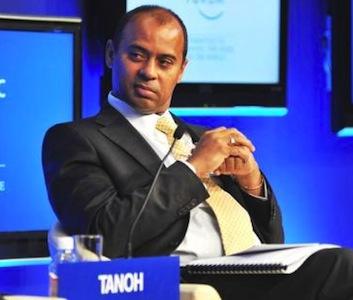
Thierry Tanoh, the Ivorien chief executive officer of Ecobank Transnational, was forced out of his exalted position yesterday at a rather quiet board meeting of the bank held on the tenth floor of the imposing Hilton Hotel in Yaounde, Cameroun.
Tanoh came under renewed fire last week after a stormy emergency general meeting of the bank, at which it was revealed that he had failed to comply with instructions by Nigeria’s Securities and Exchange Commission (SEC) to recall Laurence do Rego, a former executive director of the pan-African bank responsible for finance and risk and whose whistle blowing, some say, brought the rumbling in the bank into the open.
Hints that the CEO may be attending his last board meeting first came at the weekend when it emerged that the directors had been advancing a position which was seen as unfavourable to Tanoh, and in the end the former CEO did not even attend yesterday’s Yaounde crucial meeting.
In his place, directors of the board asked one of the deputy managing directors, the Ghanaian Albert Essien, to occupy the CEO position until a substantive head was found for the bank in October.

At yesterday’s meeting, it was also decided that do Rego be recalled.
South Africa’s Public Investment Corporation (PIC), Ecobank’s single largest shareholder, has for sometime expressed concerns about Tanoh.
“We have reservations about Thierry Tanoh,” Daniel Matjila, PIC’s chief investment officer, said in a telephone interview with Bloomberg last week.
The PIC, which owns more than 18 percent of Ecobank, according to the Lome, Togo-based lender, was concerned about performance under Tanoh, Matjila said, without being more specific.
However, two former directors of Ecobank, Babatunde Ajibade and Kolapo Lawson, who served on a board that now has 12 members, said criticism of Tanoh was rooted in fear by other senior executives that his willingness to reform governance might expose past problems.

In interviews, both men declined to spell out those alleged failures in detail. But Lawson said in a resignation letter dated February 7 and seen by Reuters that they stemmed from “the ETI public offering of 2008”, which refers to the bank’s flotation on the Nigerian Stock Exchange.
Ecobank Transnational Incorporated recently set up a new committee to search for new board members. The seven-member search committee consists of two former chairmen (Gervais Djondo and Philip Asiodu), two representatives of the current board, and three shareholder representatives.
The committee has been established as part of the detailed 51-point Governance Action Plan agreed by shareholders at an extraordinary general meeting held at Ecobank’s Pan-African Centre in Lomé on Monday, March 3, 2014. It will be assisted by an external search firm.
The move to reconstitute the board at ETI follows recommendations made by West African regulators of the stock exchanges where Ecobank is listed, as well as from a report by the Global Board Centre of the renowned Swiss business school, the International Institute for Management Development (IMD).
The IMD report by its Global Board Centre followed a review of ETI’s corporate governance, including the size and constitution of the board, its procedures for managing related party transactions, as well as its committee structures and incentive policies.
The search committee will recommend potential board members to the shareholders of Ecobank Transnational Incorporated at their Annual General Meeting to be held in June.
At their extraordinary general meeting on March 3, the shareholders agreed to limit the size of the board to a maximum of 15 people. It will comprise representatives of both majority and minority shareholders, executives and independent directors. In addition, the reconstituted board will reflect the geographical spread of ETI as well as a more balanced gender and professional mix.
ETI, a public limited liability company, was established as a bank holding company in 1985 under a private sector initiative spearheaded by the Federation of West African Chambers of Commerce and Industry with the support of ECOWAS.




