…Power supply yet to improve
Nigeria’s electricity subsidy bill skyrocketed to a historic N1.94 trillion in 2024, the highest level in a decade, even as the government implemented sweeping tariff reforms intended to reduce its financial burden.
The Nigerian Electricity Regulatory Commission (NERC)’s latest annual report paints a sobering picture of rising subsidies, driven by policy contradictions and macroeconomic headwinds.
The report reveals that subsidies accounted for a staggering 62.59 percent of the Nigerian Bulk Electricity Trading (NBET) Plc’s total invoice for 2024, despite the introduction of a cost-reflective Band A tariff for premium power users.
This figure eclipses previous subsidy records and underscores the deepening fiscal strain on Nigeria’s power sector.

Government policies undermining reforms
According to the NERC, the ballooning subsidy bill can be traced to a federal government directive that froze electricity tariffs for most customer categories at the December 2022 levels.
This policy persisted even as inflation and foreign exchange (FX) volatility dramatically pushed up the actual cost of electricity production.
“The FGN directive to freeze all customer tariffs at the December 2022 approved rates, despite the increase in the cost-reflective tariffs arising from the major increase in FX rates, caused the FGN subsidy to reach N633.30 billion in 2024/Q1,” the report noted.
Read also: FG cuts electricity subsidies by 80% as DisCos demand tariff increase
The first quarter (Q1) subsidy alone represented a 303 percent increase from the 2023 quarterly average of N157.15 billion, and a staggering 1,699 percent surge from 2022’s average of N35.21 billion per quarter.

Subsidies have fluctuated widely over the past decade, but never reached these levels. Historical figures show N230 billion in 2015, N310 billion in 2016, N350 billion in 2017, N440 billion in 2018, and N530 billion in 2019.
Subsidy numbers remained elevated through 2020 (N510 billion), 2021 (N250 billion), 2022 (N140 billion), and 2023 (N650 billion), before the 2024 spike.
Tariff hike: Too little, too late?
In a bid to reduce subsidy exposure, the NERC announced a hike in electricity tariffs for Band A customers, those receiving at least 20 hours of daily supply, on April 3, 2024.
Rates jumped from N66 per kilowatt-hour to N225/kWh, before being adjusted downward to N206.80/kWh in May following public outcry.
The tariff increase was projected to cut government subsidies by N1.14 trillion in 2024. And while it initially reduced subsidy liabilities to N380 billion in the second quarter (Q2), the gains were short-lived.
By the third quarter (Q3), the subsidy bill had climbed to N464 billion. In the fourth quarter (Q4), it reached N556 billion as inflation and currency devaluation continued to erode the benefits of cost-reflective pricing.
The problem lies in the growing gap between ‘allowed tariffs,’ which means what consumers are charged, and ‘cost-reflective tariffs,’ meaning what it costs to generate and deliver power.
As FX rates climb and operational costs rise, especially for gas and imported components, this gap has widened.
Electricity distribution companies (DisCos) are only able to pay a fraction of the NBET invoices, leaving the federal government to make up the shortfall in the form of subsidies. With tariffs frozen for the vast majority of customers, the current structure has become unsustainable.
Sector voices: Reform urgently needed
Adetayo Adegbemle, executive director of PowerUp Nigeria, emphasised the gravity of the situation, warning that without urgent reforms, the sector faces severe instability.
“With subsidies ballooning to N200 billion monthly and GenCos receiving only 39 percent of their invoices by December 2024, the sector risks deeper instability,” he said. “However, this delay need not spell collapse.”
Adegbemle criticised the federal government’s failure to activate the Power Consumer Assistance Fund (PCAF), which was designed to provide targeted support to vulnerable customers.
“The failure to activate the Power Consumer Assistance Fund by Q1 2025 represents a significant setback in resolving Nigeria’s electricity liquidity crisis,” he said.
He also called for a national dialogue involving labour unions, manufacturers, and civil society groups to rebuild trust and foster consensus around necessary reforms.
“NERC and DisCos should publish monthly ‘scorecards’ detailing subsidy reductions, PCAF progress, and service improvements,” he added.
For Ikenna Ejimakor, a power sector analyst, the federal government and other stakeholders need to adopt a sustainable strategy over electricity subsidy in Nigeria, stating that it was important to provide functional and accessible electricity for national development.
Read also: The $200 billion quest for reliable electricity
He, however, said such could only be sustainable if there is a cost recovery propensity. “The impact of this subsidy on Nigeria’s economy is multifaceted. On one hand, it provides temporary relief to households and businesses struggling to make ends meet.”
On the other hand, it fosters a culture of reliance, deters private investment in the power sector, and redirects vital resources away from essential areas like education, healthcare, and infrastructure development, he said.
Market revenue improves, but at a cost
Despite the record subsidies, the government claims significant progress in improving market liquidity. In April 2024, Adebayo Adelabu, minister of power, announced that revised Band A tariffs injected an additional N700 billion into the electricity market, a 70 percent increase from the previous year.
This brought total electricity market revenues for 2024 to N1.7 trillion, up from N1 trillion in 2023.
Adelabu noted that the tariff reform contributed to a 35 percent reduction in the government’s subsidy shortfall, shrinking it from an estimated N3 trillion to N1.9 trillion.
Read also:How N6trn electricity subsidies stifled Nigeria’s power sector
“It is evident that, due to our transformative tariff reforms, the market has generated an additional N700 billion in revenue, reflecting a 70 percent increase. This results from the cost-reflective tariff adjustment for Band A customers,” he said.
The minister hailed the reforms as evidence that financial viability and service delivery could coexist. But critics argue that the reforms are being undermined by poor implementation, rising costs, and inconsistent communication with the public.
Experts warn that without an overhaul, the mounting subsidy bill could crowd out funding for other essential services, including health, education, and infrastructure.
“Subsidy management in the power sector is now the biggest threat to fiscal sustainability,” said an analyst at a Lagos-based energy think tank. “It has overtaken fuel subsidies in terms of drain on public finances.”
Industry insiders say the solution lies in a transparent, phased removal of subsidies, combined with targeted consumer protection and enforcement of service delivery standards.
They also urge the immediate activation of the PCAF and the restructuring of NBET to ensure that DisCos and GenCos are financially accountable and technically competent.
Furthermore, experts call for real-time transparency: publishing service metrics, payments data, and subsidy costs, so consumers and stakeholders can hold the system accountable.
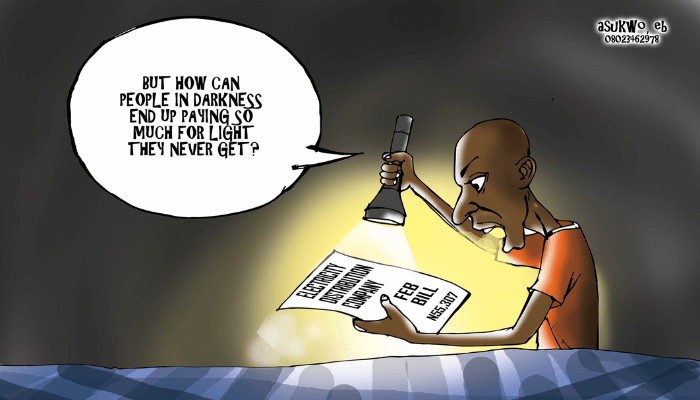
For millions of Nigerians, it’s not just about tariffs or electricity subsidies, it’s about finally having reliable, affordable electricity in a country of over 200 million people that still struggles to keep the lights on.
Power supply is still inadequate, forcing six Nigerian universities, telecoms giant MTN Nigeria, the Nigerian Defence Academy, and 16 other companies to exit the national grid.
The national grid has often plunged the entire country into darkness without warning as generation capacity fluctuates between 3,000 megawatts (MW) and 4,500 MW, grossly insufficient for a population of over 200 The cost of powering Nigerian factories rose 44 times in 10 years due to high energy prices fuelled by a combination of deregulation, inflation and naira fall. million people.
“We self-generate over 13,000 megawatts (MW). If you improve power supply and charge moderately, people will pay – and you don’t need to subsidise. Aren’t people buying petrol now after subsidy removal?” asked a manufacturer who chose to remain anonymous.