Duncan Niederauer learned that nothing lasts forever in financial markets when Goldman Sachs turned to him to figure out how to overhaul its trading business during the high-tech frenzy of the late 1990s.
Goldman was looking for ways to maintain the unit’s profitability as computers displaced human stock traders on Wall Street. Mr Niederauer, who had cut his teeth in the equities business and still dresses in the fleece vests favoured by floor traders, realised Goldman would have to make acquisitions and new investments to adapt fast enough to stay ahead of its competitors.
Those lessons in the need to respond to changing circumstances help explain why he became the man who sold the New York Stock Exchange to the derivatives bourse IntercontinentalExchange in a $11bn deal that closed last year.
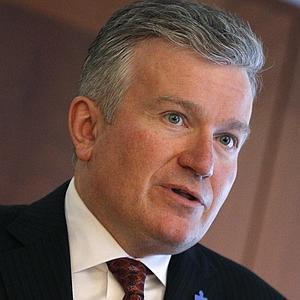
Now in his sixth and probably last year as chief executive of NYSE Euronext, the 55-year-old American says: “I would not have been the right person for this job in 2007 if I didn’t spend the last seven or eight years of my career focused on the evolution in the equity markets, which really started back then.”

High-speed computer trading programs and automated networks for matching trades were then in their infancy. Mr Niederauer knew the transition to computer trading would unsettle his peers and turned to Robert Steel, a Goldman partner, for help. Mr Steel gave Mr Niederauer advice that he would keep in mind as he remade the securities industry.
“You might try to walk into a situation and win over people who may not be ready to be won over, but you have to get them with you enough so that they are at least willing to move along, even if you are not their champion,” he recalls Mr Steel telling him.
Between 1999 and 2000, Goldman invested in Archipelago, an electronic stock market operator, purchased Hull, a leading electronic trading company, and acquired Spears, Leeds & Kellogg, the biggest trading firm on the NYSE floor. The reconditioning was not easy. In his own words, Mr Niederauer took a voice trading business involving close personal attention and fostered a “peaceful coexistence” with a computer-led model. He became a partner.
Surrounded by photos of himself and US military veterans along with other memorabilia, we are seated in Mr Niederauer’s lofty chambers on the sixth floor of the colonnaded exchange building in downtown Manhattan.
On the ground level below rests the historic trading floor, perhaps the best-known symbol of capitalism. It is a vestige of a bygone era when Dick Grasso, the mighty chairman who reigned from 1995 to 2003, and its members operated the exchange. Back then, NYSE’s share of overall US trading volumes was well over 70 per cent. It now stands barely above 20 per cent and just ahead of arch-rival Nasdaq.

Mr Niederauer says NYSE is more often the last stop for a stock order, rather than the first stop. He wonders how much longer ICE will find it rational to keep the trading floor, while assuring no divestitures are imminent.
A majority of US stocks transact at broker-run networks where fees are lower and an exchange, BATS Global Markets, which is backed by a consortium of Wall Street trading firms.
To its competitors, the NYSE building is an expensive-to-maintain museum. The trading floor serves more for business media than it does for any real brokerage activity, they argue. That it has survived this long, though, is in large part thanks to the efforts of Mr Niederauer and John Thain, a former Goldman investment banker.
Mr Thain took over NYSE in 2004, shortly after Mr Grasso was ousted when details of his hefty pay package became known. Through a merger with Archipelago, where Mr Niederauer was on the board, Mr Thain achieved a public listing that ended the exchange’s two-century run as a private enterprise.
If you Google ‘successful US-French business combinations’, Google comes back and says ‘did you mean unsuccessful’?
In 2006, NYSE’s first year as a public company, Mr Thain acquired Euronext, the pan-European stock and derivatives exchange. Mr Niederauer joined in 2007 to help figure out how once again to integrate and take forward a business that was rapidly being disrupted. Six months later he became CEO, when Mr Thain departed for Merrill Lynch.
Mr Niederauer soon discovered the job of transforming the exchange was way behind schedule and on an errant path. He jumped into modernising the company’s culture, technology and systems, relying even more on his favourite hobbies – such as basketball – to relieve stress.
Broad-shouldered and standing a few inches above six feet, he more closely resembles a power forward than the sharpshooting guard he is known to be on the court. “None of the guys I play with work on Wall Street . . . It’s a good mental health break for that reason and it keeps me very close to people I care a lot about.”
With three children, one of whom is autistic, Mr Niederauer and his wife Alison devote spare time to sponsoring a New Jersey school for children with special needs. He says time spent on the school and his family are the most important work of his life. Like Mr Thain, he also keeps bees.
It is on and around the trading floor though where he has tried to keep the buzz. The Big Stage, as it has been branded, is like Madison Square Garden mixed with a casino. Mr Niederauer takes pride in NYSE’s most recent achievement, winning a greater share of technology listings than Nasdaq for the first time in two decades in 2013. That included the coveted Twitter IPO.
The listing business will be among the arguments in favour of keeping the floor. That decision, however, rests in the hands of Jeffrey Sprecher, ICE chief executive, to whom Mr Niederauer, adding the title of ICE president, reports for now.
After years of transatlantic integration, Euronext is set to be spun out in the coming months, although ICE is keeping its London-based interest rate derivatives franchise, Liffe.
Of the experience with Euronext, Mr Niederauer jokes: “If you Google the keywords ‘successful US-French business combinations’, Google comes back and says ‘did you mean unsuccessful’?” Other technology initiatives into which Mr Niederauer sunk more than $500m also disappointed.
“Given the number of capable people here that are more than ready to succeed me, I wouldn’t anticipate staying beyond the end of 2014,” Mr Niederauer confides.
Instincts from a career on Wall Street told him to suppress any resentment he may have felt for Mr Sprecher, after the latter launched a failed 2011 hostile takeover bid with Nasdaq. At the time, NYSE was in the process of a merger with German exchange operator Deutsche Borse that was ultimately blocked.
Mr Niederauer resolved not to burn bridges, calling Mr Sprecher to congratulate him after a strong quarter. “That was my way of telling him you never know where life will take us.”
Culled from FT