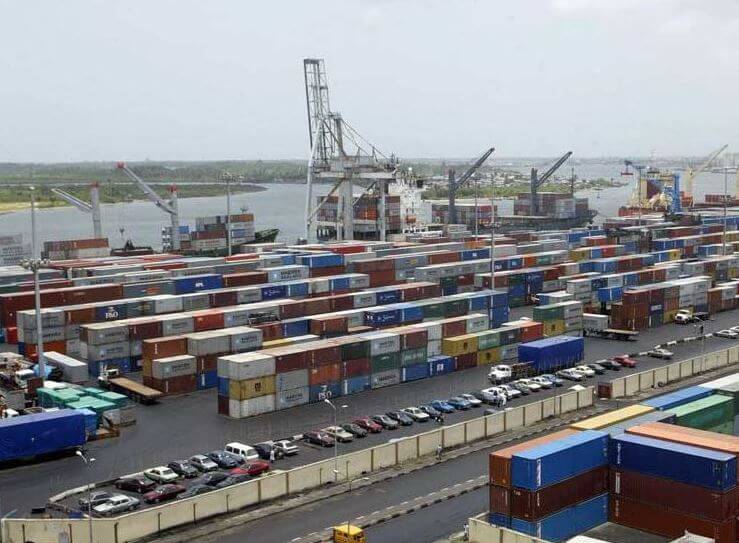
A few days to the Christmas and New Year celebrations, importation of items such as Sports Utility Vehicles, jewels, industrial supplies, food and non-African fabrics, which typically characterise the season, has reduced drastically.
Consumer demand has likewise remained low over dollar scarcity and poor purchasing power.
Consequently, the volume of imports through the nation’s seaports in the month December this year, witnessed a drop of about 76 percent, compared with the volume the same period in the year 2014 and 2015.
Analysts say this is caused by a scarcity of foreign exchange together with the lingering economic recession and high rate of inflation that hiked the market prices of goods, and limiting the purchasing power of consumers who now invest their little income on household supplies, food items and less luxury items.
According to the Nigerian Ports Authority (NPA) daily shipping position, the cargo throughput in the Lagos Pilotage District, which stood at 700,852.6 metric tons in December 2014, reduced to 435,428.96 metric tons in December 2015, and in the same period this year, it further dropped to 163.452.89 metric tons.

The NPA shipping position further disclosed that container throughput, which stood at 12,520 twenty equivalent units (TEUs) in 2014, dropped to 7,447 TEUs in 2015 and further declined to 5,903 TEUs in December 2016. The number of ships coming into the Lagos Pilotage District, which was 60 in 2014, reduced to 38 in 2015 and 21 in 2016.
The shipping position however listed containerised cargoes, premium motor spirit (PMS), bulk gypsum, bulk salt Automated Gas Oil (diesel), JET A1 (aviation fuel), bulk wheat, bulk fertilizer, frozen fish, bulk rice and bulk sugar as commodities that are expected to be in the port before Christmas.
“There is a drop in ship traffic and the volume of containers coming into the seaports, despite the fact that Christmas and New Year celebrations are a few days away. Many businesses and individuals were not able to raise finance to go into importation due to high dollar rate, and the most affected are industrial supplies like raw materials and construction goods,” Tony Anakebe, managing director of Gold-Link Investment Limited, a Lagos-based clearing and forwarding company, told BusinessDay.
Anakebe further observed that items which are coming in gradually, are goods tagged ‘personal effects’ owned mostly by Nigerians in the Diaspora, who want to reach out to their families in Nigeria.
Continuing, Anakebe said: “The importation culture of Nigerians has changed, following the Central Bank of Nigeria (CBN) monetary policy that does not allow importers a free hand to import. With the CBN policy restricting importers of 41 selected items from accessing foreign exchange at interbank rate, many importers, including manufacturers, no longer import.”
Comparing the current importation business with what it used to be in the past, Emmanuel Nwabunwanne, a Lagos-based importer, who deals in imported exotic jewelleries, said sales had been low throughout the year, and that this month (December) was no exception to the reality on ground.

“I am not surprised that Nigerian seaports are presently empty. In the past, we used to have a rush at Christmas but now, my company has not been able to sell off the inventories that we managed to stock earlier in September this year. This is unlike the previous Christmas seasons during which we stocked our sales outlets many times, from from September till January the following year,” Nwabunwanne said.
Jonathan Nicole, president, Shippers’ Association of Lagos State, confirmed that the issue of foreign exchange and the restriction placed on 41 selected items had affected the volume of goods coming into the country.
The ports, he pointed, are operating at the lowest ebb because it is only a few importers that are taking the risk despite the odds, because they believe that they can still sell their goods based on the rate at which the foreign exchange is obtained.
“Most manufacturing companies are no longer importing their critical input as they used to. Investors who used to bring imports are no longer doing so, due to the economic downturn and people are not sure of how to invest and make a profit,” he said.
AMAKA ANAGOR-EWUZIE