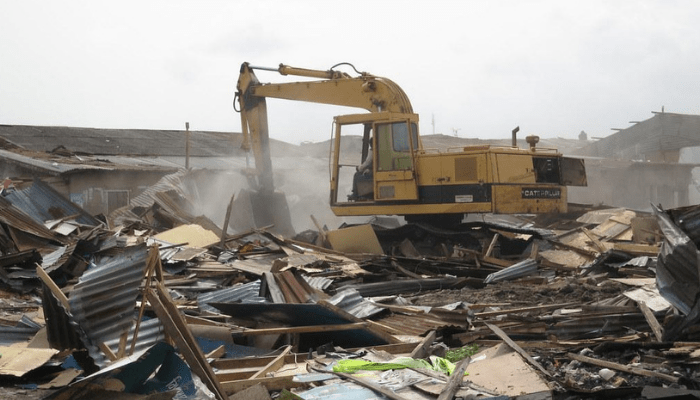
On Friday July 30, 2021, Nigerian documentary catalog is going to be enriched with a revealing, yet well-captured documentary on the many evictions in Lagos, but not just for the fun of watching, the probing of the rationale, situation afterwards, and the impact on the many evictees are reasons the documentary is a must-watch.
Tagged, ‘Dispossess: Evictions for development’, the documentary, is hosted by hFACTOR Collective in partnership with Heinrich Böll Stiftung. It will screen at the National Museum, Onikan, Lagos, alongside an exhibition, explores the extent to which evictions contribute to Lagos city’s economy and social landscape in service of “public interest.”
Yes, ‘public interest’ because that has always been one of the reasons governments give for evicting people, usually the poor, and that is why the title of the documentary is rhetorical, leaving people to offer the answers in their own opinions.
Speaking during a media parley heralding the film screening and exhibition in Victoria Island, Lagos, recently, Dolapo Osunsina, community liaison/legal officer, hFactor, noted that the documentary is an effort at bringing to the fore, the plight of evictees years after, holding government accountable to its promises to the evictees and especially on putting the spaces created after the evictions for the right use.

Read also: Lagos State internal revenue service to launch service charter
Osunsina, who spoke after the media watched the trailer of the documentary, noted that the case study for now is Lagos State.
She observed that the vision of the Lagos State Government has always been to transform Lagos into Africa’s model megacity, and a global economic and financial hub. Over the past decade, she noted that the government has also engaged private sector partners on a series of major infrastructure and real estate projects.
But while the projects are welcome development, she also observed that in many instances, many people have been rendered homeless and places of work demolished in order to make way for the planned developments.
While those evicted from these places now turned developmental sites are crying, the government and its private partners keep assuring that the projects contribute to the socio-economic development of the city, but a cursory look at the realities on the ground suggests otherwise.

The documentary went further to meet some of the evictees whose stories are pathetic. From the market woman who cannot pay for a shop at Tejuosho market in Yaba, the dry fish seller, who has been displaced at Oyingbo market to the mechanics whose once thriving shops at Babs Animashaun Mechanic Village in Surulere has been demolished, the stories are same; injustice, governance without human face and no concern for the poor.
The intrigue for the concerned evictees is that after demolishing the informal markets, the land is left empty for a long time, and in some cases gigantic modernised market buildings are built on the same land, but are struggling to attract traders and customers.
In the same vein, Tushar Hathikamani, space manager, hFactor, noted that the documentary asks the right questions to the right people in order to bring to the fore the plights of the evictees, situations on ground at some of the sites and also on projects that either delivered not by the government, ascertaining if they are truly in ‘public interest’.
Apart from the film screening, other programmes of the event on that day include; a presentation titled ‘4 Myths on the Lagos Land And Real Estate Market’ by Dr. Taibat Lawanson and Victoria Ibezim-Ohaeri.
As well, there will be a panel on, What “development” means to the various parts of Lagos society; The meaning and value of land: Do we need to review our thinking about land and see it as a social good than as an economic commodity and How do we understand the clause in the land use act: “for public purpose”?
The event will be spiced by a performance on abuse of public and private land ownership by movement artist Hermes Iyele and Women Traders Association of Teju Osho Market.
Other programmes of the event that day include; World Café Sessions, including information sessions by academics, advocates, developers and various social development organisations.
Moreover, hFACTOR Collective are Heinrich Böll Stiftung promising enlightenment and goodtime for participants at the film screening and exhibition, which runs from 9am -2pm on July 31, 2021 at the National Museum Onikan, Lagos.