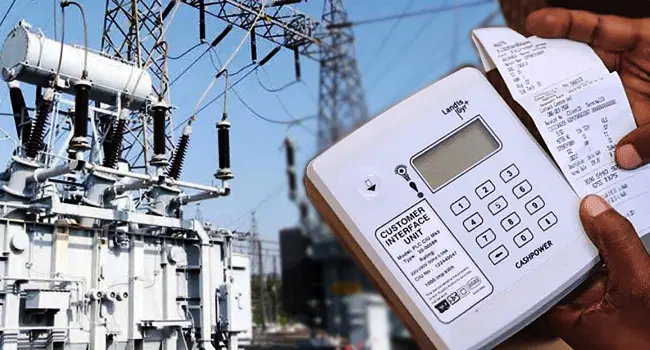
Nigeria’s electricity distribution companies (DisCos) recorded their highest quarterly revenue since privatisation in the first quarter (Q1) of 2025, despite persistent complaints over poor power supply across the country.
Data released by the Nigerian Electricity Regulatory Commission (NERC) show that the 11 DisCos raked in a total of N553.63 billion between January and March 2025, a nine percent increase from the N508 billion reported in the last quarter (Q4) of 2024.
The rise in revenue comes at a time when millions of Nigerians continue to grapple with erratic electricity supply, prolonged blackouts, and worsening grid performance.
Industry analysts attribute the revenue spike to the implementation of a new electricity tariff structure, increased metering, and improved billing efficiency, rather than actual improvement in energy delivery.

“One obvious answer would be the Band A tariff,” said Pedro Omontuemhen, partner, West market area, energy, utilities & resources leader at PricewaterCooper (PwC). “So, even though you’re not getting Band A power like they proposed (20 hours per day), you’re now paying at a higher rate for the same supply.”
Read also: DisCos fail to recover N202bn power bill in three months
He said while the supply has remained relatively unchanged, the introduction of Band A, which led to an increase in the tariff, is sufficient to lead to an increase in revenue.
“The way it appears now, it seems that the government decided to go away from providing subsidies to the rich. Nigeria is now providing subsidies for the poor,” he said.
Analysis of the report revealed that Eko Electricity Distribution Company (EKDC) generated the highest revenue during the period at N104.95 billion, followed by Ikeja Electricity Distribution Company (IEDC) at N101.20 billion and Abuja Electricity Distribution Company (AEDC) at N88.10 billion, respectively.

Ibadan DisCo generated N61.73 billion, Benin DisCo had N52.31 billion, Enugu DisCo got N44.96 billion, Port Harcourt DisCo saw N37.63 billion revenue, while Kano and Jos DisCos recorded N25.71 billion and N17.14 billion, respectively.
Also, Yola DisCos generated the least revenue in the period at N8.2 billion, behind Kaduna DisCos at N11.72 billion.
“The total revenue collected by all DisCos in 2025/Q1 was N553.63 billion out of N744.27 billion billed to customers. This translates to a collection efficiency of 74.39 percent,” NERC stated.
Read also:How DisCos can lure biggest customers back to grid
Poor electricity supply
“On average, a Nigerian household experiences electricity blackouts 6.7 times per week, with each outage lasting approximately 12 hours,” the National Bureau of Statistics (NBS) recently stated.
This revelation was what the move to privatise and unbundle the generation and distribution arms of the Nigerian power sector sought to repair. However, privatisation of the sector, which initially met with enthusiasm for positive growth, has dashed the hopes of many 12 years later.
When the sector was privatised in November 2013, Nigeria’s installed generating capacity was approximately 7,500 megawatts (MW), with an operating capacity of around 4,000 MW.
Speaking to these statistics in 2013, PwC, in its ‘Privatisation in the power sector: Navigating the transition’ report, stated that electric power is still a major hindrance in Nigeria’s objective to be regarded as one of the world’s top 20 economies by 2020.
“The rule of thumb for an industrial nation is about 1MW for every thousand of population. This puts Nigeria’s energy needs in the 160,000MW range, given its population of 160 million. The Federal Government has a target of 40,000MW by the year 2020,” the report stated.
With a population of over 200 million, the government’s target of 40,000MW by 2020 was not met, and it still appears far-fetched in 2025.
According to the International Energy Agency (IEA), Nigeria’s total installed capacity stands at 13,610MW, and its transmission capacity is a little over 8,100MW.
Meanwhile, DisCos have a distribution capacity circa 4,000 MW, which could lead to overloading that significantly affects the grid.
In 2025, Nigeria experienced multiple power grid disturbances, resulting in widespread power outages. These disturbances, sometimes referred to as grid failures or power outages, resulted in significant disruptions to daily life and business operations.
While the Transmission Company of Nigeria (TCN) acknowledged the disturbances, the company emphasised that no complete grid collapses had occurred.
On November 7, 2024, major cities in Nigeria, including Abuja, Lagos and Kano, suffered blackouts as the country’s national grid collapsed.
According to the TCN, the outage was due to a sudden rise in frequency from 50.33 Hz to 51.44 Hz because of a malfunction in one of TCN’s substations, which led to “a series of lines and generators tripping that caused instability of the grid and, consequently, the partial disturbance of the system.”
Band A earnings
In April, the federal government, through the Minister of Power, stated that by ensuring tariff increases for Band A customers, the market has generated an additional N700 billion in revenue, representing a 70 percent increase.
Adebayo Adelabu, minister of power, stated that the development led to a rise in market revenue for 2024, from N1 trillion in 2023 to N1.7 trillion.