Pension numbers, including the number of Retirement Savings Accounts (RSA) holders and Assets Under Management (AUM), are expected to rise with the recent guidelines allowing diaspora Nigerians and foreigners working in Nigeria to participate in the Contributory Pension Scheme (CPS).
Experts in the industry who commented on the impact of the guideline said, it will deepen penetration and further democratise the pension system.
Omolola Oloworaran, director general of the National Pension Commission (PenCom) who expressed confidence on positive impact of the guideline to the growth of the scheme, said the benefits Nigerians and the country as a whole will be huge.
Today, over 10 million Nigerians from public servants to artisans are covered under the CPS, noting that pension assets have grown to N25 trillion, powering national development through strategic investments.

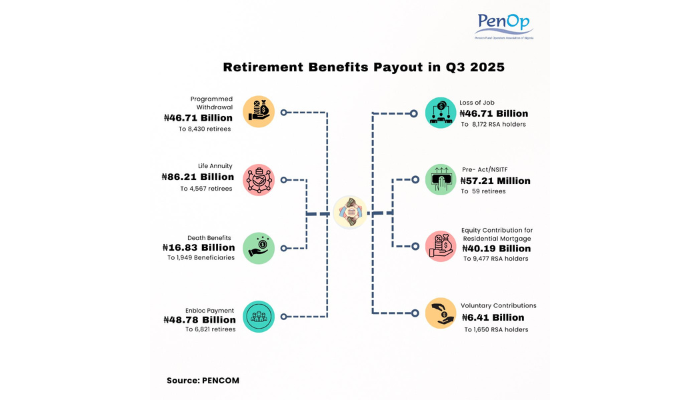
According to her, “More than 844,000 retirees across public and private sectors now enjoy steady, reliable, and transparent retirement benefits, with over 552,000 retirees receiving monthly pensions, while 291,735 have accessed lump sum benefits.”
Read also: PenCom expands pension scheme to Diaspora Nigerians, foreigners
Olumide Oyetan, chief executive StanbicIBTC Pension Managers said gap, along with the lack of a proper framework for investing contributions made in foreign currency, led to a broader conversation. Feedback from existing customers and the collaboration between regulators and operators brought us to where we are now.
“Our aspiration is that in the next four to five years, we will see significantly higher participation. Pensions in Nigeria can become a force for good, helping catalyse growth and improving the quality of life for Nigerians.
Nike Bajomo, executive director, Business Development at StanbicIBTC Pension Managers, said if you earn in foreign currency, either in Nigeria or abroad, and wish to maintain a retirement savings account in Nigeria, you can now contribute in foreign currency, and receive your benefits in the same currency when the time comes. “It is a much more flexible system, she said.

PenCom recently issued a guideline for Foreign Currency (FCY) Pension Contributions, paving the way for Nigerians living and working abroad and Nigerian/Foreign workers working in Nigeria, but earning all or part of their remuneration in foreign currency to be part of the scheme.
Oloworaran, while releasing the guidelines, said, “The FCY Pension Contributions Guidelines provide a pension arrangement under the CPS, for Nigerians living & working abroad and Nigerian/Foreign workers working in Nigeria but earning all or part of their remuneration in foreign currency.
According to her, the pension contributions by Diaspora Nigerians and other eligible persons are to be made in dollars. In the same vein, contributors will also access their benefits in dollars except they elect to do otherwise.
Read also: Diaspora Nigerians tap state-backed mortgage loans
“The FCY Pension Contributions Guidelines, which are now being issued for the first time, mark a watershed moment for the CPS coverage expansion and financial inclusion drive. It is a bold reform, which shows that PenCom cares about the retirement security of all working Nigerians, the DG said.
This Guideline establishes the regulatory framework for Licensed Pension Fund Operators (LPFOs) to accept, manage, and invest foreign currency (FCY) contributions under the Contributory Pension Scheme (CPS).
The provisions address scope, eligibility, operational requirements, and governance standards for FCY contributions. They align with global best practices on foreign currency pension administration, ensuring robust risk management, clear accountability, and effective oversight.
The objectives of this guideline are to expand access to the CPS for Nigerians earning in foreign currency, including those living abroad, provide a secure and transparent mechanism for making and managing FCY contributions, strengthen the investment potential of pension funds through diversified currency inflows, and ensure compliance with local regulatory requirements and international standards.