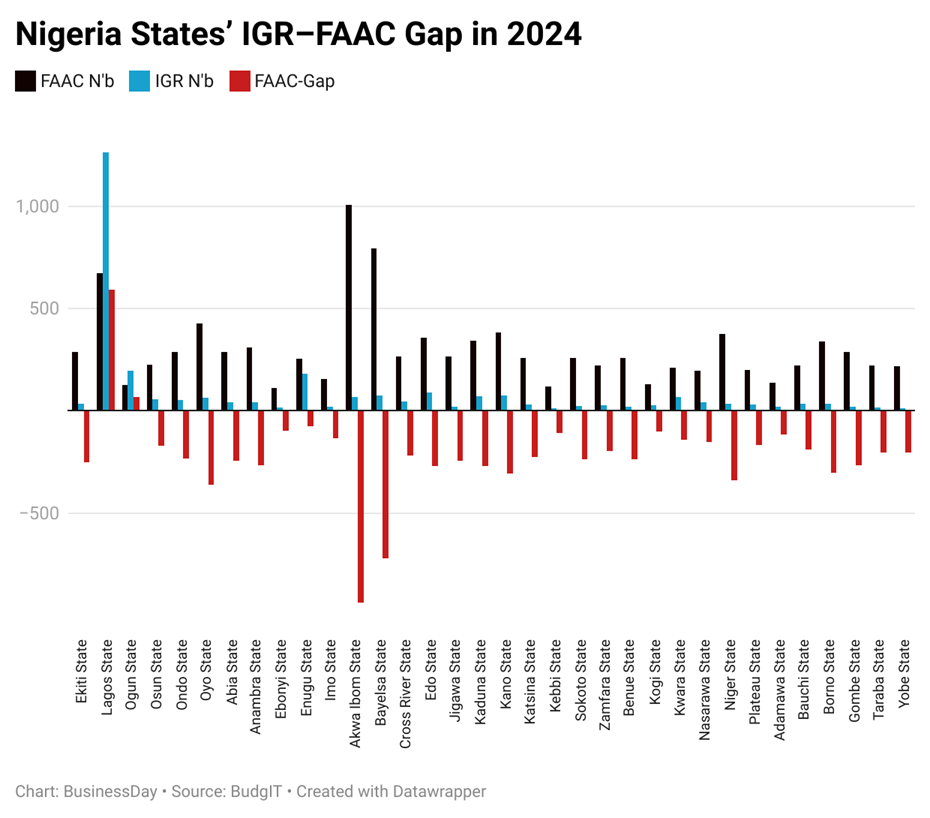
Nigeria’s state finances are sliding toward a structural crisis hidden beneath record federal transfers. A review of BudgIT’s State of States 2024 dataset shows that only a handful of sub-nationals could remain functional if allocations from the Federation Account (FAAC) were withdrawn.
For most states, internally generated revenue (IGR) is so weak that budgets would collapse without Abuja’s monthly lifeline. BudgIT’s analysis is based on audited state accounts, FAAC disbursement records, debt data from the Debt Management Office and state-level fiscal reports for 2024. With this dataset, the scale of state-level fragility becomes clearer.
The data reveals a simple but uncomfortable truth: only Lagos and Ogun generate more revenue internally than they receive from FAAC, while Enugu is the only other state with a revenue profile edging toward sustainability. Every other state depends on FAAC for 70 to 95 percent of total income, reinforcing a fiscal structure that cannot withstand external shocks.
The revenue imbalance

The disparity between states becomes stark once FAAC inflows are stripped away. Lagos generated N1.26 trillion in IGR in 2024 against N670.99 billion in FAAC, making it the only state where internally generated revenue significantly outweighs federal transfers. Ogun follows with N194.93 billion in IGR versus N127.57 billion in FAAC, demonstrating rare self-sufficiency among Nigeria’s sub-nationals.
Enugu sits just below that threshold, earning N180.5 billion in IGR against N255.67 billion from FAAC. While still dependent, its internal revenue now accounts for 41 percent of total income, well above the national average.
Beyond these three, the numbers deteriorate quickly. Twenty-one states rely on FAAC for more than 80 percent of their total revenue. Bayelsa (91.4 percent), Akwa Ibom (93.6 percent), Jigawa (93.3 percent) and Yobe (95.1 percent) are among those almost entirely bankrolled by the federal purse. Any oil-price volatility or disruption to national revenues could bring governance in these states to a halt.
What survival looks like under zero FAAC
A simple way to assess vulnerability is to match IGR against annual obligations. In most states, internally generated revenue cannot cover even the basics, salaries, pensions, or running costs.

Consider states across the North and South that illustrate this strain. Taraba generates only N16.06 billion in IGR against recurrent spending of N87.23 billion. Borno raises N33.97 billion internally but faces recurrent outlays of N170.57 billion. Bayelsa, despite huge FAAC inflows, earns N74.44 billion in IGR far too little to sustain its large expenditure profile. Kebbi brings in only N11.37 billion internally, while its recurrent costs exceed N62.66 billion.
If FAAC were removed, these states would struggle to pay salaries for even a quarter.
Even larger states are exposed. Kano generated N75.31 billion in IGR but recorded recurrent spending of N179.01 billion, leaving a gap that can only be closed through FAAC transfers.
Debt exposure adds further fragility
FAAC dependency would be less alarming if states carried minimal debt obligations. Instead, several heavily reliant states also hold significant domestic and foreign debt.
Cross River owes N118.13 billion domestically and $202.46 million in foreign loans among the highest external exposures in Nigeria. Kaduna carries $625.1 million in foreign debt, accounting for more than 80 percent of its liabilities. Edo owes $383 million, with foreign loans making up 83 percent of its total debt stock.
In these states, debt servicing is already absorbing a growing share of available revenue. Without FAAC, meeting repayment schedules would be impossible.
The few outliers
Lagos remains in a league of its own. Even with N900.19 billion in domestic debt and $1.17 billion in foreign loans, its diversified economy and wide tax net provide significant insulation.
Ogun’s strong manufacturing and industrial base has helped it build a resilient revenue profile that can withstand FAAC shocks.
Enugu’s recent reforms expanding the tax base and improving compliance have transformed it into the strongest fiscal performer in the South-East. What sets these states apart is that their revenues grow from real economic activity, not merely improved collection.
A widening structural fault line
The danger is not immediate insolvency but the emergence of a two-tier federation: a small group of states capable of absorbing fiscal shocks and a much larger bloc trapped in a dependency cycle that deepens each year. With FAAC still providing more than 70 percent of revenue in most states, Nigeria’s broader fiscal stability remains tied to the volatility of oil earnings.
For Muda Yusuf, CEO of the Centre for the Promotion of Private Enterprise, “fiscal independence and competitiveness are achievable through strategic investments in infrastructure, urban productivity and governance efficiency.” Yet in many states, rising IGR numbers are not backed by real economic expansion.
Faruq Quadri, a public-policy researcher, warns that the appearance of higher collections may be misleading. “Without productive activity behind the numbers, a single revenue disruption could push many states toward distress,” he said.
Economists argue that the current model where FAAC funds more than 70 percent of revenue in most states, is fundamentally unsustainable. Without aggressive reforms, investment in productive assets and stricter spending discipline, many states risk borrowing not for development but for survival.
For now, FAAC masks these underlying weaknesses. But BudgIT’s data makes the picture clear: without federal transfers, only Lagos, Ogun and arguably Enugu have the fiscal capacity to stand unaided. The remaining 33 states are not managing prosperity; they are surviving on federal oxygen and remain acutely vulnerable to the next shock.