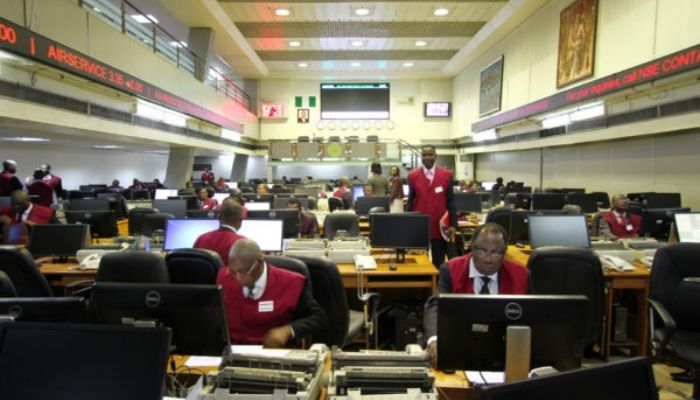
After its negative start to the month of November, Nigeria’s equities market recorded its first gain this month, rising by 1.23percent or N292billion at the close of trading session on Wednesday, November 2.
Africa’s largest cement maker, Dangote Cement Plc led the league of advancers on Wednesday after its share price rose from N220.50 to N240, up by N19.50 or 8.84percent. It was followed by NGX Group which gained 30kobo, from N20 to N20.30, up by 1.50percent.
The Nigerian Exchange Limited (NGX) All Share Index (ASI) and its market capitalisation appreciated from preceding day lows of 43,745.73 points and N23.827trillion respectively to 44,283.02 points and N24.119trillion. The market’s positive return year-to-date (YtD) increased to +3.67percent.
Sterling Bank, Access Corporation, FBN Holdings, GTCO and Fidelity Bank were top-5 traded stocks on the Nigerian Exchange Limited.

In 3,796 deals, investors exchanged 155,406,684 shares valued at N1.526billion.
FBN Quest Capital research analysts in a recent note to investors said the exchange’s declining fortunes “have been mostly caused by a sell-off in several of the bellwether firms that fueled its gain in first half (H1) 2022.
“The most notable name responsible for the NGX’s negative return last month was Airtel Africa, whose shares plummeted by circa -36percent during the month. Its shares lost steam following a price correction on the shares.
Read also: Reps reject N5.1bn budget for auditor general’s office
The shares had rallied hard for most of this year, returning close to +119percent due to demand from the offshore community because of its dual-listed status which suited their exit strategy.

“Dangote Cement, another bellwether, saw its shares decline by almost -11percent following a dispute with the Kogi State government over Obajana Cement plant, its largest production facility.
“Seplat Energy and MTN Nigeria are two other notable names whose shares declined over the month because of investors’ profit-taking activity.
“The additional rate hike of 150 basis points (bps) announced by the CBN’s monetary policy committee at its September meeting was another significant element that contributed to the waning investor confidence and the rotation of portfolios out of equities,” FBN Quest Capital research analysts said.
“The Nigerian Stock Exchange (NGX) performance declined dramatically last month after a fantastic run in H1 ’22, during which it outperformed its rivals on the continent. In October, the NGX’s suffered its worst monthly return this year, shedding -10.6percent, far worse than its counterparts, Nairobi (NSE 20) and Johannesburg (Joburg) stock exchanges which delivered returns of 6.5percent and -3.8percent respectively over the same period. Following the hammering it took last month, the Lagos bourse’s year-to-date (ytd) return has now plunged to low-single-digits (+2.4percent) from a peak of almost +27percent in May,” the analysts added.
Looking ahead, they expect to see a muted performance for equities “due to elevated yields on the fixed-income market and investors’ waning appetite for risk as the 2023 presidential election approaches.”