…As refinery ends petrol scarcity ‘ritual’ at festive periods
Nigeria’s oil history has been that of misery. A country blessed with rich deposits of crude oil has wallowed in perennial petrol scarcity, particularly at Christmas and New Year periods, when the product is most needed.
The nation’s four refineries have long packed up. ‘Efforts’ to resuscitate them have always ended in political abracadabra and miasma of entrenched corruption.
Over the years, petrol scarcity at Yuletide had caused untold hardship to travellers who spent long hours in queues at a few lucky filling stations. There had been cases of fire outbreaks as a result of households storing petrol in jerry cans. While the scarcity lasted, the nation’s highways saw terrible crashes as a result of commercial drivers, even private car owners on intra-city journeys, carrying kegs of petrol which exploded under intense pressure and high temperature. The highways used to be littered with charred bodies and wreckage of vehicles as a result of petrol fires. Before now, every festive period used to provide opportunities for street urchins to go into brisk but dangerous petrol-hawking business. Not only that their activities exacerbated the price of the product, they also increased cases of fire incidents in neighbourhoods as they were known to hide their unsold product at street corners. A lot of negative things happened during the dark era of petrol-hawking in many cities across the country.

Read also: Fuel scarcity at Yuletide jinx broken two years on
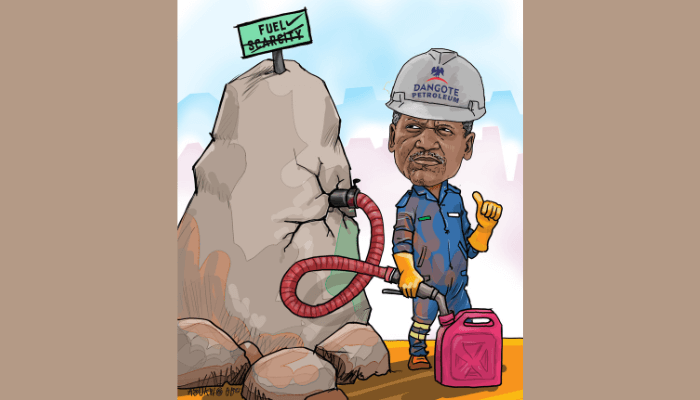
Then enters Dangote Refinery
It has been one year now since the Dangote Refinery became operational. By this time last year, there was no panic buying of the product because of its availability. There were no cases of fire incidents as a result of stored products in the neighbourhood. There were cases of families wiped off as a result of adulterated petrol in their power-generating set, which used to be a common occurrence. Since Dangote came to the scene, black market business has been dealt a deadly blow. Before then, unscrupulous elements used to adulterate the product to make more money, which usually caused the deadly conflagrations in the cities with the attendant loss of lives and properties.
The product may be costlier than it used to be in the recent past, but when compared with the negatives that used to follow the scarcity and the several man-hours lost to get just few litres, it can safely be said that things are better today, petrol-wise.
The arrival of Dangote on the scene appears to have upturned the apple cart but has been met with harsh resistance. The forces of darkness, who were used to doing things in a particular way for some sinister motives became uncomfortable, hence the push-backs that the Dangote Refinery has suffered. Just like Paul the apostle described his many battles as “fighting the beasts at Ephesus,” Dangote can also be said to be fighting many beasts in the course of the massive project. The good news is that the beasts, as it were, have not been able to buccaneer the good job going on at the refinery.
Read also: Dangote accuses NMDPRA of planning N250bn payout to loss-making marketers

The monopoly theory and allegation
Some critics have come up with conspiracy theory and blind allegation that to have a monopoly in the critical oil space in Nigeria may be hurtful and dangerous. These critics have also pointed to what is happening in other spaces, like cement, where Dangote operates and how it would seem that competitors have been emasculated and end users exploited. They raise the fear that a time might come when the refinery could go monopolistic and begin to afflict the same people it claims to be rendering service to.
There is also the argument that the refinery does not meet the local needs, hence the reason for the issuance of import licences to some individuals/companies.
Let competition come from inside, not through cheap imports
Some Nigerians who spoke with BusinessDaySunday said that they would be happier if the competition would come from inside the country by way of other refineries, modular refineries coming up, not by importing petrol into Nigeria, a situation that could threaten the huge investment Dangote has made.
Alex Avoaja, a communication expert, who spoke with BusinessDaySunday, said: “I am pro-business; I don’t play politics when it comes to defending business. Over the years, Nigerians have suffered seriously despite the four refineries owned by the federal government. None is working with all the government stories and propaganda. Now, an individual decided to invest massively with $20 billion to achieve what a government cannot. I expect every well-meaning and sensible Nigerian to support the project.
“People are talking about the fear of a monopoly; my response to that is, let those who have the capacity come up with their own refineries. What we must not do is to allow cheap imports to destroy our quest to industrialise. Once you begin to bring in cheap petrol, you have destroyed the good effort of Dangote.”
Bad policies killing Nigeria’s industrialisation
A former managing director of a paint-making company, who spoke on condition of anonymity, relived his experience, which he said was not palatable.
According to him, “My company’s location is at Mowe, Ogun State. We used to produce high quality paint. But we are no longer in business. Our company collapsed because of cheap imports which was sanctioned by the federal government. We thought we were being patriotic by going into production, but people were just bringing all manners of products from outside the country. Because of our operating environment, our cost was always high which usually pushed up the prices of our products. Of course, you do not dictate to a customer the product to buy, even though you may try to convince him about the quality of your product
It is the price that matters. That’s how we continued to go down until the company could no longer sustain itself despite the quality product we had.”
Advising Dangote to continue to fight on to protect his investment, the private sector player said: “I like what Dangote is doing. Some operators do not have what it takes to look eyeball to eyeball with the regulator which Dangote has. He must not back down. A $20 billon investment is not something to toy with.
“Look at what is happening in the Agric sector, farmers are labouring to produce quality food items in-country, but government is giving all sorts of import licences to bring in cheaper items. Farmers are lamenting. Those who took out loans to do their cultivation cannot pay back those loans. People are developing hypertension here and there, and many are dying slow deaths as a result of the trauma.
“So, if there should be any competition against Dangote Refinery, let it be from inside, not cheap imports.”
Beyond ethnicity
The effusive outbursts by many Nigerians goes beyond ethnicity. Many of those who spoke with BusinessDaySunday said that what Dangote has done deserved commendation by every true Nigerian irrespective of ethnicity or religion.
“I am here today speaking for Dangote, not because he is my brother or same religion with me or that we are of same ethnic background. No. It is because he has done what a patriotic citizen should do. If, for instance, he invested that money in other sectors, he could even reap returns more than what he may be getting from the refinery. If the project were just to serve his narrow interest, I am not sure he would have gone into it. He looked at the larger interest of the country. Those he accused of standing in his way are probably of same ethnic and religious bias; so, why are they not protecting him and his business? Many of us Nigerians see the refinery as a collective pride,” Ifeoluwa Dara, a young graduate, said.
Read also: Agbakoba urges amicable resolution of Dangote Refinery/NMDPRA rift in Nigeria’s interest
Olisa Agbakoba weighs in
Reacting to the recent impasse between Dangote Petroleum Refinery and the Nigerian Midstream and Downstream Petroleum Regulatory Authority (NMDPRA), Olisa Agbakoba, senior partner, Olisa Agbakoba Legal (OAL), said: “The paradox is striking: Nigeria now has a $20 billion refinery—one of the world’s largest—yet we continue importing petroleum products.
“A private investor has built the refining capacity our nation desperately needs, but faces systematic undermining from the very regulatory authority whose mandate is to support such investments.”
He pointed out that “When government policy actively frustrates transformative local investment, we must question whether our economic strategy serves national interest or perpetuates dependency.
“The issues here—local refining, poverty alleviation, employment, industrial development—go far beyond commercial dispute. They touch the fundamental question of how Nigeria governs its most valuable resource.”