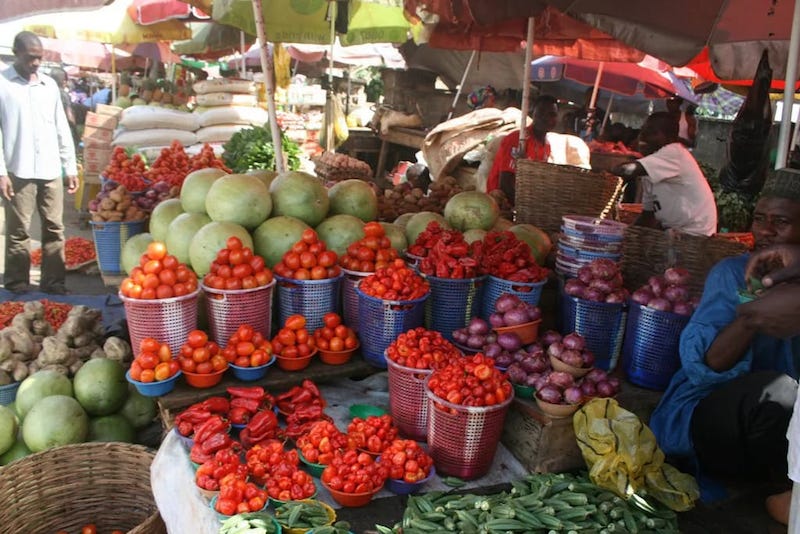
The Federal Government import restriction policy and the emphasis on home-grown foods driven by initiatives such as the Anchor Borrowers Programme has indeed been the saving grace for food security amid the novel coronavirus outbreak in the country.
The resilience the country has built unwittingly against the COVID-19 pandemic in the area of food is a testimony of the Anchor Borrowers Programme and import restriction policies of the government.

The recent approval of 100,000 metric tons of grains from the strategic reserves underscores the workability of an emerging agro-based diversified economy, which if sustained will free the country wasteful food importation.
“The ABP and border closure policy of the government has helped in boosting our food production before the coronavirus outbreak,” said Ibrahim Kabiru, national president, All Farmers Association of Nigeria.
“This is why we still have enough food amid the coronavirus spread but if the lockdown persists we might start seeing food prices escalating, owing to the obstruction in the supply chain,” Ibrahim said.

The Central Bank of Nigeria’s ABP initiative which started since 2016 to provide single-digit interest rates for smallholder farmers and guarantee off-takers in key staples has impacted the country’s agricultural sector tremendously and increased food production.
The ABP and FX restriction initiatives have also created a sustainable value chain in rice and other grains in the country.
Kabirus noted that farmers are currently unable to go to their farms as often as possible owing to the lockdown and supply of key inputs is also being obstructed by the directive.
He stated that the COVID-19 pandemic is a risk factor to the country’s food security and its impact will be greatly felt next year if smallholder farmers are unable to boost their productivity.
“We need to grow enough and replace the grains that were taken from the strategic reserves as a stimulus package for Nigerians during the pandemic,” he said.
Currently, the coronavirus pandemic is penetrating into global supply chains as countries continue to enforce lockdown policies to curtail the spread of the virus.
Globally, food prices are now surging as countries place restrictions on export, forcing prices of rice and wheat – two key staple foods to make rapid climbs in the global market.
The situation is creating an added financial burden on countries that rely on imports as the virus continues to shatter their economies and erode purchasing power.
Before the ABP initiative started in 2016 and FX restriction, Nigeria used to be among the top importers of rice – a key staple in the Nigerian diets.
But the narrative has changed with the initiative and FX restriction for importers of rice.
Nigeria’s rice production has increased significantly and the country is able to meet up with its local demand for the grain.
The ABP initiative has led to an increase in the country’s paddy production from about four million to seven million metric tons annually, according to data obtained from the National Bureau of Statistics (NBS).
Numbers of rice mills both integrated and cottage mills have also increased by more than 50 percent as the government and private sector continues to make more investments in processing.
The average crop yield per hectare of the crop has risen from 2.5 metric tonnes per hectare to an average of 4 and 5 metric tonnes of the same acreage, owing to the initiative.
Currently, the United States Department of Agriculture (USDA) puts Nigeria’s milled rice 2018/2019 production at 4.78 million metric tons (MT), up over 2.5 percent from 2017/18 figure of 4.66 million MT.
Rice import has reduced by 99 percent from about 1.2 million MT to about 784MT, industry estimates show.
Josephine Okojie