Côte d’Ivoire heads to the polls on October 25 for a presidential election taking place under tight security and amid a ban on political rallies, at a time of mounting tension over who should lead the world’s top cocoa producer into the next decade.
President Alassane Ouattara, 83, is seeking a fourth term in office, despite earlier pledges not to run again. His decision has stirred unease among sections of the opposition and civil society, who say it raises questions about political renewal and democratic succession. Yet, for many Ivorians, Ouattara remains synonymous with stability and economic growth after years of conflict and political unrest.
Read also:NCAA to take actions against Max Air, Air Côte d’Ivoire over passengers complaints
The election will be held under a plurality system, meaning the candidate with the most votes wins outright. Côte d’Ivoire’s 8.7 million registered voters will be choosing from five approved candidates, following the disqualification of two heavyweights, former president Laurent Gbagbo and Tidjane Thiam, ex-Credit Suisse chief and a prominent figure in the opposition Democratic Party of Côte d’Ivoire (PDCI).

Just a week before the vote, the government imposed a two-month nationwide ban on political rallies and demonstrations, citing security concerns. The order, issued jointly by the interior and defence ministries, applies to all parties and groups except the approved candidates, a move that opposition figures say tilts the field in favour of the ruling party.
Read also: FG repatriates 78 trafficked victims from Côte d’Ivoire
The announcement followed several days of unrest in parts of Abidjan and other regions, where protesters clashed with police over the exclusion of Gbagbo and Thiam. Roads were blocked and schools disrupted, prompting fears of a repeat of the 2020 election crisis, when opposition parties boycotted the poll and Ouattara was re-elected with 94 percent of the vote on a 54 percent turnout.
The main contenders
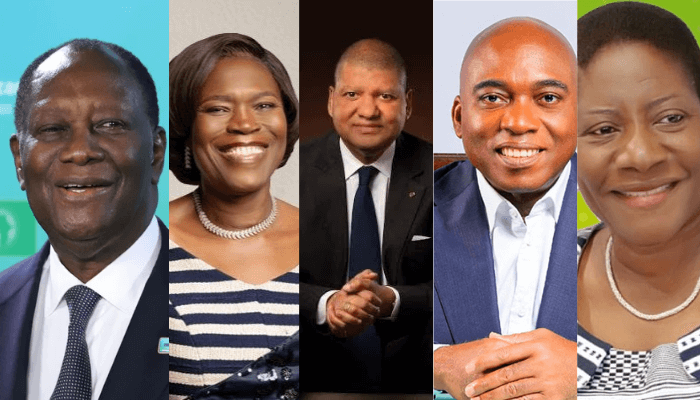
Alassane Ouattara (RHDP)
The incumbent president, in power since 2010, has built his campaign on continuity, promising to consolidate infrastructure gains and economic reforms credited with keeping Côte d’Ivoire among West Africa’s fastest-growing economies. Critics, however, argue that his long stay in office risks entrenching political fatigue and resentment, particularly among younger voters.
Read also: Electricity Access: Nigeria’s dream is reality in Cote d’Ivoire

Simone Gbagbo (Movement of Skilled Generations)
Once one of the country’s most powerful women, Simone Gbagbo, 76, is making a political comeback. The former first lady and ex-prisoner — pardoned in 2018 after a 20-year sentence — is now positioning herself as a reformist voice. At her rallies, she has praised Ouattara’s infrastructure record but called for stronger healthcare and job creation, saying Ivorians “want a government that serves the people, not the elite.”
Jean-Louis Billon (Democratic Congress)
A former trade minister and businessman, Billon, 60, represents a coalition of 18 parties and movements. He has styled himself as a pro-market moderniser, pledging to reduce the size of the civil service, tackle corruption, and shift more government operations to Yamoussoukro, the political capital. Billon says it is time for Ouattara and his generation to “pass the baton” to younger leaders.
Ahoua Don Mello (Independent)
Once a close ally of Laurent Gbagbo, Don Mello, 67, has charted his own course after being expelled from Gbagbo’s party for running as an independent. A vocal critic of the CFA franc and of French influence in West Africa, he has called for revising Côte d’Ivoire’s defence pacts and pursuing stronger ties withemerging partners.
Read also:Nigerian workers spend 40% of salaries on house rents – BD Poll
Henriette Lagou Adjoua (Group of Political Partners for Peace)
A former minister of social affairs and women’s affairs, Adjoua, 66, is one of the few female presidential candidates in Ivorian history. She ran in 2015, earning less than 1 percent of the vote, but has re-entered the race as a centrist advocating peace, reconciliation and greater female participation in politics. Her recent book, Why Not a Woman?, challenges entrenched gender barriers in public life.
What’s at stake
With a population nearing 32 million and a reputation as a regional economic powerhouse, Côte d’Ivoire’s political stability matters far beyond its borders. Investors are watching closely, mindful of the country’s history of post-election violence.