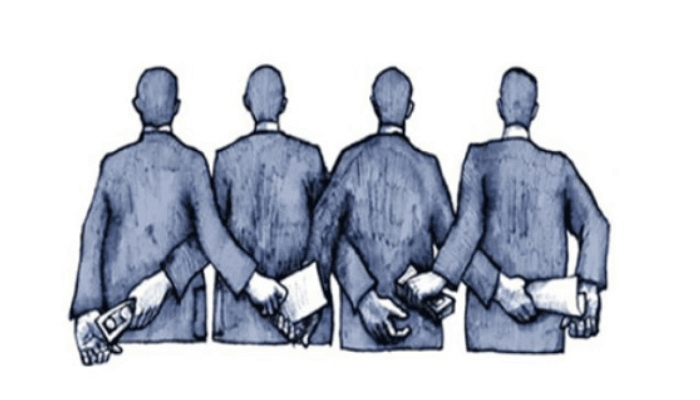
On the balance of available evidence, one is tempted to agree with the assertion above. But we know that change is constant and inevitable, so we remain hopeful that somewhere down the line, someone or something will nudge the country away from this ruinous path.
It is a fact that corruption reigns in Nigeria. But just when you think the country cannot go lower in moral depravity, something almost unimaginable will happen that hits you between the eyes like those sledgehammer-like Tyson punches.
This is a curse, not a prayer
A viral video of a christening ceremony provided the latest evidence of the seemingly irredeemable decadence the country has fallen into. What happened in the video was beyond shocking; it was downright disturbing. As a preamble to her prayer for the baby, who was held before her probably by the mother, a prayer contractor gave the story of how the populace regularly complain about the harsh economic realities in Nigeria and how, in spite of the hardship, the leaders, politicians especially, still find ways to manipulate public accounts by changing figures to steal millions. What we call pen robbery. The prayer contractor then proceeded to bring out a pen and put it in the child’s hand while she prayed, “[the child’s name] I give you this pen this day that in Nigeria the heavens have counted you among those who will use a pen to defraud the country and steal from the public coffers.” And the crowd at the ceremony, including the child’s parents, said amen. She even admonished those reluctant to say amen to the strange prayer – perhaps I should label it correctly, a curse – and wondered at the reluctance, pointing out that it’s not taboo if the child grows to become elected as a governor or a senator and enriches himself corruptly.

A classic case of Stockholm syndrome
Such impudence only shows how far gone under we are as a society, and the incident is not an isolated case. A few years ago, young ladies in the country took to the streets to protest what they called the constant harassment and extortion of their Yahoo Yahoo (tricksters) boyfriends by security agencies. Corruption, stealing, and fraud have become a culture in the country publicly celebrated as smartness or “my turn”; it has become a badge of honour while honesty, integrity, and uprightness are sneered at and considered stupid, dull, and uncreative. Those who game the system and steal millions and billions from the commonwealth are hero-worshipped, and their ungodly actions are rationalised by the citizens. You’d often hear the populace make statements like “How much did he/she even steal?” This question-like statement is in defence of politicians accused of corruption. It’s a rhetorical question suggesting that the corrupt politician was modest in his/her stealing and therefore undeserving of the “harassment/embarrassment” from the financial crime agencies. And to further justify the “smallness” of the stealing we then move to comparisons: “Has he/she stolen as much as Politician A, Governor B, or President D?” Or you’d hear: “At least he invested the stolen funds in the country and didn’t take them abroad like some others did.”
The many evils of corruption
Poverty
When we give such justifications, we forget so easily that it is this kleptomaniac disposition by our leaders and politicians that is directly responsible for widespread poverty in the country, because monies meant for the country’s development are funnelled into private pockets, leaving millions helpless. Almost 70% of the country’s 200 million population lives in multidimensional poverty, according to the Multidimensional Poverty Index (MPI) of the National Bureau of Statistics. According to the World Bank, Nigeria accounts for 15% of the world’s poorest, and many more have been projected to sink into poverty in the next few years.
Perhaps we need to be reminded that when we rationalise corruption, we forget it is at the core of collapsing social infrastructure and institutions.

Backward healthcare system
The public healthcare system has all but collapsed; there’s a shortage of everything in our healthcare system: limited healthcare facilities, qualified manpower, functional modern diagnostic labs and other facilities, and adequate medications. On top of that is the scourge of fake and adulterated medicines imported into the country while our leaders collect money from the evil importers to look the other way.
Poor education sector
Our education system is in urgent need of an upgrade to cope with modern learning demands. Many public schools are decrepit and in poor environments, lacking in everything that could lead to a beneficial learning outcome. Governor Alex Otti of Abia State recently trended in the news when he publicly apologised to students of the Abia State University (ABSU) during a visit to the school for the appalling state of facilities there. “I’m happy to see you [the students], but I’m very unhappy with the state of the facilities,” Governor Otti told the students. “The conditions under which you live cannot allow you to do any academic work,” the governor said. The ABSU situation is common in public schools across the country. Unfortunately, our governments care little for education beyond the phoney assurances they regularly give to transform the sector. This is clearly shown in the meagre yearly budgetary allocations to education.
Harsh/unfriendly business environment
We forget so easily that when we rationalise corruption, it destroys economic activities and stifles entrepreneurial drive. Corruption is responsible for the harsh business operating environment that often leads to collapsed businesses. To get licensing and approval for operations and or product development, business promoters often had to contend with government officials who demand to be “settled” before approval is given. An industrialist Adedeji Adeleke narrated how a planned power plant that would generate 1,250 megawatts of electricity for the country was almost truncated by a government official, who declared the project, according to Adeleke, “doomed to fail”, possibly due to Adeleke’s refusal to settle. For a country struggling with electricity generation, it is simply unbelievable. But that is what corruption does; it kills consciences and dead consciences kill businesses and scare away investors.
Dehumanisation
And, the most distressing aspect of corruption, one that many of us often miss or gloss over, is that it has made us lose our humanity as a people. Imagine the prayer contractor spiritually invoking a baby’s spirit to become a thief. She considered it a perfectly normal prayer, and many in the gathering agreed with her, and those who disagreed failed to strongly reprimand her. Our relationships today, social or economic, are often defined by what people stand to benefit, so much so that people are ready to take advantage of others without compunction. Someone will set up a business and create jobs for family and friends and those same people are thinking and scheming on how to game the system and defraud the business and the owner. You see families today who relate based on the financial benefits derivable from the family member. We have seen parents who openly and shamelessly reserve special love or attention for a child who is financially strong over the others who are less so.
It wasn’t like this then
As a society, we were never like this. In the past, communities across the country upheld the highest standards of integrity, honesty, hard work, love for others, selfless service, and willingness to help while abhorring indolence, theft, manipulations, selfishness, corruption, and other negative vices. While I was growing up in the 80s, families feared being associated with theft and waywardness; they tried to avoid it the way a rat avoids snakes because such association would earn the family shame and isolation. People would refuse to marry into such families. Today, people celebrate corruption, theft, and Yahoo Yahoo like you’d celebrate a major achievement. And like the prayer contract and people of her ilk, they pray to be a part of the action.
Is there redemption in sight?
It’s difficult to see that in the horizon. It would take a long long time for the country to retrace its steps. Redemption will be dependent on the actions we take and the choices we make today as a country. However, the retracing won’t start from our leaders, and certainly not from people like the prayer contractor. They are far too deep in it to turn around. The led must take the lead; they must be strident in demanding transparency and accountability from the leaders. While doing that, we must determine to live right and set good examples for our children. We must also seek to support individuals and groups who fight corrupt leaders and institutions.