The present economic downturn in Nigeria caused by falling global oil prices, foreign exchange scarcity and rising food inflation has continued to put strain on consumers.
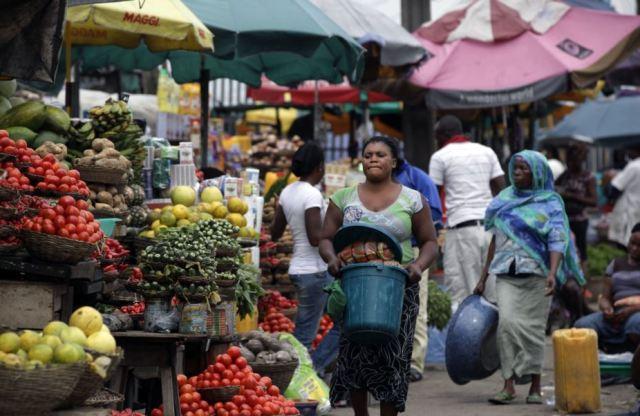
Checks reveal that prices of household and perishable goods are all going up despite contraction in consumer disposable income.
‘‘The irony is that as the purchasing power of Nigerians decreases, the price of the very items they seek to purchase will continue to increase rapidly, creating a double jeopardy situation,’’ Cheta Nwanze, head of research for SBM Intelligence, said.
Inflation numbers have dropped to 17.8 percent in February 2016 from 18.7 percent in January 2016, but food inflation has continued to increase.
The latest inflation data from the National Bureau of Statistics (NBS) show that food inflation increased to 18.5 percent in February from 17.8 percent in January, which is driven by increases in the cost of bread, cereals, meat and fish.
“This contraction reflects a difficult year for Nigeria, which included weaker inflation-induced consumption demand, an increase in pipeline vandalism, significantly reduced foreign reserves and a concomitantly weaker currency,” the NBS said in its verdict.
Checks also show that a bag of 50kg garri is now N13,000, as against N11,000 a month ago. A 50kg bag of Oloyin beans now goes for N18,000 instead of N16,000.
A bag of fresh pepper, which previously sold for between N7,000 and N8,000 is now N10,000. Also, the price of rodo pepper that sold at N6,000 is now N12,000, which is 100 percent increase, and a basket of fresh tomatoes that was N4,000 on Saturday now goes for between N5,000 and N6,000.
A carton of Titus iced fish now goes for N19,100 instead of N18,500; a carton of Kote iced fish that previously sold for N16,200 is now N17,800, and a carton of Sawa iced fish rose to N10,700 from N10,000, within the same period.
However, some food items witnessed a slight decline in price over the last one month.
A bag of onions dropped from N22,000 to sell at N12,000, a bag of 50kg rice now goes for between N15,500 and N16,000, instead of between N17,500 and N18,500, depending on the brand.
‘‘The price of food items in season are coming down while those that are approaching their offseason like fresh tomatoes is going up gradually,’’ Biliya Lawal Adam, secretary of perishable goods section, Mile 12 Market, Lagos, said.
‘‘The price of everything is coming down compared to last month because of the fall in the price of fertilizers. The fertilizer we usually buy between N8, 200 and N8, 300 is now N5, 500 for any time and its readily available,’’ Adam said.
Meanwhile, about 3.67 million Nigerians have been added to the unemployment rolls since the second quarter (Q2) of 2016 as the unemployment rate jumped to 13.9 percent in Q2 2016, from 13.3 percent in the earlier period.
Many businesses have closed shop, many others have lay off staff and slashed salaries of those who remain in their jobs, while some others have replaced high-earning staff with low-earning ones within the period.
“Even now that the prices of some food items have come down, customers still complain they do not have enough money to spend,” Chiamaka Udemezue, a trader in Lagos, said.
Some consumers who spoke with BusinessDay, say they now spend more of their income on food leaving them with little to meet other pressing needs such as house rent, children school fees.
‘‘Half of my income now goes into food procurement. Before now, I spend one-third on food. This has impacted negatively on other areas such as payment of my children’s school fees, house rent, even transportation,’’ Adebayo Obajemu, a consumer in Lagos, said.
Monique Chigbo, a housewife in Abuja, said, “It is really amazing that even garri is now beyond the reach of the poor. One small mudu that I used to buy for N120 is now N400. Eating common two meals a day is now a huge problem. The price of everything seems to be increasing by the minute and the money is not even there. Now, we eat what we can afford and not what we want to eat.”