Materials or medium applied in creating art comes with meanings beyond mere texture as artist, Oluwapelumi Oluyemi’s paintings explain. Applying indigenous fabrics, among other materials, Oluyemi’s visual narratives expose the connection between identity, memory as well as self-discovery.
Some of her works, mostly expressed in portrait style figurative paintings, touch on the artist’s life experience. It is also of interest that sometimes she captures the real person behind every emotive experience by using a model who shares a similar battle with her.
Every victim of oppressive systems, either at the workplace or domestic, hardly gets courage to fight back. It becomes more traumatic when such victims lack window to ventilate their angst, leading to emotional, perhaps mental suppression. For Oluyemi and her friend, who is the subject of one of the paintings, art serves as a refuge to manage the trauma of silence.
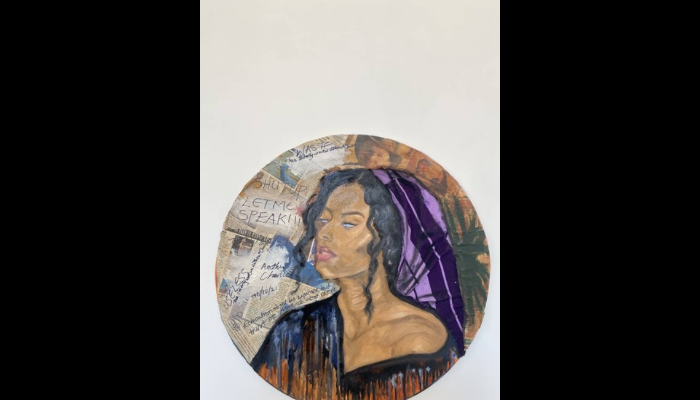
In one of the paintings titled ‘A Whisper Against the Roar’, rendered in portrait-style, the model for the piece – deliberately chosen as someone who often felt silenced and dismissed, just like the artist – brings bold texture into the painting. Oluyemi texturing the background with waste newsprint also creates suspense that generates more curiosity about the entire content.

Energising the courage of the subject, despite traumatic intimidation, are inscriptions on the waste newsprint background that generate depth for the composite. As a key material in the collage, the newsprint becomes more interactive with the theme of the painting as the artist enlivens the canvas with some inscriptions. Among such words are what appears like confrontation between a bully and the victim. Written in bold letters, comes an order to “SHUT UP”, accompanied with “You’re useless”. But comes the resistance in response with “Let Me Speak,” capturing some familiar experiences that people go through, either within a domestic or workplace environment.
The symbolism of the Aso-Oke and newsprint materials application by Oluyemi in ‘A Whisper Against the Roar’ exposes deliberate connection between theme and an artist’s choice of medium. Collaged as a loose headcover in the painting, the Aso-Oke fabric, traditionally of Yoruba, Southwest of Nigeria origin, symbolises resilience. In the painting, the fabric comes with its aesthetic value, strengthening the thematic focus of the piece.
Back to the newsprint, it does appear that Oluyemi almost lost the symbolism or the importance of using specific waste newspapers. Why not the natural contents of part of the newsprint sharing headline or texts, coincidentally, with the theme of the painting? In compensation for what appears like a missing symbolic link between the newsprint and the theme, the artist does many pen inscriptions across the paper, apart from the three mentioned earlier. And should there be conflict of focus with the texts of the newspaper and the theme-focus of ‘A Whisper Against the Roar’, the artist avoids such competing content. She applies spots of brushings, in white, to mask the possibility of intruding background texts from the newspaper.
Oluyemi is a Nigerian artist, whose Yoruba descent has shaped her creative direction. She creates visually compelling narratives that reflect kinship, resilience, and grace. With her preferred medium of oil paint, mixed media, and image transfer, she integrates personal memories, applying Aso-Oke fabric, scripture, and meaningful words passed down through generations.
Oluyemi is a trained visual artist, having earned a Master of Fine Art in the United Kingdom, expanding her perspective through global engagement. Her work preserves stories of belonging while celebrating the enduring strength and beauty of Yoruba culture.

Artwork caption:
‘A Whisper Against the Roar’ (oil on wood, newspaper, Aso-Oke and image transfer, 67cm, 2025) by Oluwapelumi Oluyemi