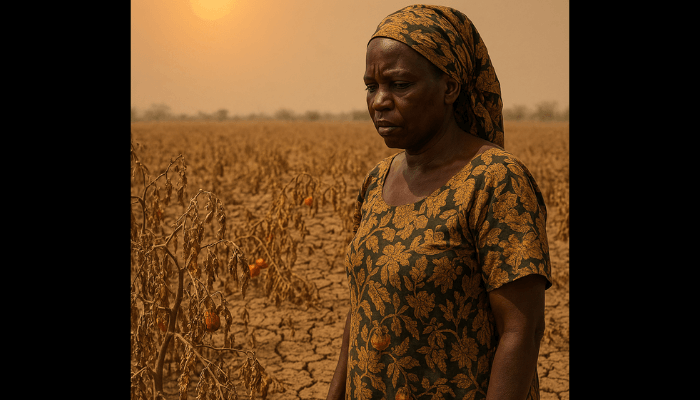
Fatima Musa watched helplessly as her tomatoes withered under Kano’s relentless sun. The current temperature had soared to 106°F (41°C), with forecasts predicting even harsher days ahead. “By the time we transport them, half are already bad,” she said, her voice heavy with frustration. For Fatima and countless other farmers in northern Nigeria, the intensifying heat is not just a discomfort but a direct threat to their livelihoods.
“For Nigeria to combat this crisis, experts advocate for increased investment in climate-smart agricultural practices.”
A struggle against the elements
In Kano, the heart of Nigeria’s tomato farming region, the searing heat has become an unrelenting adversary. Tomato plants thrive between 59°F and 90°F (15°C to 32°C). However, when temperatures exceed 95°F (35°C), the plants experience severe stress, hindering their growth and fruit development.
The Nigerian Meteorological Agency (NiMet) has predicted that both daytime and nighttime temperatures will be warmer than the long-term average over most parts of the country in January, February, March, and May 2025. This relentless heat not only damages crops but also fosters the proliferation of pests like the tomato leaf miner, further devastating harvests.

The silent killer of Nigeria’s food security
Climate change is not just about rising temperatures—it is silently crippling food production by worsening post-harvest losses. Erratic rainfall, extreme heat, and humidity create the perfect conditions for food spoilage. Nigeria already loses up to 40 percent of its agricultural output, amounting to N3.5 trillion annually—a staggering figure that surpasses the combined five-year federal budget for agriculture.
Perishable crops like tomatoes, peppers, and vegetables are particularly vulnerable. Without cold storage or reliable transport, farmers are forced to sell at desperate prices or watch their produce decay. “We produce enough food in Nigeria, but we waste almost half of it before it reaches the market,” says Dr Adeola Fakorede, an agricultural economist. The economic impact of these losses is severe, leading to reduced farmer incomes, rising food prices, and an increasing strain on already fragile household budgets.
Experts warn that the situation is only getting worse. Alhaji Aliyu Maitasamu, President of the National Onion Producers, Processors, and Marketers Association of Nigeria (NOPPMAN), notes that onion farmers face over 50 percent post-harvest losses due to high production costs, climate challenges, and inadequate storage infrastructure. “More than half of our production is wasted after harvest due to inadequate storage, limited preservation technology, and unreliable transportation,” he explains. The inefficiency in Nigeria’s agricultural supply chain is not just a problem of wastage but a ticking time bomb for national food security.
Read also: Climate change undermining efforts to reduce poverty, inequality – WorldBank

Economic hardships deepen
The economic ramifications of these climatic challenges are profound. Nigeria loses up to 40 percent of its agricultural output annually, amounting to approximately ₦3.5 trillion. Perishable crops like tomatoes are particularly vulnerable. Without adequate storage facilities and reliable transportation, farmers are forced to sell their produce at minimal prices or watch them decay. This inefficiency not only reduces farmer incomes but also drives up food prices, straining household budgets and exacerbating food insecurity.
Abiodun Adeyinka, a food vendor in Lagos, describes how her business has been affected. “I used to buy a basket of tomatoes for N5,000, but now it costs over N25,000. Customers are complaining, and my business is suffering,” she says. The struggle to balance affordability with profitability is forcing many small-scale traders out of business. Meanwhile, families are forced to make difficult choices—reducing meal portions, substituting with less nutritious food, or, in some cases, skipping meals entirely.
Ramadan fasting amidst scorching heat
The timing of this heatwave coincides with the holy month of Ramadan, during which Muslims fast from dawn to dusk. In Kano, where temperatures have been soaring, residents are finding the fast particularly challenging. The Daily Post reports that temperatures have approached 40°C (104°F), intensifying the physical demands of fasting.
For farmers like Fatima, the combination of grueling agricultural labor and fasting under such extreme conditions is a test of endurance and faith. “We work all day in this unbearable heat, but we must also observe our religious obligations,” she says. The harsh climate is making an already difficult situation even more punishing for those observing Ramadan while toiling in the fields.
Global lessons and possible solutions
The challenge of post-harvest losses is not unique to Nigeria, and global case studies offer valuable lessons. In Belgium, scientists are developing climate-resilient pear varieties to withstand heat-waves and unpredictable precipitation. The goal is to create a sustainable food system that anticipates and adapts to climate shifts rather than merely reacting to them. In Zimbabwe, an innovative approach to addressing food shortages has emerged through maggot farming. Farmers are turning organic waste into protein-rich livestock feed, cutting down production costs and reducing environmental impact.
For Nigeria to combat this crisis, experts advocate for increased investment in climate-smart agricultural practices. The Nigerian Stored Produce Research Institute (NSPRI) estimates that at least 300 cold storage hubs are needed nationwide to reduce spoilage and prolong the shelf life of perishable crops. Expanding such infrastructure would mean that farmers like Fatima Musa would no longer have to watch their hard-earned produce rot before it reaches consumers.
Additionally, adopting heat-resistant and drought-tolerant crop varieties could significantly improve yields and post-harvest durability. Investing in better storage technologies, such as evaporative cooling chambers and zero-energy cooling systems, would provide cost-effective solutions for smallholder farmers. Improved irrigation and staggered planting techniques could also help mitigate the unpredictability of rainfall patterns.
A call for immediate action
Addressing these challenges requires urgent intervention. Investments in climate-resilient agricultural practices, such as developing heat-tolerant crop varieties and improving irrigation systems, are essential. Establishing adequate storage facilities and enhancing transportation infrastructure can reduce post-harvest losses. Additionally, providing farmers with timely climate information and access to extension services can empower them to adopt adaptive strategies.
While technological solutions are essential, they must be accompanied by strategic government policies. Strengthening agricultural extension services to educate farmers on best post-harvest practices is critical. Providing financial incentives for adopting modern storage and preservation methods could accelerate the transition to a more resilient agricultural sector. Moreover, establishing dedicated funds for research and innovation in food preservation technologies would ensure that Nigeria does not lag in the fight against food wastage.
The plight of Nigerian farmers like Fatima underscores the urgent need for comprehensive policies and actions to mitigate the impacts of climate change on agriculture. Without such measures, the cycle of hardship will persist, threatening the livelihoods of farmers and the food security of the nation.
The question remains: Will Nigeria rise to the challenge, or will it continue to let its harvest rot before reaching the table?