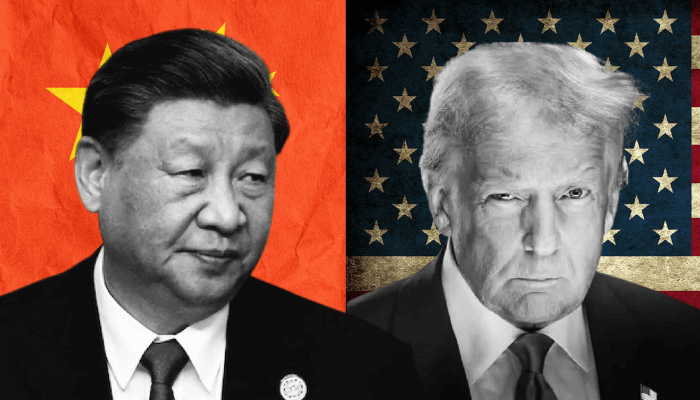
China has confirmed the finalisation of a trade deal framework with the United States, a significant step aimed at defusing tensions in a long-standing economic standoff between the world’s two largest economies.
Under the agreement, the U.S. will lift several “restrictive measures” on Chinese goods, while Beijing pledged to streamline approval processes for items subject to export controls, including rare earth minerals critical to global industries.
This development follows months of fluctuating negotiations and rising tariffs that had rattled global markets.
Officials from both countries reached a consensus during talks in Geneva in May, where they agreed to temporarily reduce the tit-for-tat tariffs that had escalated over the past year.

However, the progress was soon overshadowed by fresh accusations from U.S. officials, who claimed that China was backpedalling on the deal by deliberately delaying the approval of export licenses for rare earth elements, materials indispensable to the manufacture of electric vehicles, hard drives, smartphones, and military equipment.
Talks resumed in London earlier this month, eventually producing a revised framework to reinforce the Geneva agreement.
A White House official confirmed to AFP on Thursday that both sides had reached “an additional understanding for a framework to implement the Geneva agreement,” clarifying President Donald Trump’s earlier comments at an event, where he said the U.S. had “just signed” a new deal with China, though he provided no specifics at the time.
In a statement released Friday, China’s Ministry of Commerce announced the formal confirmation of the deal and urged continued cooperation.
“It is hoped that the United States and China will meet each other halfway,” the ministry said, emphasizing the mutual benefits of the framework.

According to the ministry, the deal stipulates that China “will review and approve applications for the export control items that meet the requirements of the law,” while the U.S. “will correspondingly cancel a series of restrictive measures against China.”
A key focus for Washington throughout the talks has been securing the steady flow of rare earth minerals, a market where China holds an overwhelming global dominance.
Read also: Trump claims US-China trade deal has been signed
The U.S. has grown increasingly concerned about China’s decision in April to tighten export controls by mandating licenses, a move widely interpreted as retaliation against the Trump administration’s aggressive tariff regime.
Earlier this year, Trump imposed a sweeping 10 percent tariff on most U.S. trading partners.
While he later paused higher rates on dozens of economies to allow for negotiations, a July deadline looms for those steeper tariffs to take effect.
On Thursday, the White House suggested that the deadline could be extended, depending on progress with trade partners, a possible reprieve for global markets and supply chains already under pressure.
The announcement comes amid a attempt by both Washington and Beijing to recalibrate their economic engagement, not only with each other but also with the rest of the world.
Notably, China and Nigeria also unveiled a shared vision for African development, indicating that the trade thaw could have far-reaching geopolitical and economic implications beyond just U.S.-China relations.
While the deal remains a framework, rather than a final, binding trade pact, analysts say it could mark a turning point if both sides follow through.
They noted that market watchers will now look closely at how swiftly the agreed measures are implemented and whether the fragile détente holds in the face of ongoing strategic rivalry.