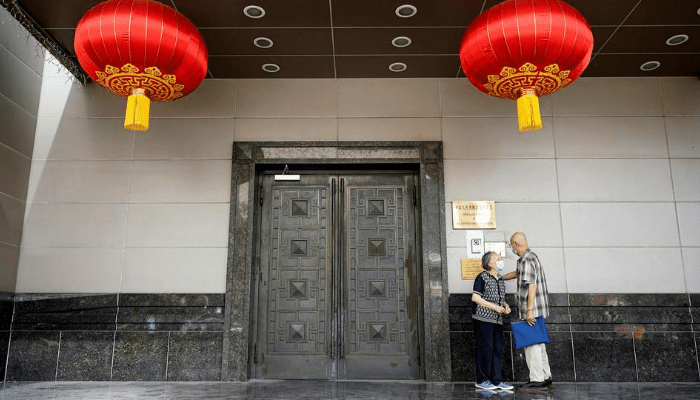
China has announced the closure of the US consulate in Chengdu just days after Washington gave Beijing 72 hours to vacate its Houston consulate.
READ ALSO: US orders China to close its Houston consulate
Tensions between the world’s two superpowers have risen to their most dangerous level in decades as the coronavirus pandemic rages through the US and Beijing cracks down on Hong Kong’s autonomy.
China said it notified the US embassy in Beijing on Friday morning that it had revoked the Chengdu consulate’s licence to operate. It said the decision was “a legitimate and necessary response to the unreasonable actions of the United States”.

The closure is “in compliance with international law and basic norms of international relations, as well as diplomatic practices”, the foreign ministry said in a statement.
It did not provide a timeline for the Chengdu closure, but Hu Xijin of the state-owned Global Times newspaper said the US was given 72 hours. Mr Hu on Wednesday said China had been given 72 hours to close Houston.
“The current situation between China and the United States is something China does not want to see, and the responsibility rests solely with the United States,” the foreign ministry said.
“We once again urge the US to immediately revoke the erroneous decision to create necessary conditions for the return of bilateral relations to normal.”
Shi Yinhong, an adviser to China’s cabinet, said: “The US government has basically declared a new Cold War.”

China’s benchmark CSI 300 index fell 3 per cent after the announcement. Futures markets tipped the FTSE 100 to open down more than 1 per cent when trading begins in London.
In currency markets China’s onshore renminbi exchange rate fell 0.2 per cent to Rmb7.0184 against the dollar. Japan’s yen, which serves as an investor haven in times of geopolitical uncertainty, climbed 0.4 per cent to ¥106.43 per dollar, its highest level in eight weeks.
“The unfortunate thing is that what the market’s probably digesting now is that this is the beginning, rather than a one-off” said Andy Maynard, a trader at China Renaissance. He added the timing of the response had intensified losses, as investors sold off to avoid taking a hit from further retaliation expected over the weekend.
Cheng Xiaohe, deputy director of Renmin University’s Center for China’s International Strategic Studies, said: “In diplomatic retaliations, you have to retaliate, this is about in the middle. If China had picked Wuhan, an empty consulate, it would have looked weak.”“But if China closed Hong Kong, Guangzhou or Shanghai, that’s too serious, so it’s about in the middle,” said Mr Cheng.
“Relations have totally deteriorated,” he added, saying what started as a trade war had expanded into a diplomatic fight and tech war.
The US Justice Department on Thursday said it had recently charged four Chinese nationals with visa fraud over allegedly lying about their status as members of the People’s Liberation Army. Three individuals were arrested and the FBI says the fourth is being harboured at the Chinese consulate in San Francisco.
Mr Cheng said it was possible China would retaliate for the arrests. “Currently it’s four but there may be more,” he added.
“If military members go to the US they often won’t say they are with the military,” he said, noting the US had tacitly allowed the situation until now. One of the researchers allegedly worked at a military hospital. China has a vast system of military hospitals which also treat the general public.
The Chengdu consulate is in China’s south-west Sichuan province and opened in 1985, providing services to the surrounding areas that include Tibet and the metropolis of Chongqing. Before the coronavirus outbreak it had about 200 staff, three-quarters of whom were locally hired Chinese employees.
After the closure, the US will have four consulates in mainland China — in Guangzhou, Shanghai, Shenyang and Wuhan — and a consulate general in Hong Kong.