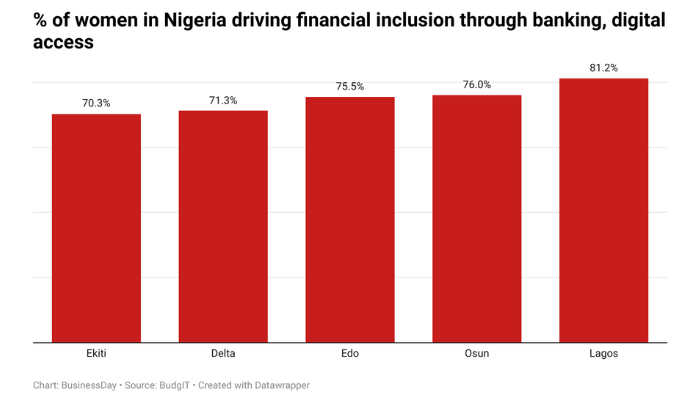
It seems the Central Bank of Nigeria (CBN) has gone back on its words about the set 80 percent financial inclusion target, claiming the 2020 goal is now possible.
This was disclosed in its Financial Inclusion Newsletter, Volume 3, Issue 2 published on Tuesday, July 31, 2018. This is contrary to the statement published in the Apex bank’s Exposure Draft of the Financial Inclusion Strategy Refresh as seen on Friday, July 06, 2018, on the CBN website.
“Despite the challenges, achieving the set financial Inclusion target is possible and requires a strong will, sustained commitment and active collaboration of all stakeholders towards the removal of bottlenecks militating against financial inclusion in the country,” Aishah Ahmad, Deputy Governor, Financial System Stability (DG, FSS) said in a statement published on CBN website.
Meanwhile, the apex bank, in its refreshed exposure draft asserts had earlier said Nigeria was not on track to meet up with the 20 percent exclusion target.

“Nigeria is not on track to meet the 2020 target set out in the National Financial Inclusion Strategy (NFIS) of 2012,” the lender had disclosed on its website a month ago.
Dolapo Ashiru, a Lagos-based financial analyst, responding to the latest development said the government need to come out with clear policy and milestone that can be verified not just making political statement.
“It is not helpful for us to have contradicting statements from our regulator. There is need for them to reconcile all the statements and come out with a situation report and also the way forward,” Dolapo told BusinessDay in a phone response.
The impediments to achieving the 80 percent set target were ascribed to economic constraints, insecurity issues in the northern part of Nigeria, obsolete strategies, among others.
Meanwhile, according to the recent Financial Inclusion Newsletter published on the last day of July 2018, the National Financial Inclusion Technical Committee held its 14th meeting on 21st June, 2018, and the meeting featured key highlights from the four working groups (Literacy, Channels, Products and Special Interventions).

In the meeting, Aishah of Financial System Stability (DG, FSS) reminded members of their critical roles in delivering the 80 percent financial inclusion target by 2020, particularly in view of EFInA‘s biennial report which showed 58.4 percent financial inclusion rate, as at 2016.
She noted that a lot of grounds were still to be covered considering the country‘s demographics which popped out adults yearly, as compiled from the publication on the CBN website.
According to the newsletter on the lender’s website, the National Financial Inclusion Strategy Refresh (NFIS 2.0) was also presented at the 14th meeting of the National Financial Inclusion Technical Committee by Akin-Fadeyi, the Head, and Financial Inclusion Secretariat.
She highlighted that the draft document had been updated following the Critique Workshop held in May 2018. The Refresh was necessitated by the 5 year implementation experience since the Strategy, as compiled from CBN’s publication.
Meanwhile, according to CBN’s 2016 financial inclusion figures, which was researched by EFInA, just 58.4 percent of Nigerian adults were financially included with only 48.6 percent using formal financial services. This showed that Nigeria lagged in her inclusion targets of 80 percent (overall financial inclusion rate) and 70 percent (formal financial inclusion rate) of Nigerian adults by 2020.
The NFIS though defined 15 targets for channels and products as well as 22 key performance indicators (KPIs) related to these targets, but Nigeria still lags across all these measures.
The economic recession in the country as well as the insecurity in northern Nigeria is said to have hampered the progress of financial inclusion in the country, as they were never anticipated in the course of drafting the NFIS in 2012.
Also, the slow uptake of digital financial services and limited rollout of national identity numbers restricted financial service providers to meet the know-your-customer (KYC) requirements, as compiled from the CBN’s statement.
Nigeria therefore performed poorly in including its citizens into the financial cycle, as seen in the latest World Bank’s Global Findex Database released 19, April 2018.
Nigerian adults who are 25 years and above with bank accounts declined by 5 basis points from 49 percent in 2014 to 44 percent in 2017.
This was not different with account holders over 15 years, as their numbers fell 4 percentage points from 44 percent in 2014 to 40 percent in 2017, as compiled from the latest World Bank’s Global Findex Database.
Meanwhile, on the way forward to including more Nigerians into the financial cycle, Dolapo, a financial analyst said he thinks CBN cannot do it alone.
“All financial service regulators would have to come together along with other stakeholders in order to straighten out all the challenges but first there is need to know where we currently stand, and let there be a quarterly or yearly review in order to know how well or how badly we are doing. All the stakeholders involved should also leverage on mobile platform because it is the fastest way to reach a mass audience as Nigeria is long overdue for mobile banking, mobile stockbroking, and mobile insurance ,” Dolapo concluded.
Endurance Okafor