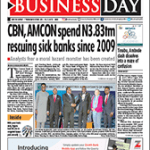
The Central Bank of Nigeria (CBN) and the Asset Management Corporation of Nigeria (AMCON) has spent as much as N3.83 trillion since 2009 rescuing sick banks, BusinessDay analysis has shown. The big bank bailout started in 2009 when the CBN pumped N620 billion into 10 sick banks to prevent them from dying.
The then CBN Governor, Sanusi Lamido Sanusi, now Emir of Kano had ordered a joint examination of 10 banks by the CBN and the Nigerian Deposit Insurance Corporation (NDIC). The 10 banks were Diamond Bank, First Bank, United Bank for Africa, Guaranty Trust bank and Sterling Bank, Afribank Plc, Intercontinental Bank Plc, Union Bank of Nigeria Plc, Oceanic International Bank Plc and Finbank Plc.
After the examinations, the CBN found five institutions in a ‘grave situation’ namely Afribank Plc, Intercontinental Bank Plc, Union Bank of Nigeria Plc, Oceanic International Bank Plc and Finbank Plc. After securing the consent of the Board of Directors of the CBN, Sanusi removed and replaced the executive management of the five banks. He then injected N420 billion in the form of tier 2 capital into the five banks to enable them continue as going concern.
Sanusi then went on to order another forensic audit on the remaining 14 banks at the time. The results showed that another four banks were found to be in a ‘grave situation’ namely: Bank PHB Plc; Equitorial Trust Bank Plc; Spring Bank Plc; and Wema Bank Plc.
Again, the CBN sacked and replaced the executive management of three banks: Bank PHB Plc, Equitorial Trust Bank Plc and Spring Bank Plc. The apex regulator then injected N200 billion as liquidity support and long-term loans in the banks which it had adjudged to be in a grave situation to enable them continue normal business, while pursuing recapitalisation options. The huge funds injected into the sick banks did not revive them.
READ ALSO: Buhari removes AMCON Chair
In August 2011, CBN revoked the licence of Afribank, Bank PHB and Spring bank and created bridge banks to take over their assets. Main Street Bank Limited assumed the assets and liabilities of Afribank Nigeria PLC; Keystone Bank Limited assumed the assets and liabilities of Bank PHB PLC; Enterprise Bank Limited has assumed the assets and liabilities of Spring Bank PLC. AMCON funded the bridge banks with N679 billion.
Also, AMCON had earlier in 2010 purchased roughly around 14,000 loans from the financial institutions for about N1.7 trillion. The loans were valued then at about N3.3 trillion according to Ahmed Kuru, AMCON Managing Director. Kuru also said that the firm had also provided financial accommodation of about N2.2 trillion. But interestingly, only about 300 customers of the 14,000 loans, which is less than five per cent of the total number of loans, accounted for more than 70 per cent of the total value outstanding of the loans that were purchased.
Despite the fact that only a small number of customers owed majority of the loans that went bad, as at 2017, AMCON had recovered only N716.1 billion from obligors of which cash and assets accounted for 45 per cent and 55 per cent respectively according to Kuru.
Most analysts had thought that the clean-up of the banking system in 2009 would be the last. But on September 21 the CBN announced that it had revoked the licence of Skye bank just as it did to three banks in 2011 and asked AMCON to capitalize a new bridge bank, Polaris bank with N786 billion.
Polaris bank will need every dime of the capital after assuming the assets and liabilities of the defunct Skye bank which Godwin Emiefele, CBN Governor said had a negative book value of almost N800 billion due to the bank’s high non-performing loans.
The new capital injection took the total amount of investment by AMCON to distressed banks to N3.16 trillion after earlier injecting N679 billion to three bridge banks, acquiring debt of financial institutions at a cost of N1.75 trillion and now injecting N786 billion into Polaris bank.
However, beyond the “remove or sack” punishment by CBN, none of the bank executives and non-executive directors of the defunct banks excluding Cecilia Ibru of Oceanic bank, have been convicted of committing any crime by the court even though their gross negligence led to failure of large cap banks and cost investors billions of Naira.
“Bailouts incite bad behaviour in the banking industry as this bailout isn’t really changing anything fundamentally as another bank can still fail tomorrow. The root of the problem is still not being tackled. We need to address the ethical issues in the bank; corporate governance right now is very bad in the country”, said Abiola Babajide, Associate Professor Department of Finance, Covenant University
“The corporate governance rule we operate in Nigeria is below standard, flawed and out-dated. The fines are too small, some sanctions are as small as N10,000. There should be tougher rules where people are jailed and their properties seized. The directors should be made to pay back to funds they squandered in the banks. Also shareholders ought to do their part by ensuring that the board of directors they elect are responsible and accountable professionals,” Babajide concluded.
“The CBN bailouts have to a large extent helped to protect depositors’ funds and also create stability in the banking industry though at the expense of the tax payers. However, in the real sense, not all of the money that the regulators have invested in these banks have been fully recouped so it is not profitable for the CBN to continues bailouts but for the sake of stability in the industry it is important they do.”
John Darlington, former Bond Bank managing director urges shareholders to sue the managing directors, executive and non-executive directors that ran down their banks. Speaking specifically about Skye Bank, he said that the past CEOs that managed Skye ‘face the law,’ for running down the bank.
‘They looted the patrimony of a whole lot of shareholders and destroyed otherwise what was meant to be a solid bank,” he said.
“The board must also face the music, the board failed in their role of protecting the interest of all stakeholders”
“I believe shareholders must now come together under an umbrella and go after the management and the board that looted and destroyed their common patrimony. Let us test it in court and see if they can get justice against those who looted the assets of the bank and destroyed their investments.”
Darlington noted that because the CBN has not decisively dealt with managing directors that ran down their banks, incidences of bank failures will continue to happen.
“The regulators have not dealt decisively with those found culpable of running down their banks. If people know they can walk away with impunity, why wouldn’t they try it,” he asked.
But Tajudeen Ibrahim, Head of Research Chapel Hill said, “I think the CBN has been doing the right thing changing the board of these banks. If the board of directors are not answerable to any case, there is no need to prosecute them”.
“The major case they could answer to will be if during the process of granting loans, processes were skipped and approval of these loans where not thorough, then the CBN could go ahead to prosecute the offenders,” Ibrahim told BusinessDay.
Bismack Rewane, CEO Financial Derivative told BusinessDay that the judicial system should be held responsible.
“The judicial system has to complement the activities of the CBN and AMCON as these regulatory bodies cannot jail people. Hence, people are freed based on technicalities”.
EMEKA UCHEAGA & DAVID IBIDAPO