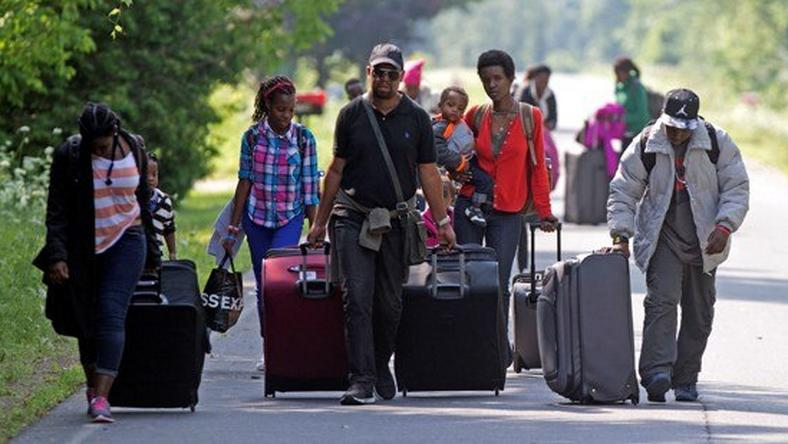
Canada removed 366 Nigerian nationals between January and October 2025 as immigration enforcement accelerated to its highest level in more than 10 years, according to official records obtained by newsmen.
Data from the Canada Border Services Agency (CBSA) removals programme further showed that 974 Nigerians are currently classified under “removal in progress,” meaning they are awaiting deportation from the country.
The figures, last updated on November 25, 2025, placed Nigeria ninth among the 10 countries with the highest number of deportees within the review period. Nigeria also ranked fifth among nationalities with the largest backlog of pending removals.
Historical trends in the data indicate that deportations of Nigerians from Canada have varied significantly over time.

In 2019, 339 Nigerians were removed from Canada. That figure declined to 302 in 2020, fell further to 242 in 2021, and dropped to 199 in 2022.
Nigeria did not appear among the top 10 deported nationalities in 2023 and 2024 but re-emerged in 2025, recording 366 deportations within just 10 months.
This represented an 8% rise compared with the 2019 total.
The increase coincides with a broader immigration clampdown in Canada, where the CBSA is now deporting close to 400 foreign nationals every week — the highest weekly rate recorded in over a decade.
During the 2024–2025 fiscal year, Canadian authorities deported 18,048 individuals at an estimated cost of $78m.

Under Canada’s Immigration and Refugee Protection Act, the CBSA is mandated to enforce removal orders against any foreign national deemed legally removable.
Individuals may be ruled inadmissible for a range of reasons, including national security concerns, violations of human or international rights, criminal offences, organised crime involvement, health-related grounds, financial inadmissibility, misrepresentation, or breaches of immigration conditions.
CBSA statistics show that failed refugee claimants make up the bulk of deportations, accounting for about 83 per cent of removals. Cases linked to criminality represent roughly four per cent.
Canadian immigration law recognises three forms of removal orders: departure orders, which require individuals to leave within 30 days; exclusion orders, which prohibit re-entry for one to five years; and deportation orders, which impose a permanent ban unless special permission is granted.
The Canadian government says stepped-up removals are part of efforts to tighten immigration controls and respond to mounting pressures related to housing shortages, labour market strain, and border security.
To support this strategy, Ottawa has earmarked an additional $30.5m over three years for removal operations, alongside a $1.3bn investment aimed at strengthening border security infrastructure.
President of the Canadian Association of Refugee Lawyers, Aisling Bondy, has cautioned that deportations could intensify further if Bill C-12 — widely referred to as the “border bill” — is enacted.
“One of the clauses in that bill is that a lot of people will be permanently banned from filing a refugee claim in Canada,” Bondy said.
An analysis of the CBSA figures showed that Nigeria is the only African country listed among the top 10 nationalities deported from Canada in 2025. Other African countries were grouped under the category of “remaining nationals,” which accounted for 6,233 removals during the year.
The leading countries for deportations in 2025 are Mexico (3,972), India (2,831), Haiti (2,012), Colombia (737), Romania (672), the United States (656), Venezuela (562), China (385), Nigeria (366), and Pakistan (359).
Nigeria is also the sole African country featured in the top 10 “removal in progress” list, with 974 pending cases. India leads that category with 6,515, followed by Mexico (4,650), the United States (1,704), China (1,430), Nigeria (974), Colombia (895), Pakistan (863), Haiti (741), Brazil (650), and Chile (621).
Despite the rising deportation figures, Canada remains a key destination for Nigerians pursuing education and economic opportunities. The 2021 Canadian census recorded more than 40,000 Nigerian arrivals between 2016 and 2021, making Nigerians the fifth-largest group of recent immigrants and the largest African migrant population in the country.
Further data from Immigration, Refugees and Citizenship Canada revealed that 6,600 Nigerians obtained permanent resident status in the first four months of 2024 alone, ranking them fourth behind India, the Philippines, and China.
Between 2005 and 2024, a total of 71,459 Nigerians acquired Canadian citizenship, placing Nigeria 10th among source countries for new citizens.
Canada’s ageing workforce and persistent labour shortages continue to draw skilled professionals and students from Nigeria, even as immigration controls tighten.