Cadbury Nigeria Plc and Okomu Oil have emerged as the top performers among Nigerian manufacturers in the first half of the year, delivering robust returns on equity (ROE) that signal strong value creation for their shareholders.
A BusinessDay analysis of twelve listed manufacturers’ financial data shows that strong earnings growth, cost discipline, and market positioning are helping these firms not only protect shareholder value but expand it, even as inflationary pressures and currency volatility continue to weigh on the broader sector.
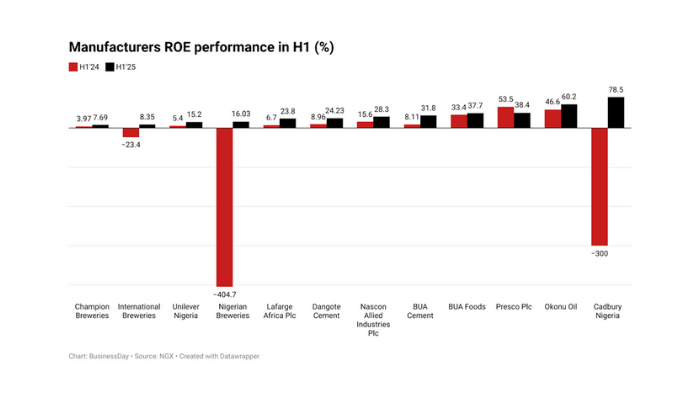
ROE, a key metric that measures how efficiently companies generate profit from shareholders’ funds, has surged for Cadbury and Okomu Oil, with figures representing 78.5 percent and 60.2 percent, respectively, well above the industry average of 25.5 percent in the first half of the year.
Presco Plc (38.4 percent) came in third place, followed by BUA Foods (37.7 percent), BUA Cement (31.8 percent), Nascon Allied Industries Plc (28.3 percent), Dangote Cement (24.2 percent), Lafarge Africa Plc (23.8 percent), and Nigerian Breweries (16.03 percent).

Others include Unilever Nigeria, International Breweries, and Champion Breweries, reporting 15.2 percent, 8.35 percent, and 7.69 percent, respectively.
The uptick in ROE signals that these companies are converting every naira of equity into higher earnings, a trend that typically resonates positively with investors seeking long-term value.
Read also: Rising investor confidence fuels new manufacturing investments
Surge in earnings translates to higher return on equity

Both Cadbury Nigeria Plc and Okomu Oil posted high earnings growth and equity expansion, strongly suggesting ROE improvement.

Cadbury’s performance reflects a combination of aggressive revenue growth, improved cost controls, and a favourable product mix. The company reported a turnaround in it’s after-tax profit of N11 billion in H1, from a loss of N9 billion in the same period of last year. while total equity grew to N14 billion.
Okomu Oil gains, on the other hand, have been driven by strong palm oil prices, export competitiveness, and efficient asset utilisation. In the first half of the year, the company’s earnings more than doubled to N47.5 billion. While its equity rose to N78 billion from N45 billion during the reviewed period.
Among the analysed companies, Dangote Cement and BUA Cement reported the highest profit among the surveyed manufacturers, amounting to N521 billion and N181 billion, respectively.
However, in terms of equity, Dangote Cement and BUA Foods buck the trend with N2.1 trillion and N689 billion, respectively.
Macroeconomic tailwinds boost manufacturing
Beyond the leaders, the wider manufacturing sector is showing signs of resilience despite lingering headwinds. Companies in consumer goods, agro-processing, and industrial products are leveraging operational efficiency, moderate price pass-throughs, and supply chain improvements to sustain margins.
Nigeria’s manufacturing sector’s contribution to the Gross Domestic Product (GDP) grew marginally by two percent in the first quarter of 2025, driven by the country’s stable foreign exchange.
Data from the National Bureau of Statistics (NBS) showed that the manufacturing sector contributed 9.62 percent to the GDP in Q1 2025, which was higher than the 7.62 percent recorded in the fourth quarter of 2024.
“While challenges remain, especially with access to dollars, the reduction in valuation losses on our dollar-denominated liabilities is significant.”
“The worst of the FX-driven losses for corporates might be behind us if current trends persist,” said Muda Yusuf, CEO of the Centre for the Promotion of Private Enterprise (CPPE). “The return of some measure of predictability in the FX market is a positive development for balance sheet planning and foreign investor sentiment.”
Read also: FX stability lifts manufacturing’s GDP contribution in first quarter
Also, the manufacturing index rose from 114.4 in May to 123.6 in June, driven by textiles, cement, rubber, and other segments, according to the Business Confidence Monitor (BCM) report, released in July 2025 by the Nigerian Economic Summit Group (NESG) and Stanbic IBTC.
Positive signals for share price performance
The ROEs of 15–20 percent are broadly considered strong, so Cadbury’s 78.5 percent+ is impressive.
High ROE often correlates with expanding share prices, especially when paired with earnings surprises and margin improvements.
In the first half of 2025, the NGX Consumer Goods Index rose by an impressive 52.2 percent, fueled by strong gains in key stocks such as Honeywell Flour Mills, Vitafoam, Champion Breweries, and International Breweries. Each of these stocks delivered triple-digit returns, with Honeywell Flour Mills leading the pack with a 241 percent surge.
Similarly, the agriculture sector was the best-performing sector in the NGX in H1 2025.
BusinessDay reported that the week ended Friday, August 15th; the stock market’s return year-to-date (YTD) decreased to +40.52 percent. This month, the market has risen by 3.41 percent.
The NGX Banking Index decreased by 0.23 percent; the NGX Industrial Index (-0.83 percent), the NGX Consumer Goods Index (-0.94 percent), the NGX Insurance Index (+8.21 percent), and the NGX Oil & Gas Index (-1.42 percent).
Stocks like Cadbury, Okomu, Presco, BUA Food, and BUA Cement ended the week with N59.8, N1,020, N1,480, N588, and N168.6, respectively.
However, analysts caution that sustained performance will depend on how well these companies navigate foreign exchange constraints and raw material price swings.
What It Means for Investors
For investors, elevated ROEs like those posted by Cadbury and its peers signal efficient capital use, profitability, and management strength. When backed by robust top-line growth, sensible leverage, and margin control, these figures enhance expectations of sustained return.