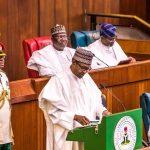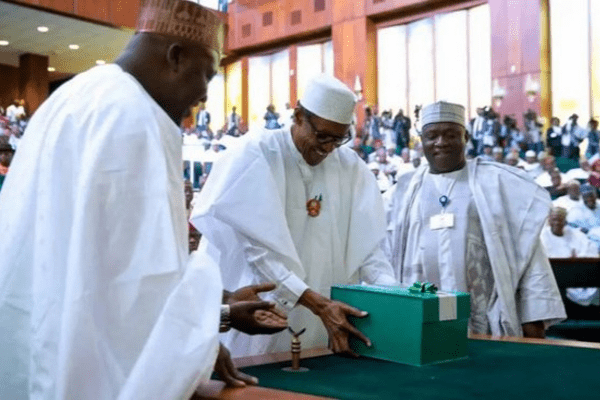
President Muhammadu Buhari unusually started his budget speech this year with an apology. Presenting his 2020 budget on 8 October, he told members of the National Assembly: “I will start by asking you to pardon my voice”, adding: “As you can hear, I have a cold as a result of working hard to meet your deadline!” But the president gave the wrong kind of apology. Instead of apologising for his voice, he should have started by apologising for the failure of the preceding 2019 budget and then for presenting a 2020 budget that, by all independent assessments, seems headed in the same boringly predictable direction of unachieved targets, poor implementation and, thus, budget failure.
Truth is, since the first in 2016, each of President Buhari’s budgets has never done what it says. Although each budget always carried a catchy phrase or strapline, it’s all empty words. The 2016 Budget was named “Budget of Change”, but what change did it bring? Zilch! The 2017 Budget was titled “Budget of Recovery and Growth”, but with the economy growing at 0.82% in 2017, that budget could hardly be said to have lived up to its name. What about the 2018 Budget? Well, it was called “Budget of Consolidation”, but it led to no fiscal consolidation but instead increased debts. The 2019 Budget went by the name “Budget of Continuity”. Well, to the extent that it signalled the continuity of Buhari’s administration’s anti-growth policies, that was rhetorically true. But in terms of its substantive promises, the budget was a failure. Now, we have the 2020 Budget, dubbed “Budget of Sustaining Growth and Job Creation”!
The truth is that President Buhari’s budgets routinely overpromise and underdeliver. For instance, when presenting his 2016 Budget, which he described as “a historic milestone for us as a nation”, Buhari said, “I know many people will say “I have heard this before” but added: “Our actions will speak for us”. Yet, it was a failed promise! The then Senate President, Bukola Saraki, said at the time that “the Senate is tired of having budget documents that, at the end of the day, when it comes to implementation, don’t mean anything”. That, sadly, was what happened with the 2017, 2018 and 2019 budgets!
Take the 2019 Budget. Even President Buhari himself couldn’t deny that it was a failure. In his 2020 Budget speech, he acknowledged that, as at June this year, the revenue performance was only 58 percent of the target set for the 2019 budget, with oil revenues falling below target by 49 percent, while non-oil revenues, such as receipts from VAT, also dropped below expectations. It’s no wonder that, with such precipitous decline in revenues, the presidency recently queried the chairman of the Federal Inland Revenue Service, Tunde Fowler, ordering him to explain the “significant variances between the budgeted tax collection and the actual collection”.

Indeed, the government now seems determined to pursue aggressive tax collection, with Buhari warning in his Independence Day speech that, “severe consequences will attend failure to achieve agreed revenue targets”. But tax collections are easier when business activities are buoyant, and the economy is growing robustly. Yet, the 2020 Budget in unlikely to incentivise such dynamism and growth.
The 2020 Budget is even worse. First, it is based on an estimated federal government revenue of N8.155 trillion, which is 7 percent higher than the 2019 estimate of N7.594 trillion. If the government failed to meet the 2019 Budget’s revenue target by over 40 percent, how does it expect to meet the much higher 2020 revenue target?
This is partly because the problem with the 2019 Budget, where recurrent expenditure was prioritised over capital expenditure, will continue. For instance, as the 2019 Budget was hit by significant revenue shortfalls, it was capital expenditure that bore the brunt while, as the president said, recurrent expenditure items “have been implemented substantially”. In other words, staff salaries and overhead costs gobbled up much of the little money available, while capital projects, which potentially benefit the economy more, suffered from “delay in capital releases”. Of course, such delay is perennial. As one minister once said, “The time it takes for budgetary allocations to translate into physical projects is too long.” Hardly any economy can perform well in those circumstances.
But the 2020 Budget is even worse. First, it is based on an estimated federal government revenue of N8.155 trillion, which is 7 percent higher than the 2019 estimate of N7.594 trillion. If the government failed to meet the 2019 Budget’s revenue target by over 40 percent, how does it expect to meet the much higher 2020 revenue target? Interestingly, the government expects N3.7 trillion (up to 46 percent) to come from other revenues and another N1.81trillion from non-oil tax revenues, which leaves N2.64 trillion (about 32 percent) coming from oil revenues. But how would the government generate the non-oil and other revenues?
Surely, that depends, as I said earlier, on buoyant economic activities and increased economic growth. Well, the president estimates that the economy would grow by 2.93 percent in 2020 from the current 2 percent, and that the growth would be driven largely by non-oil output, “as economic diversification accelerates, and the enabling business environment improves”. Now, a key rule of budgeting is to avoid “optimism bias”, but this is pie-in-the-sky economics, not least because the budget is based on unrealistic estimates, not helped by the lack of incentives to make them realistic.
Of course, in an ideal world, moving from a growth rate of 2 percent to 2.93 percent within a year is not extraordinary, but the Nigerian economy is so sluggish that it needs a shot in the arm to achieve that. But here is a budget of N10.33 trillion, of which only N2.14 trillion (about 20 percent) goes to capital expenditure, while the rest are spent on recurrent expenditure (N4.88 trillion) and debt servicing (N2.45 trillion). The 2020 Budget has a deficit of N2.18 trillion, which would be financed through more borrowings. So, again, spending on staff salaries, overhead costs and serving Nigeria’s burgeoning debt, now estimated to be about N25.7 trillion, according to the Debt Management Office, DMO, have stifled this country’s ability to invest in basic infrastructure and human capital development, both critical to economic growth.

It says a lot about Nigeria’s priorities – doesn’t it? – when only N48bn in a budget of N10.33 trillion is allocated to education and N46 billion to health, and that’s despite the government planning to increase the VAT rate from 5 percent to 7.5 percent and saying that the extra revenues would be spent on education and heath! As for investment in basic infrastructure, it is, at N2.46 trillion, 23 percent lower than the 2019 budget provision. The government says it would use tax credits to induce private sector investment in infrastructure projects, such as roads. But apart from tax credits not being a transparent and efficient way of boosting private investment in infrastructure, the truth is that Nigeria lacks the hospitable environment for attracting significant private capital and investment.
Last week, I expressed scepticism about President Buhari’s call on members of his newly constituted Economic Advisory Council to come up with “homegrown solutions” to Nigeria’s economic problems. Of course, the term “homegrown” usually means that the proposed solutions were developed without outside pressure but doesn’t mean they should ignore universal economic principles. For instance, at the heart of Ethiopia’s “Homegrown Economic Reform Agenda are business focus, market reforms, privatisation and liberalisation. It’s not surprising that investment accounts for about 38 percent of Ethiopia’s GDP, which is growing at over 7 percent. I have always argued, and strongly believe, that Nigeria needs a robust market economy system to achieve any meaningful growth and progress.
But the 2020 Budget, despite being called “Budget of Sustaining Growth and Job Creation”, lacks both the institutional and policy underpinnings of a successful market economy. What’s more, like its predecessors, the budget is also likely to suffer from unrealistic projections and poor delivery. All of which, the roots of budget failures, underscore the Buhari government’s acute lack of technical competence!