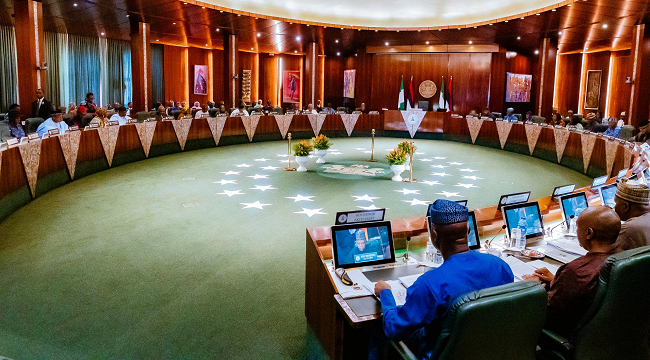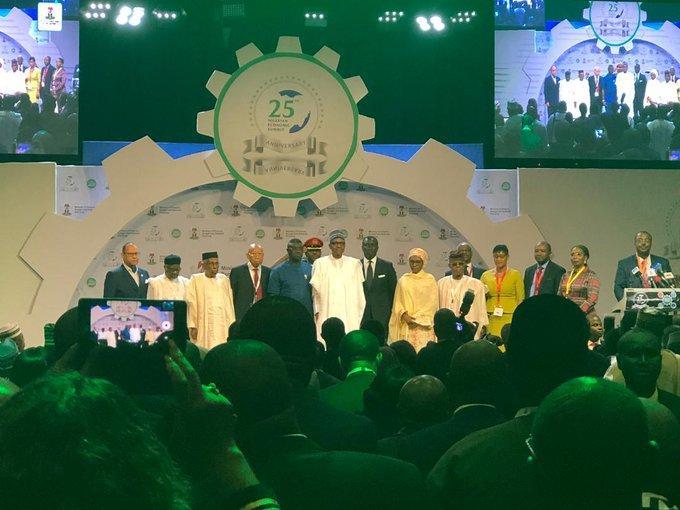
President Muhammadu Buhari on Monday, said Nigeria’s challenge can only be addressed using home- grown solutions
The President, while declaring open the 25th Nigerian Economic Summit (NES25) in Abuja, charged both public and private sector leaders to look inward to solve the unique challenges confronting the nation’s socio-economic development.
In an apparent response to criticism of poor engagement with the private sector, the President pledged that his administration would henceforth collaborate with the private sector in designing and implementing developmental projects that will keep Nigeria on track for sustained, inclusive and prosperity driven growth.
The 2019 Summit of the Nigeria Economic Summit Group has identified key job-creating sectors such as agriculture, manufacturing, ICT, creative industry and extractive industry as its main focus, while deliberations will look at “unlocking capital through our financial services sector to actualize the opportunities in these sectors”.

On the focus of this year’s economic summit which is discussing what Nigeria would be in the year 2050 when many studies estimate the country’s population would rise to over 400 million people, the President said: ‘‘As a government, our view is to equip our citizens with the means to seize any opportunities that may arise.
‘‘This means we continue investments in education, health care, infrastructure, security and strengthen and entrench the rule of law.’’
While wishing the 25th NES fruitful, robust and productive deliberations, the President praised the organisers and stakeholders of the Summit for sustaining the platform established since 1993 to deliberate on key issues on national development.
President Buhari charged the Summit to come up with “productive, inventive and innovative proposals in keeping in mind that Nigeria’s unique challenges can only be solved by made in Nigeria solutions.”
The President harped on the 2019 general elections, adding that “the successful conclusion of the elections and the resort by aggrieved candidates to seek redress in the courts rather than the street was proof that Nigeria‘s ‘‘democracy is maturing’’.

‘‘The elections have come and gone. Our country, once again, has shown the world that we can choose our leaders in a peaceful and orderly manner.
‘‘Apart from a few pockets of unrest, majority of voters exercised their civic rights without hindrance.
‘‘Furthermore, we also saw an increase in the number of aggrieved candidates, and supporters, who took their concerns and grievances to the courts as opposed to the streets. This is how it should be.
‘‘Ladies and Gentlemen, what this clearly shows is that our democracy is maturing,” he said.
Reflecting on the manifesto of the ruling All Progressives Congress (APC) party, the President noted that his administration’s economic policies in the last four years focused on the need to uplift the poor and the disadvantaged and encourage inclusivity.
‘‘During the elections, almost all candidates proposed their vision for the economy and for the country.
‘‘Our party, the APC, put before the country policies that focus on delivering prosperity to all Nigerians through enhancing security; eliminating corrupt practices in public service; supporting sectors that will create jobs; and promoting socially focused interventions to support the poorest and most vulnerable among us.
‘‘These areas are all interconnected and are equally important in creating a prosperous society for all,’’ he said.
Underscoring the importance of collective prosperity, President Buhari asserted that a prosperous society is one where the majority of its citizens have an acceptable standard of living.
‘‘Today, many mistake prosperity with wealth. They are not necessarily the same.
‘‘Experts and analysts explain economic trends by making references to indicators of wealth.
‘‘Wealth, however, in its simplistic form, is money or other assets. In recent years, global events have shown that when a society and its leaders are driven and motivated by these alone, the ultimate outcome is a divided state of severe inequalities.
‘‘But a prosperous society is one where majority of its citizens have an acceptable standard of living and a decent quality of life,’’ he said.
The President used the occasion to affirm that in addressing population growth, security and corruption matters in developing economies, policies and programmes must focus on promoting inclusivity and collective prosperity.
‘‘Nigeria is a country with close to 200 million people living in 36 states and the FCT.
‘‘A significant proportion of Nigeria’s prosperity today is concentrated in the hands of a few people living primarily in 4 or 5 States and the FCT. Some of the most prosperous Nigerians are here in this room.
‘‘This leaves the remaining 31 States with close to 150 million people in a state of expectancy and hope for better opportunity to thrive. This, in the most basic form, drives the migratory and security trends we are seeing today both in Nigeria and across the region.
‘‘In the recent weeks, I have been to Niger Republic to attend the ECOWAS summit; Japan with fellow African leaders to attend the Tokyo International Conference on African Development; the United Nations General Assembly in New York and South Africa on a State visit to exchange ideas on the common themes we share as the two largest economies in Africa.
‘‘What was very clear at these meetings, and numerous others I have been privileged to attend over the years, is the increased consensus by leaders that to address population growth, security and corruption matters in developing economies, our policies and programmes must focus on promoting inclusivity and collective prosperity.
‘‘This shift implies that the concept of having competitive free markets that focus on wealth creation alone will be replaced by those that propagate the creation of inclusive markets which provide citizens with opportunities that will lead to peaceful and prosperous lives,’’ he said.