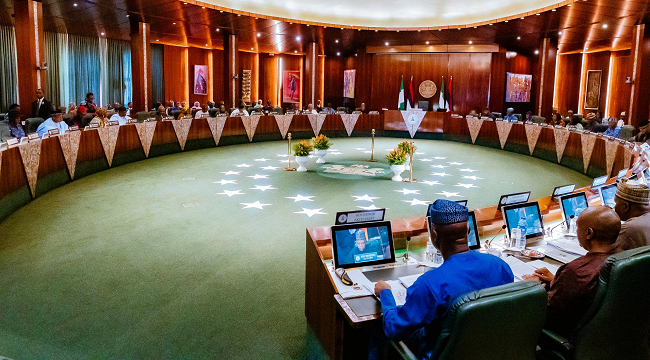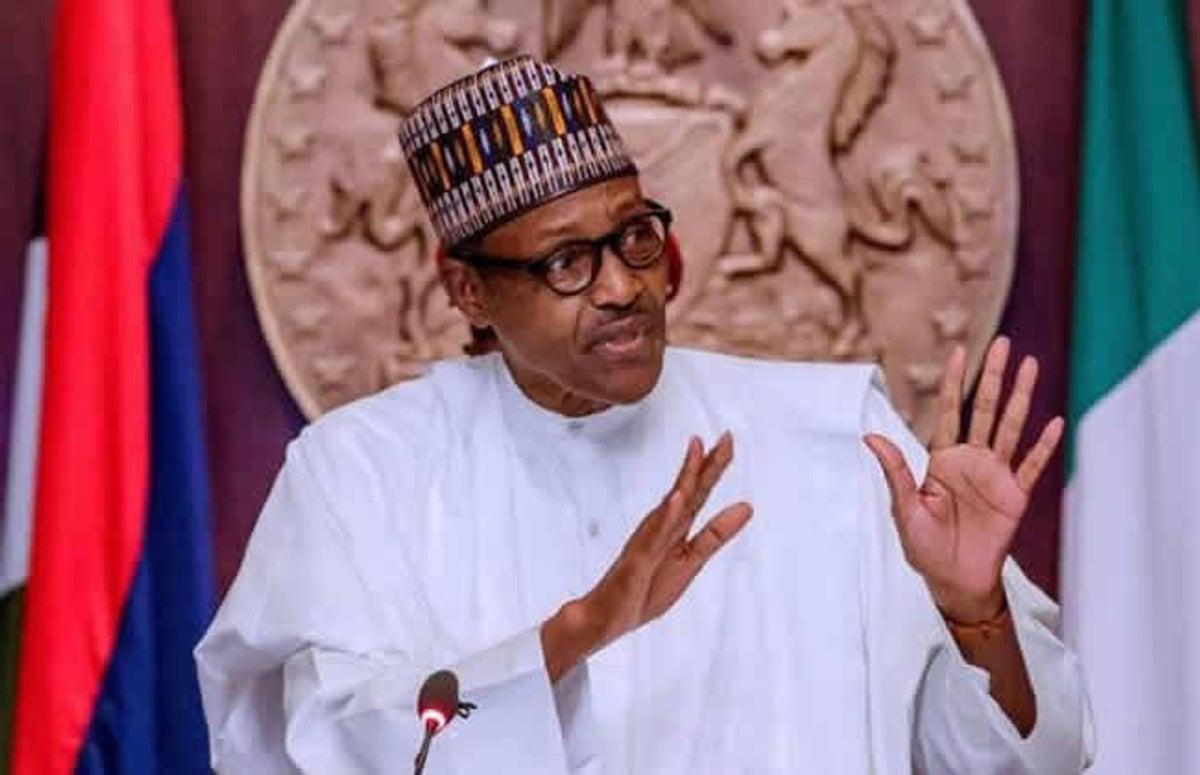
President Muhammadu Buhari may have complicated matters by publicly admonishing his ministers to report to his Chief of Staff.
On May 29, the president swore an oath to uphold the constitution of the Federal Republic of Nigeria and serve the country to the best of his ability faithfully.
One obligation this places on the president and at least the minimum requirement for a man occupying the office of president is to appoint a cabinet made of the best the country has, give them unfettered access and provide the leadership needed to inspire them to achieve to their objective.
On these counts, this president, in his second term is failing. To start with, it took him nearly three months after his inauguration to select a cabinet in a country with an economy recording slow growth of less than 2 percent, severally indebted and badly in of bold reforms.

The cabinet of Buhari is uninspiring, except in a few instances. It could easily pass off as a collection of tired politicians whose relevance is their supposed loyalty to the ruling party or the president.
In a country with over 60 percent of the population in their 20s, the president appointed ministers with an average age of 60. The Minister of Youths and Sports is 53 years old.
The president’s uninspiring performance as Minister of Petroleum Resources is set to continue for the next four years characterised with failures to pass a petroleum industry bill, attracting fresh investments into the sector or conducting a bid round as many oil-producing countries are doing.
Worse still, candidates who appeared in Senate screening brimming with ideas were posted to ministries unsuited to their capabilities. Festus Keyamo, a lawyer and advocate is a junior minister of the Niger Delta and Adamu Adamu whose tenure as Minister of Education in the first term was disastrous is returned to head the ministry.
As president, a key part of the leadership Buhari is expected to offer the ministers is unhindered access to him. It ensures the high-level consultation required to move the country forward is done seamlessly. Assuming some may forgotten, the cabinet is known and called the Federal Executive Council for good reason.

Barring ministers from direct contact with him portrays an Abdicator- rather than a Commander-in-Chief, it makes ridicules the millions of Nigerians who voted to re-elect the president, and the other millions who are no less citizens. This directive portrays the president as aloof. How does the president expect his ministers to “collaborate” and “succeed in their given assignments” without a direct channel of communication?
The directive of the president gives ample room for his chief of staff (an unelected post) to exercise his discretion as he pleases and leaves ample room for an Aso Rock of confusion – the recent query issued to the Babatunde Fowler, head of the Federal Inland Revenue Service, came from the office of the chief of staff. No doubt, the suspicion that certain interests are controlling the presidency will fester further.
In the wake of President’s Buhari’s cabinet appointment, many people are already looking towards the next election cycle because the situation is well and truly hopeless.
For the president to direct that ministers should report to his Chief of Staff is to abdicate the office he swore to uphold and to disdain his cabinet. This is totally unacceptable.