Nigeria’s democracy, while evolving in many areas, continues to grapple with the challenge of gender imbalance in political representation. Despite constitutional provisions and policy frameworks aimed at promoting equality, the number of women in elective and appointive positions across the country remains significantly low. In a country where women account for nearly half of the population and an even larger share of voter turnout, their limited representation in governance structures is not only inequitable, it also weakens the inclusiveness and effectiveness of democracy.
At both national and subnational levels, women hold a disproportionately small share of political offices. The 2023 general elections, for instance, saw a decline in the number of women elected into the National Assembly compared to previous cycles. Out of 469 seats, only 17 were occupied by women, less than 4% representation. This trend is even more pronounced in some northern states, where socio-cultural norms, economic constraints, and systemic exclusion further limit women’s political participation.
Efforts to reverse this trend have been led by a combination of civil society organizations, gender advocacy groups, and women in politics. Among them is Hon. Halima Zubairu Danbatta, a politician and community organizer from Kano State. A former candidate for the Kano State House of Assembly under the People’s Democratic Party (PDP), she has emerged as a voice for gender inclusion, particularly in northern Nigeria, where barriers to women’s leadership are often more deeply entrenched.
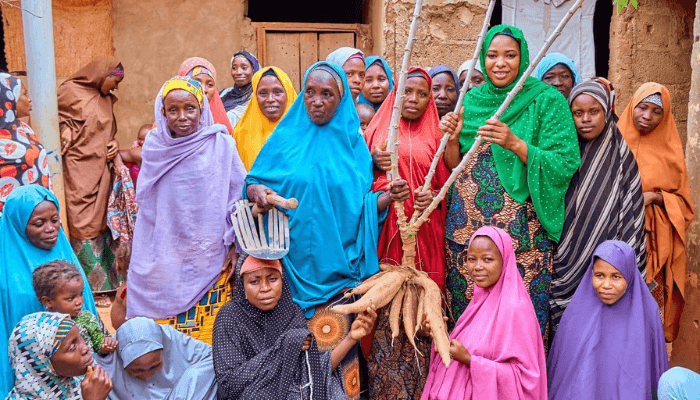
Hon. Danbatta’s advocacy is shaped by her multifaceted background. She established a vocational skills centre that trains women in jewellery-making as part of a women’s empowerment initiative. In addition to her political aspirations, she serves as the Chairperson of the Nigeria Cassava Growers Association (NCGA), Kano Chapter, where she champions the economic empowerment of rural women through agriculture. She argues that economic and political marginalization are interlinked: when women lack financial independence, they are often excluded from decision-making spaces. By supporting women farmers and promoting access to agricultural resources, she believes they can gain the confidence, stability, and recognition needed to pursue leadership roles.

In 2024, she organised a high-impact community engagement in the Dambatta/Makoda Federal Constituency of Kano North, where issues of women’s representation were discussed alongside broader themes of education, voter awareness, and local development. While the event did not promise immediate structural change, it contributed to a growing awareness within the community about the importance of inclusive governance and the practical steps required to achieve it.
However, it is important to note that personal commitment alone cannot overcome systemic challenges. Nigeria’s political structure remains deeply patriarchal, with political parties playing a central role in either enabling or obstructing women’s participation. Many female aspirants face financial exclusion, internal party bias, limited media coverage, and even threats to their personal safety. These factors discourage capable women from contesting or continuing in political careers, especially in rural and conflict-prone areas.
To bridge the gender gap meaningfully, a coordinated reform agenda is required. This includes implementing legal frameworks such as the National Gender Policy, which proposes a minimum of 35% representation for women in governance. Unlike countries such as Rwanda or Ethiopia, which have legally mandated quotas that significantly improved women’s participation, Nigeria’s gender parity provisions remain largely aspirational.
There is also a pressing need to reform political parties from within. Most Nigerian parties do not have enforceable gender inclusion policies. Although some waive nomination fees for female aspirants, this is often not accompanied by technical support, mentorship, or a level playing field during primaries. Enforcing internal party reforms and encouraging more transparent and inclusive candidate selection processes would go a long way in addressing gender disparity.
Beyond institutional changes, societal attitudes must evolve. Gender roles in Nigeria are heavily influenced by cultural, religious, and familial expectations that often position politics as a male domain. Many female politicians report facing stigmatization, moral scrutiny, and lack of support from their immediate communities. Therefore, public education campaigns that engage traditional leaders, religious scholars, and youth are essential in shifting perceptions and promoting female political participation as both acceptable and necessary for national progress.

Finally, addressing the issue of campaign financing is critical. Nigerian politics is notoriously expensive, and the cost of running for office is prohibitive for many women. Establishing independent funding mechanisms or state-supported grants for female aspirants could help reduce the financial burden and encourage more women to enter politics.
Hon. Halima Zubairu Danbatta’s work underscores the importance of grassroots engagement and the interconnectedness of economic empowerment and political representation. Her efforts, while admirable, also highlight the limitations of individual advocacy in the absence of institutional support. If Nigeria is to close its gender gap in governance, the country must move beyond rhetoric to enforceable policy actions, backed by political will and broad-based public support.
In the long term, gender parity in politics is not only about fairness, it is about strengthening democracy itself. Women bring diverse perspectives, priorities, and problem-solving approaches to governance. Ensuring their full participation is essential for sustainable development, peacebuilding, and national progress. Nigeria stands at a crossroads, and the choices it makes today will determine the inclusiveness and resilience of its democracy tomorrow.