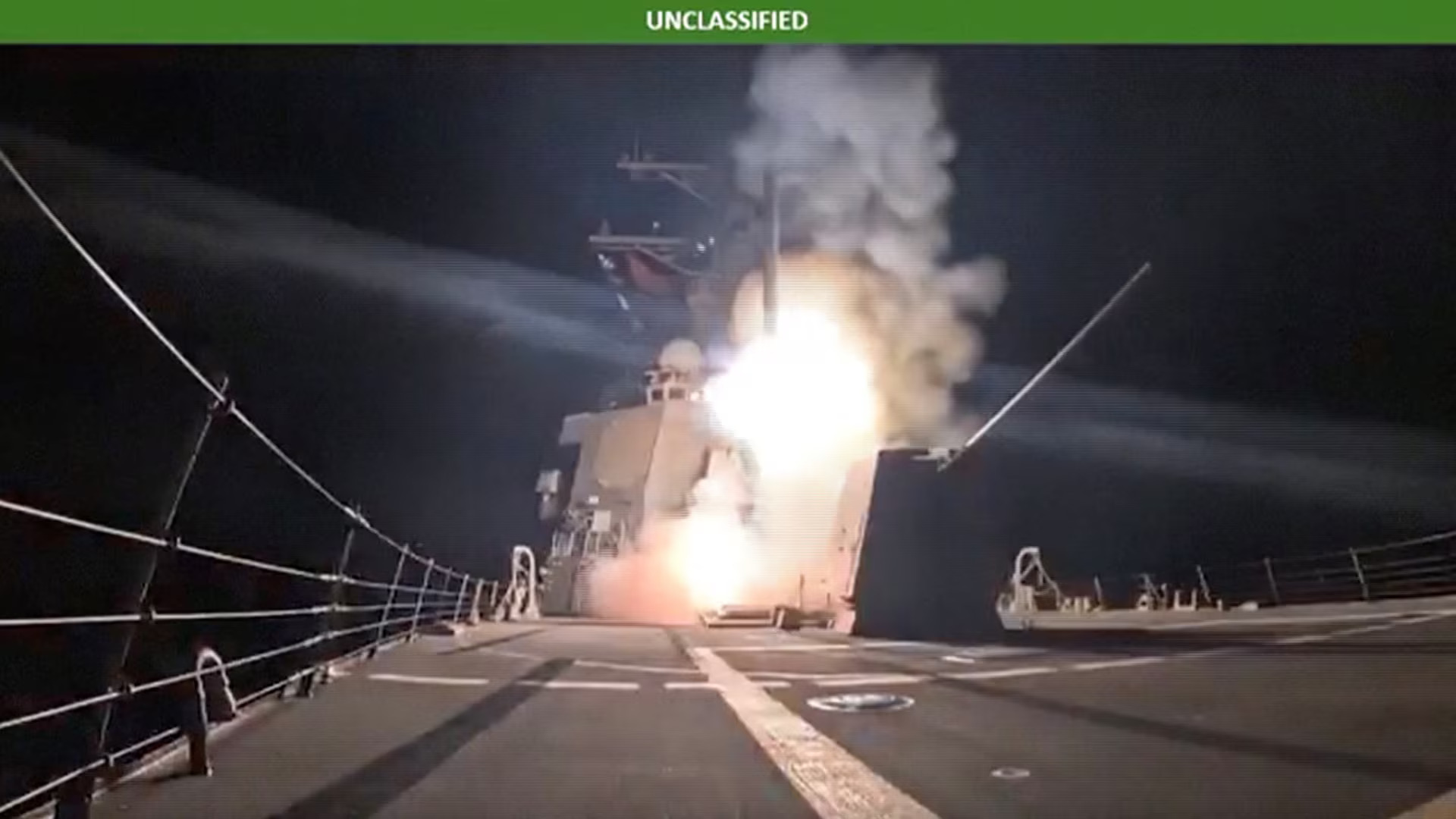
Donald Trump, the United States president has announced that the US military has carried out airstrikes against Islamic State (ISIS) militants in northwest Nigeria, describing the operation as “powerful and deadly” and saying it was aimed at halting what he claimed were sustained attacks on civilians, particularly Christians.
In a statement posted on his social media platform, Truth Social, Trump said the strikes were ordered by him in his capacity as commander-in-chief and targeted ISIS elements operating in the region.
“Tonight, at my direction as Commander in Chief, the United States launched a powerful and deadly strike against ISIS terrorist scum in Northwest Nigeria, who have been targeting and viciously killing, primarily, innocent Christians, at levels not seen for many years, and even centuries,” the president wrote.
He added that he had previously warned the group to halt what he described as the “slaughtering of Christians,” insisting that the operation was a direct response to those warnings.

Read also: Like Trump, Israel’s Netanyahu calls for end to attacks against Christians in Nigeria
According to Trump, the US Department of Defense carried out “numerous perfect strikes,” underscoring what he called America’s unrivalled military capability.
“Under my leadership, our country will not allow radical Islamic terrorism to prosper,” he said.
AFRICOM, Hegseth confirm strikes in Sokoto
Confirming the operation, the US Africa Command (AFRICOM) said the airstrikes were conducted in Sokoto State and were carried out “in coordination with Nigerian authorities.”
A US official, speaking to the Reuters news agency, said the strikes killed multiple ISIS targets, though no specific casualty figures were provided.

Pete Hegseth, US secretary of defense also weighed in on the operation, saying the president had been unequivocal about ending violence against Christians in Nigeria and elsewhere.
Writing on X, Hegseth said: “The President was clear last month: the killing of innocent Christians in Nigeria (and elsewhere) must end. The Department of War is always ready, so ISIS found out tonight on Christmas.”
He added that the US was grateful to the Nigerian government for its “support and cooperation” in the operation.
Nigeria’s foreign ministry confirms precision hits on terrorist targets
In a press release early Friday morning, the Ministry of Foreign Affairs of Nigeria confirmed that Nigerian authorities remain engaged in structured security cooperation with international partners, including the United States of America, in addressing the persistent threat of terrorism and violent extremism.
“This has led to precision hits on terrorist targets in Nigeria by air strikes in the North West,” Kimiebi Imomotimi Ebienfa, the spokesperson for the Foreign Affairs Ministry in Abuja said in a statement.
Ebienfa said the engagement leading to the strikes were in line with established international practice and bilateral understandings, consistent with international law, mutual respect for sovereignty, and shared commitments to regional and global security.
“Nigeria reiterates that all counter-terrorism efforts are guided by the primacy of protecting civilian lives, safeguarding national unity, and upholding the rights and dignity of all citizens, irrespective of faith or ethnicity,” the spokesperson noted. “Terrorist violence in any form whether directed at Christians, Muslims, or other communities remains an affront to Nigeria’s values and to international peace and security.”
Trump’s earlier comment and US surveillance in Nigeria
The strikes follow Trump’s comments last month, when he said he had instructed the Pentagon to begin planning for possible military action in Nigeria over claims of religious persecution.
Around the same period, his administration designated Nigeria a “country of particular concern” under the US International Religious Freedom Act, citing alleged violations of religious freedom.
As part of the measures announced, the US government said it would impose visa restrictions on Nigerians and their family members accused of involvement in mass killings or violence against Christians in the West African country.
However, the Nigerian government has previously rejected Trump’s characterisation of the security situation, saying claims of targeted persecution of Christians misrepresent the complex nature of the country’s security challenges.
Nigerian officials have repeatedly argued that violence across parts of the country is driven by a mix of terrorism, banditry, communal conflicts and criminality, rather than a singular religious agenda.
BusinessDay had earlier reported, citing an exclusive Reuters investigation, that the United States has been conducting intelligence-gathering flights over large parts of Nigeria since late November, signalling heightened security cooperation between Washington and Abuja.
Read also: NAF admits civilian casualties in Sokoto airstrike, compensates victims
According to flight-tracking data and U.S. officials cited by Reuters, the surveillance missions are being carried out by contractor-operated aircraft that typically take off from Ghana, fly over Nigeria, and return to Accra.
While the precise purpose of the missions could not be independently confirmed, they followed threats made by Trump in November to intervene militarily in Nigeria over what he described as the government’s failure to halt violence against Christian communities.
The aircraft involved was identified as being operated by Tenax Aerospace, a Mississippi-based company that provides special-mission aircraft and works closely with the U.S. military.
Read also: US allegedly preparing UAV strikes in Nigeria as covert ISR flights reported
Liam Karr, Africa team lead at the Critical Threats Project of the American Enterprise Institute, told Reuters that the operation seemed to be running out of Accra, which he described as “a known hub for the U.S. military’s logistics network in Africa.”
He noted a recent resumption of intelligence and surveillance flights over Nigeria.
In a statement, the Pentagon said the U.S. government had held “productive meetings” with Nigerian officials following Trump’s earlier comments on the country, but declined to comment on intelligence or surveillance activities. Nigeria’s military spokesperson and Ghana’s deputy defence minister did not respond to requests for comment.
Nigerian authorities have repeatedly maintained that armed groups in the north target both Muslims and Christians, arguing that U.S. claims of systematic Christian persecution oversimplify a complex security challenge and overlook efforts by the government to protect religious freedom across communities.
They added that many violent conflicts arise from “communal and ethnic tensions, as well as disputes between farmers and herders over limited access to natural resources.”
During a meeting on November 20 between Nuhu Ribadu, Nigeria’s National Security Adviser, and Pete Hegseth, U.S. Defence Secretary, Washington agreed to deploy air assets to support intelligence gathering.
Flight-tracking data showed the Tenax Aerospace aircraft at MacDill Air Force Base in Florida on November 7 before it flew to Ghana on November 24, days after the security talks. MacDill hosts the headquarters of the U.S. Special Operations Command.
The aircraft, identified as a Gulfstream V, is a long-range business jet commonly modified for intelligence, surveillance and reconnaissance missions. Since its arrival in Ghana, it has reportedly flown over Nigeria almost daily.
The intervention has been met with approval by the President’s allies in Congress. Figures such as Senator Ted Cruz have recently called for US intervention, claiming the Nigerian government “wasn’t doing enough to prevent attacks on Christians.”
Although Trump entered office vowing to limit foreign military entanglements, his second term has been defined by a willingness to use force.