The 2026 reforms are admirable. They’re also beside the point.
The Nigerian government has, with considerable fanfare and some controversy, signed into law what it describes as the most significant tax reforms since 1999. The legislated tax reforms, effective 1 January 2026, introduce a progressive tax structure that exempts minimum wage earners, reduces rates for middle-income groups, and raises them for high earners. Taiwo Oyedele, Chairman of the Presidential Fiscal Policy and Tax Reforms Committee, assures us that a lot of workers will either pay no PAYE tax or see their burden reduced. A lot of small businesses will be exempt from corporate income tax, VAT, and withholding tax. All is on schedule for implementation.
All of this is admirable. Truly. I have no quarrel with progressive taxation that shifts the burden away from the vulnerable. The reforms are, on paper, pro-people. The new tax thresholds represent a genuine improvement on what came before.
But here is what troubles me: this entire exercise addresses, at most, 10% to 28% of the total fiscal burden facing Nigerian citizens.

Let me explain.
The actual problem
I have spent some of my Christmas holiday, in between numerous experiments of what I can eat alongside Ofada stew, building a model (because sceptical audiences require evidence, not assertions) to calculate what I’m calling the Effective Comprehensive Burden Rate (ECBR – I know. It’s the best I could come up with. I’m on holiday). This goes beyond traditional tax measures to capture the full spectrum of government-induced costs and purchasing power erosion. The methodology is straightforward but comprehensive, I argue. It measures five distinct components:
Direct fiscal extractions: The traditional stuff – PAYE, VAT, a proxy for stuff like National Housing Fund (NHF) contributions, and pension contributions. Essentially, what the 2026 reforms address.
Inflation tax: The hidden confiscation of purchasing power through monetary debasement. With inflation at 14.45% (November 2025 NBS data) and nominal wage growth assumed at roughly 5%, there is a 9.45% annual erosion of real income. This is a stealth tax, let’s face it, and it hits everyone.

Subsidy removal effects: I’ve been a strong advocate, for years, of the removal of the petrol subsidies. I did so knowing it would hurt but also knowing it was something we needed to move on from. That said, I think it’s an incredibly important consideration to have on your dashboard if you are looking at policy choices that hit the pocket of the citizen. So, let’s factor in the structural cost increases from the 2023 fuel subsidy removal. Petrol prices went from ₦185 per litre to ₦790 per litre – a 327% increase depending on what current price you use. This doesn’t just affect your fuel tank; it cascades through transport costs and the price of every good that needs to be moved, albeit to varying degrees.
Exchange rate depreciation tax: The erosion of purchasing power for import-dependent consumption. With the naira at ₦1,450 to the dollar (official rate, just before Christmas 2025) and depreciating roughly 15% annually, this affects anywhere from 15% to 35% of household consumption depending on income level (the idea being the higher the income, the higher the impact/dependency).
Infrastructure deficit tax: The cost of privately providing public goods because the state has failed to do so consistently. Stuff like generator fuel, private security, water provision, and private education premiums.
It’s not the most conventional thing to say, but these are all taxes when viewed through the lens of impact on the pocket. So, I have called all of them just that – taxes. I modelled this for three income scenarios: “low” (₦100,000 monthly), “middle” (₦300,000 monthly), and “high” (₦1,000,000 monthly). I know. Just work with me and my categorisation. The results are sobering.
What did I find?
For someone making ₦100,000 per month:
Direct fiscal extractions: up to 10% of income
Inflation tax: 9.5%
Subsidy removal impact: 42.5%
FX depreciation: 1.4%
Infrastructure deficit impact: 10.0%
Total ECBR: 73.3%!!!
For someone making ₦300,000 per month:
Direct fiscal extractions: up to 24.5%
Inflation tax: 9.5%
Subsidy removal impact: 35.2%
FX depreciation: 1.9%
Infrastructure deficit impact: 32.0%
Total ECBR: 98%!!! I know!!
For someone making ₦1,000,000 per month:
Direct fiscal extractions: up to 27.8%
Inflation tax: 9.5%
Subsidy removal impact: 21.9%
FX depreciation: 2.1%
Infrastructure deficit impact: 32%
Total ECBR: 93.3%!!!
Read those numbers again. The effective fiscal burden ranges from 73.3% to 98% of gross income. Direct taxes – the thing we obsess over, the thing the 2026 reforms address – represent only 10% to 28% of this total.
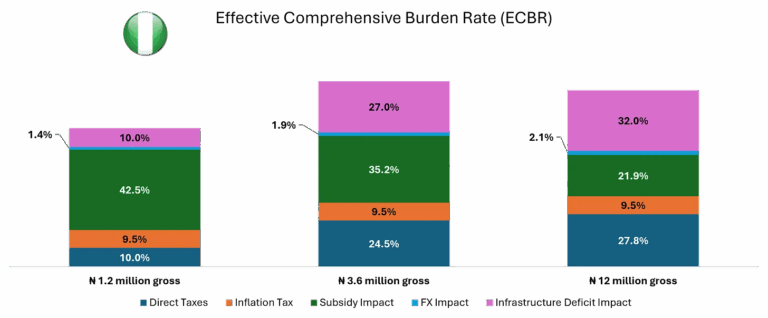
The system is incredibly burdensome, not because of the tax structure (which is now properly progressive), but because the wealth producers must spend vastly more to privately provide basic public services. The ₦300k / month earner spends 27% of their income on infrastructure deficits; the ₦1 million / month earner spends 32% from my calculations (we can, of course, fight over my methods). This is the cost of state incapacity.
Cui bono?
The obvious question: who benefits from framing this as a tax reform story rather than, well, something else?
The answer is depressingly clear. It allows the government to claim victory on “reform” whilst avoiding the harder questions about why inflation is running at 14.45% (a vast improvement from before, mind), why the electricity grid remains, well, poor, and why citizens must privately fund their own security, water, and education. It shifts attention from monetary policy failure to income tax brackets. It turns a conversation about state capacity into a conversation about tax rates.
This is not to suggest conspiracy. It is simply an incentive. Politicians prefer ribbon-cutting ceremonies to the unglamorous work of fixing the Central Bank, reforming NERC, or actually building functional public infrastructure. Tax reform makes for good headlines. “Government Reduces Inflation to 5%” does not have the same ring, largely because it requires doing things that are politically difficult and take time.
The methodology (for sceptics)
I anticipate the objections. “How do you quantify the infrastructure deficit tax?” Fair question. The model uses household expenditure patterns: 8-12% of monthly income on generator fuel (scaled by income), 3% on private security for those earning above ₦300,000, 2% on water provision, and 15% on private education premiums for households above ₦300,000. These are conservative estimates based on what Nigerian families actually spend when the state fails to provide.
“How do you measure the inflation tax?” Simple: the difference between the inflation rate (14.45%) and nominal wage growth (estimated at 5%) multiplied by income. This is the purchasing power you lose annually to monetary debasement. It is real, it is measurable, and it affects everyone.
“What about the fuel subsidy removal effects?” Direct fuel consumption (50-200 litres monthly, depending on income) multiplied by the price increase, plus 5% of income for transport cost increases, plus a 12% markup on consumed goods due to embedded fuel costs. Again, these are not theoretical; they are what Nigerians are experiencing.
The model uses actual 2025 data: NBS inflation figures, CBN exchange rates, market fuel prices, and the 2026 tax brackets from the Nigeria Tax Act.
All formulas are transparent and can be interrogated. It’s all in Excel, and it isn’t sleight of hand; it is arithmetic.
What does this mean?
The 2026 tax reforms will indeed provide relief. A worker earning ₦100k monthly will save perhaps ₦8,000 to ₦10,000 or more in PAYE. This is nothing. But their total fiscal burden is ₦73,250 a month or ₦879,000 annually. The tax reform addresses a tiny fraction of their problem.
The fellow earning ₦300k saves a fair chunk in PAYE with these reforms, but their total burden is ₦294k monthly or ₦3.5 million annually. Frightening, no?
The ₦1 million earner gets to pay even more as intended, but even then their tax burden is modest by international standards. However, you’re looking at an effective total fiscal burden of ₦933k monthly, or ₦11.2 million annually. Again, the reform does precious little for their other battles.
I am not arguing that the tax reforms are bad. They are good. Progressive taxation is sensible. Exempting minimum wage earners is the right thing to do. But celebrating this as a major fiscal relief for Nigerians is rather like rearranging the deck chairs whilst the ship takes on water. It addresses a symptom, not the disease.
Ok. Now that we’re done criticising…
If the government were serious about reducing the fiscal burden on citizens, and if blogs had all the answers, the agenda would look rather different in my view:
Monetary policy reform: Keep chasing lower inflation through sound(er) money management. This alone would save low-income earners, especially significant chunks of their income annually. That can be more powerful than eliminating their PAYE entirely.
Energy policy transformation: Fix the electricity grid. I know, right? Reduce generator dependence. This would save middle-income families 10-12% of their monthly income, calculated in this model. The fuel subsidy removal, painful as it was, should have been accompanied by a credible plan to provide reliable alternatives. It wasn’t. Or maybe it’s that I’m not satisfied with what I’ve seen.
Infrastructure investment: Also not new, this. Public water systems. Public education quality. Security provision. The fact that Nigerians must spend up to 32% of their income privately providing these basic services is an indictment of state capacity, not a feature of modern life.
Currency stability: Go harder on implementing sustainable FX policy. Build productive capacity to reduce import dependence. We really do need to work on our ability to make and export stuff. The persistent depreciation quietly erodes purchasing power.
These are harder than adjusting tax brackets. They require competence, patience, and political courage. They don’t lend themselves to grand announcements and quick wins. But they address 72% to 90% of the problem, rather than 10% to 28%.
Not the win you think it is
I suspect the government believes the 2026 tax reforms are a significant achievement. Good on them. In narrow terms, they are. But in terms of what actually burdens Nigerian citizens – the inflation that erodes their savings, the fuel costs that eat their budgets, the generators they must buy because the state cannot provide electricity, the school fees they pay because public education is not exactly great – these reforms are a footnote.
Nigeria’s fiscal burden problem is not primarily a tax problem. It is a state capacity problem, a monetary policy problem, and an infrastructure problem. Solving a fraction of the problem and declaring victory is not great policymaking.
I am reminded of what Thomas Sowell often says about the difference between solutions and trade-offs. The 2026 tax reforms are a solution to a problem that is not the main problem. They trade political capital and political goodwill for addressing the wrong fraction of the burden. The actual problems – inflation at 14.45%, collapsed infrastructure, fuel costs up 327% – remain untouched.
This is not the win the government was looking for. Or rather, it shouldn’t be. Happy New Year.
The complete ECBR model, including all data sources, formulas, and assumptions, is available for those interested in the detailed calculations. The model is built in Excel and can be stress-tested against different economic scenarios.
Dr. Ekpen Omonbude is a development economist with over 20 years’ experience in energy and extractives policy. He is Senior Policy Advisor at IISD (IGF), previously served at the Commonwealth Secretariat, advises governments on resource governance, holds advanced degrees from Dundee and Abertay, and is UK-based.