Aisha Musa, a tomato farmer in Kaduna, depends on Zenvus’s soil sensor app for irrigation updates. Today, the app shows optimal moisture levels, helping her save diesel by skipping unnecessary pumping. Unlike a few years ago, when she relied on instinct and hoped for rain, Aisha now considers data her most valuable tool.
As part of a growing community of smallholder farmers, Aisha helps transform Nigeria’s food system. Digital agriculture is changing the landscape, with platforms like Farmcrowdy and ThriveAgric connecting over 11,000 farmers to urban investors and market insights. Hydroponic ventures like Fresh Direct in Abuja and BIC Farm Concept in Abeokuta are growing soil-free lettuce. Still, the stakes are high, with Nigeria’s population expected to reach 398 million by 2050. Even though agriculture accounts for a steady 25% of GDP, roughly the same as in 2017, food import bills range from ₦835.9 billion to ₦920.6 billion each quarter.
Climate change has increased the pressure: floods in ten farming states destroyed crops for 100,000 farmers in one season, while desertification continues to push herders south, sparking deadly conflicts over land and water. Emerging solutions like drone mapping and solar irrigation demonstrate how agritech can help improve food security amid climate challenges and conflicts. Nonetheless, a deeper question lingers: can digital innovation truly outpace the forces of climate, conflict, and cost, or will the promise of agritech remain just another harvest deferred?
State of Agriculture in Nigeria

As of mid-2025, agriculture remains the heartbeat of Nigeria’s economy: contributing 24–26% of GDP and employing nearly four in every ten Nigerians. Yet beneath the surface of this vast sector lies a paradox: immense potential restrained by chronic underperformance.
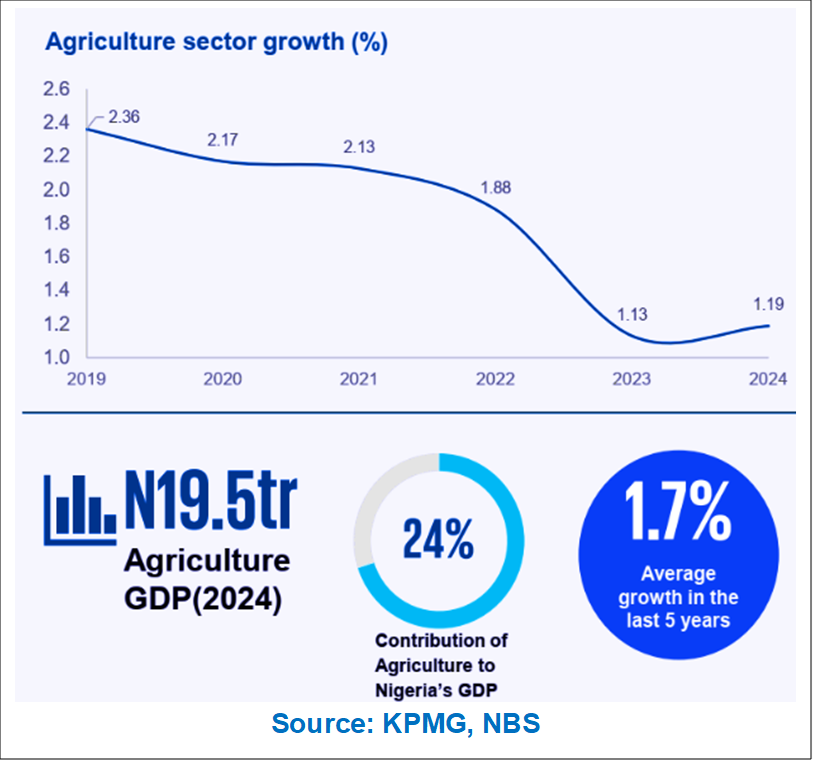
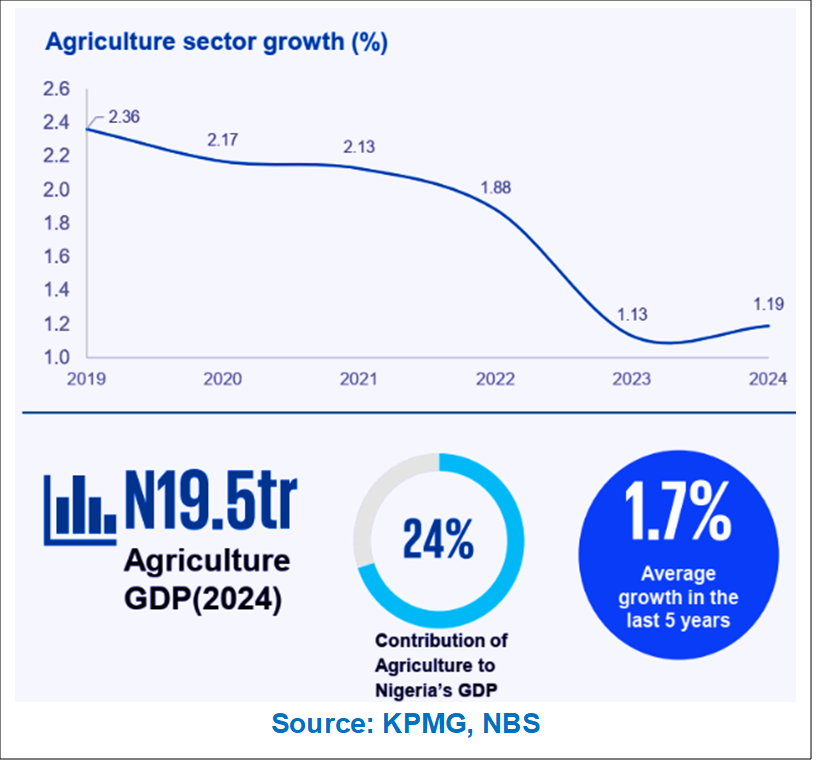
Despite being valued at ₦19.5 trillion in 2024, agricultural growth has averaged just 1.7% over the last five years, weighed down by insecurity, climate shocks, and a persistent funding gap. Although the 2025 national budget doubled agricultural allocation to ₦2.27 trillion (4.12%), it remains far below the 10% Maputo Declaration benchmark, reaffirming food security as more of an ambition than an active agenda.
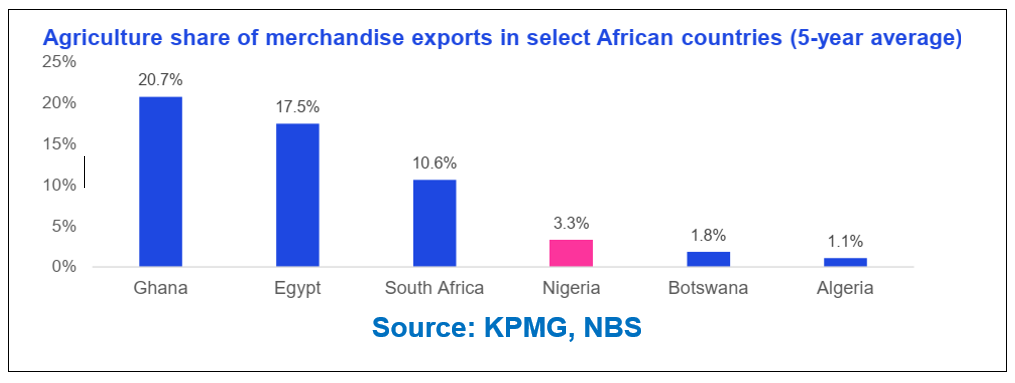
Crop production continues to dominate, making up over 91% of agricultural GDP, while other subsectors — livestock, forestry, and fishing — have stagnated. Nigeria’s agricultural exports account for only 3.3% of total exports, far behind peers like Ghana (20.7%), Egypt (17.5%), and South Africa (10.6%), reflecting weak value addition and poor competitiveness.

Still, there are flickers of renewal. Initiatives such as the $510 million Special Agro-Industrial Processing Zones (SAPZ) and the $1 billion mechanization partnership with Brazil and John Deere aim to inject productivity and scale into the system. But until insecurity, post-harvest losses, and limited access to finance are tackled head-on, Nigeria’s food systems will remain trapped in a cycle of survival rather than growth.
Thus, by pulling the right lever: technology, mechanisation, and smart farming, agriculture could finally shift from being a social safety net to a powerful engine of prosperity.
The Tech harvest
Where policy and infrastructure have long stumbled, agritech is stepping in. Innovators like Fresh Direct and BIC Farm Concepts are leading the charge with hydroponic and aquaponic systems, soil-free farming that delivers high-yield vegetables in urban spaces. Globally, hydroponics is booming, with the market projected to reach $27.3 billion by 2030. Other notable agricultural innovations in Nigeria include digital farming (such as Farmcrowdy), value-chain logistics (Naija Pride), and smart agriculture (such as Zenvus).

Meanwhile, Nigeria’s logistics bottlenecks, responsible for wasting up to 15 million metric tonnes of perishables each year, are starting to ease. A significant 1,045 km refrigerated tomato shipment from Kaduna to Lagos marks a new chapter for cold-chain logistics.
The urgency is clear: agriculture contributes 26% to GDP and employs 38% of the labour force, yet Nigeria spends ₦3.35 trillion on agricultural imports every four years. Climate shocks, post-harvest losses, and a widening food trade deficit demand smarter systems.
Technology is answering the call through:
- Hydroponics and vertical farms enable dense, urban cultivation
- Drones and sensors optimize pest control and fertilizer use
- Cold-chain transport reduces spoilage across long distances
- Solar irrigation powers off-grid farms
- Digital platforms offer microloans based on verified yield data
Nigeria leads Africa’s agritech boom, with over 100 active startups and $150 million in funding since 2016 according to PwC report. To this end, the next harvest might not come from the soil, but from software.
From sensor-driven farms to fintech-backed financing, agritech is stitching together the broken links in Nigeria’s food system. The result: not just better yields, but a more resilient, tech-powered agricultural future.
Feeding the Future- The big policy and infrastructure question
Despite its potential, Nigeria’s agritech revolution still faces a common challenge: can innovation outpace the system’s inertia? The digital advances from hydroponics and drone mapping risk stalling in a landscape still weighed down by aging infrastructure, policy uncertainty, and limited funding for smallholders who comprise over 80% of the sector.
The PwC report warns that Nigeria’s food production needs to increase by nearly 300% by 2050 to meet the demand from an expected 398 million people. However, the country loses up to $9 billion each year due to post-harvest waste, undermining both investor confidence and farmer resilience. Power shortages, poor road access, and the lack of integrated cold-chain systems continue to make farm-to-market logistics a costly challenge.
Policy efforts are starting to catch up. Initiatives like the National Agricultural Technology and Innovation Policy (NATIP) and the now-suspended Central Bank’s Anchor Borrowers’ Program have created new credit opportunities and driven mechanisation, while public-private partnerships are testing solar-powered irrigation and digital extension services across multiple states. However, without a clear plan to incorporate these efforts into the wider food value chain, progress remains scattered.
The future of Nigeria’s food security, then, may hinge less on invention and more on integration — aligning technology, policy, and capital to feed both people and promise. The next frontier is not about growing more; it’s about growing smarter.
The Next Harvest: Can tech innovation outgrow the old system
Nigeria’s agritech revolution is no longer a whisper: it’s a pulse beating across fields, cities, and data networks. Yet the next challenge is scale. Feeding an estimated 400 million Nigerians by 2050 will demand more than clever apps and pilot projects. It will require breaking the old system, the one built on subsistence practices, outdated infrastructure, and a fragmented policy mindset, and replacing it with one that runs on innovation, inclusion, and intent.
The country’s youth, now over 60% of the population under 35, are central to this shift. They are shaping the future of agriculture, not just working in it. From drone engineers in Ilorin to hydroponic startups in Lagos, a new generation is transforming agriculture from a basic survival trade into a high-tech industry. However, for their innovations to succeed, private capital needs to step in where public funding falls short. With agriculture still making up about 26% of GDP and receiving less than 5% of the national budget, the private sector — including venture investors and agri-fintechs — must support the ecosystem with patient, risk-tolerant capital.
At the same time, climate-smart solutions are no longer optional; they’re existential. With droughts shrinking yields and floods washing away livelihoods, the winners of the next harvest will be those who can grow more with less: leveraging solar irrigation, precision farming, and circular value chains that cut waste and carbon alike.
The promise is clear: if technology, talent, and capital converge, Nigeria’s food future can be both secure and sustainable. But one question lingers; the one that will define the decades ahead. Can these digital innovations truly outpace the forces of climate, conflict, and cost? These are still the burning questions that all stakeholders need to examine more critically and closely.