




On a humid Saturday night in Surulere, my favourite suya man, Mr Dauda, apron dusted with pepper flakes, handed me a smoky skewer, and sighed.
“Fuel don high. Tomato is done high. Customer patience no dey high,” he said, half joking, half worried. Yet, his lights were on, and his phone kept chirping with mobile-money alerts.
“How you still dey cope?” I asked.
He grinned. “Solar box from MTN. I pay small amounts every day. Jos’ farmer sends spices through GIG Logistics. I settled everybody with my Sterling wallet.”

Right there on the sidewalk, energy, telecoms, logistics, and finance were pulling a night shift to keep one grill alive. Multiply that by thousands, and you will see the real heart of Nigerian Innovation: unlikely partners working together because the alternative is darkness, literally and figuratively.
Why working alone no longer works
Our biggest headaches – power cuts, pricey transport, shaky healthcare – are tangled knots. Tug one strand and the others tighten. Solving them inside neat industry fences is like cooking.
Jollof with only rice and no pepper is technically food, but nobody wants it twice. Progress here tends to look like mash-ups:
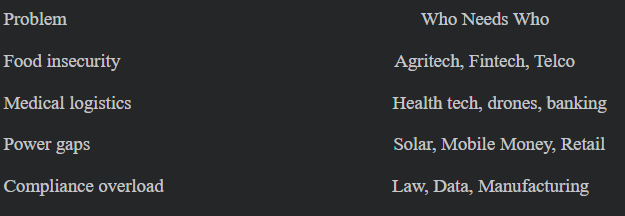

The magic happens when these strangers share data, risk and, hardest of all, credit.
Three home-grown collaboration stories
1. Tractors by airtime
Hello Tractor helps farmers rent machinery, but farmers need cash upfront, and banks require proof that they will repay. Hello Tractor shook hands with Sterling Bank and MTN. Now, a farmer books a tractor in an app, Sterling fronts the loan, and repayments flow in through MTN airtime. Last season, 50,000 smallholders received mechanical help, and tractor owners reduced defaults to single digits. One field, three industries.
2. Blood by drone
LifeBank once weaved through Lagos traffic on okadas. Today, hospital inventory data triggers drones that zip blood bags across the lagoon. Zipline supplies aircraft, state regulators approve flight corridors, and fintechs handle payments. Emergency delivery times fell from two hours to forty minutes, an eternity to a cardiologist.
3. A solar box in a SIM card
Remember the “I Better Pass My Neighbour” generator symphony? Lumos slipped solar into that soundtrack. Customers pick up a yellow box at an MTN shop, pay daily with airtime and all finances the kits for riverine towns. More than 150,000 homes now enjoy light. without diesel fumes, and MTN enjoys a higher average revenue per user. Everybody sleeps better.
Why these marriages work
• Shared data beats secret data. Telco APIs reveal spending habits, banks gauge credit, and health centres expose supply gaps.
• Risk is sliced, not swallowed. Each player keeps the risk they understand, banks mind defaults, agri-startups mind soil sensors, and telcos handle last-mile reach.
• The customer sees magic, not plumbing. My suya man does not care who wrote the code. He cares that the spice shows up and bulbs stay bright.
But collaboration is still rare
1. Low Trust. We guard ideas like family secrets and handshake NDAs, only to appear after someone feels burnt.
2. Regulatory Ping Pong. A startup that combines pills and payments may be subject to scrutiny from the Central Bank, NAFDAC, and NCC for months.
3. Short-Term Targets. Quarterly KPIs push managers to defend turf instead of building bridges.
How we make it easier
• Regulators as Matchmakers. Picture NCC hosting a quarterly “Collab Day” where Telcos, banks and health startups pitch joint sandboxes.
• Reward Data Sharing. Cut licence fees for firms that publish secure, anonymised
APIs. More carrots, fewer sticks.
• Celebrate the Bridge, Not the Moat. Investors should ask founders, “Who is your best partner?” before “Who is your biggest rival?”
A note to boardrooms
ICT already accounts for about 16 per cent of GDP, according to the National Bureau of Statistics, and its ripple effect is undeniable. When telecom infrastructure supports agriculture or healthcare, tomato prices drop, export volumes increase, and children are read by LED light.
The boardroom question for 2025 isn’t “Who is eating our lunch?” but “Whose breakfast can we cook together?” The next Flutterwave-sized wave probably comes from the fastest partner, not the fiercest gatekeeper.
If Mr Dauda can orchestrate telecom, fintech, and solar projects over a charcoal pit, what’s stopping the rest of us? The nation’s jollof is simmering. Let’s not let it burn for lack of pepper or partners.
Wilson Dike is a founder and strategic enterprise sales leader dedicated to accelerating SaaS growth, engaging C-suite executives, and driving sustainable innovation through the integration of IT, cutting-edge infrastructure, and renewable energy solutions.





