The Central African Republic (CAR) is facing one of the most severe and protracted education crises in the world. More than a decade of armed conflict, political instability, mass displacement, chronic poverty, and systemic underfunding has pushed the country’s education system to the brink of collapse. Although education is officially free and compulsory for children aged 6–14, parents and guardians are still required to cover costs such as uniforms, furniture, books, and supplies, creating a system that is unable to deliver even basic learning outcomes for the majority of children.
As of 2025, an estimated 40.6 per cent of children requiring education assistance in CAR remain out of school, according to UNICEF. This represents hundreds of thousands of children in a country where approximately 843,829 school-aged children need urgent educational support. CAR consistently ranks among the countries with the highest out-of-school rates globally. Dropout levels are extreme, with between 39 and 47 per cent of girls and 31 to 33 per cent of boys leaving primary school early. Learning outcomes are equally dire: only about 4.7 per cent of children aged 7–14 demonstrate foundational reading skills, underscoring a deep and entrenched learning crisis.
The roots of this crisis are structural. Armed conflict has destroyed, occupied, or rendered thousands of schools inaccessible since 2012. Teachers have fled violence, been killed, or abandoned postings due to insecurity, leaving many schools dependent on untrained and unpaid maîtres-parents. Displacement has uprooted entire communities, with hundreds of thousands of internally displaced children dropping out of school, often permanently. Gender disparities remain acute, with adult female illiteracy exceeding 75 per cent, driven by early marriage, househollabouror burdens, and gender-based violence. Chronic underfunding compounds these challenges, with the education sector receiving less than half of its annual requirements and an estimated USD 95 million external funding gap projected between 2025 and 2029. Overcrowded classrooms, poor infrastructure, and the absence of school meals, healthcare, and WASH facilities further undermine access and retention.
Without decisive intervention, experts warn that CAR risks becoming largely illiterate within a generation, with devastating consequences for national development, social cohesion, and security. Education deprivation fuels cycles of poverty, child recruitment into armed groups, early marriage, malnutrition, and long-term dependency on humanitarian aid.

An Existential Intervention: InnerCity Mission’s Education Model in CAR
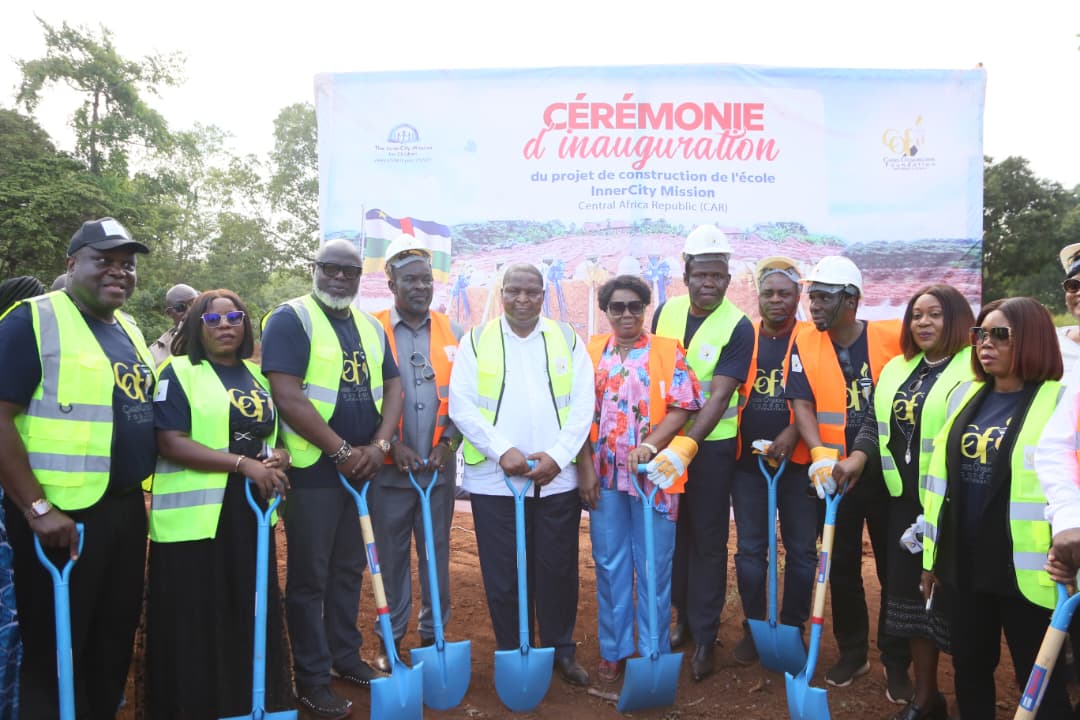
Against this backdrop of systemic collapse, in May 2025, the InnerCity Mission for Children, a faith-based humanitarian organisation operating under the Chris Oyakhilome Foundation International, began implementing what amounts to a structural, long-term intervention rather than a stopgap response. The organisation is currently constructing the largest charity primary school in the Central African Republic, located in the Libi district, one of the region’s most affected by educational exclusion.
Designed to accommodate 1,500 pupils, the school is envisioned as a central educational hub serving at least ten surrounding communities within a 100-kilometre radius. Construction is actively underway following a groundbreaking ceremony attended by President Faustin-Archange Touadéra, who personally laid the first stone to signal the commencement of construction of the school. He lauded the project and the magnitude of impact it would bring to his country, stating:
“giving that the school will accommodate more than 1500 students, it will be the biggest school compared to other schools we have. The advantage is that the school is free and they will be benefit for books, text books and that will be able to eat twice a day because there will be a canteen where they can eat twice a day”
The facility is scheduled to commence operations in the first quarter of 2026.
As highlighted by President Faustin-Archange Touadéra, the InnerCity Mission’s approach addresses the education crisis at its structural pressure points. The school will provide 100 per cent free education, eliminating tuition costs that exclude the poorest households. Beyond classrooms, the model integrates free textbooks, learning materials, daily nutritious meals, and healthcare services, directly confronting poverty, hunger, and poor child health—key drivers of dropout and absenteeism in CAR. By combining education with nutrition and health, the initiative stabilises children’s capacity to remain in school and learn effectively.
Equally significant is the creation of a safe, modern, and protected learning environment in a context where schools are often targets of violence or neglect. The scale of the facility allows for trained teachers, standardised instruction, and sustained oversight, countering the widespread reliance on unqualified volunteer teachers. Rather than dispersing limited resources thinly across fragile systems, the InnerCity Mission is establishing a durable institution capable of delivering consistent, high-quality primary education over the long term.

This model is consistent with InnerCity Mission schools across Nigeria (13), Uganda (1), Malawi (1), Liberia (1), India (1), and Fiji (1). In addition to these large-scale investments, the InnerCity Mission operates learning centres and women empowerment centres as family support programs within and beyond the communities where these schools are built.
From Humanitarian Relief to Systemic Impact
While international partners such as UNICEF, the Global Partnership for Education, Education Cannot Wait, and various NGOs continue to support remedial and accelerated learning programs across CAR, these efforts remain constrained by funding volatility and insecurity. In contrast, the InnerCity Mission’s school represents a fixed, physical, and institutional investment—an existential structure designed to outlast emergency cycles and restore educational continuity to some of the country’s most vulnerable populations.
This project builds on the InnerCity Mission’s established network of tuition-free schools across Africa, extending a proven model into one of the continent’s most fragile states. By targeting a high-burden region and delivering holistic, no-cost education at scale, the initiative directly counters the trajectory toward mass illiteracy and social breakdown.
In a context where the education system itself is at risk of extinction, the InnerCity Mission’s intervention is not merely charitable; it is foundational. It demonstrates how strategically designed, fully subsidised educational infrastructure can function as a stabilising force—preserving human capital and offering a pathway out of generational deprivation for children in the Central African Republic.