…As third work mirrors life, relatable narratives
On August 16, 2025, the Nigerian literary community was delighted with the presentation of a new book from the creative stable of one of its own.
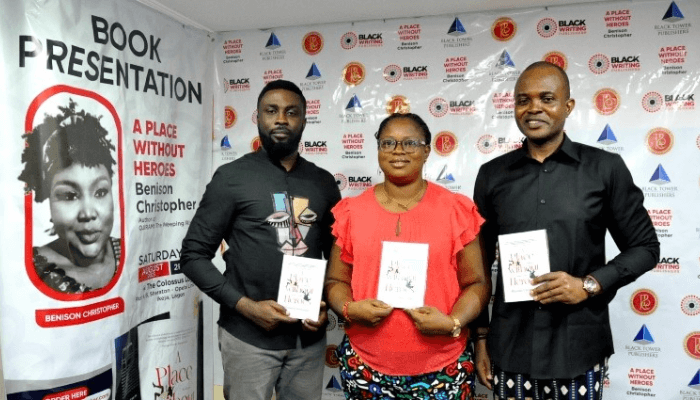
That day, at The Colossus Lagos, Benison Christopher, a Nigerian writer, presented ‘A Place Without Heroes’, her latest book, to the public.
Published by Black Writing Publishers, the 165-page book is a collection of seven short stories, amid a thought-provoking exploration of moral compromise, corruption, and human frailty.

It also trails two previous successful books of the author: ‘Dear Sista’ and ‘Pastor Gbenga’s Chronicle’.
In the new book, the author expressed herself further, while taking her creative ingenuity a notch higher, all for exciting reading, amid salient messages embedded in her beautiful narratives.
In recognition of her qualitative output, Romanus Egudu, a professor emeritus, endorsed the book with his cover page quote: “This collection of short stories is a marvellous manifestation of the functions of enlightening and delighting the readers in the tradition of the Horatian concept of “Utile Et:Dulce”.
In reality, Benison Christopher, in her latest and captivating short stories book, shines light on life, using Nigeria as a microcosm to explore universal human experiences and the need for heroes. Each of the seven narratives is masterfully crafted to draw the reader in, while leaving a lasting impression. The collection opens with the first story entitled, ‘The Perfect Husband,’ where Ireti’s seemingly perfect marriage takes a shocking turn that changes her life forever.
The second story, ‘Being with a Fat Girl,’ explores how heartbreak shapes the destiny of Samuel Onoja, while ‘A Place Without Heroes’ delves into the moral dilemmas faced by a bank operations head during a robbery.

The stories continue with ‘The Weeds,’ where Kofoworola and Akinlade’s discovery of their only son’s sexuality broadens their perspective on life. ‘The Pastor and the Robber’ and ‘The Fear of Darkness’ depict the struggles of Pastor Gbenga, balancing spiritual and natural alertness amidst hunger and lack. The collection concludes with the poignant tale of ‘The Riverbank,’ in which Chiamaka recounts her traumatic experience in a Nigerian government hospital while giving birth to her second child.
With diverse themes and richly drawn settings, the collection is engaging from the first page to the last.
However, in her speech at the event managed by Plexus, Benison Christopher, who participated virtually, described the unveiling of her work as a celebration of a journey of stories that demanded to be told, voices that refused to be silenced, and truths that insisted on being seen.
According to her, the new book holds a mirror to society, one that does not flatter, but reveals that people are flawed.
“We are compromised and broken in ways we rarely admit, yet we are resilient. “And we are capable of quiet, astonishing acts of courage,” she said.
Speaking further at the book presentation, she noted that the stories in the book are not of caped saviours swooping in to fix everything, but stories of ordinary people, who are caught in extraordinary circumstances.
“They are not just fictional creations; they are mirrors of the people we know, and perhaps even of ourselves. The question that haunted me while writing this book was: what happens to a society when the people who could save it decide it is too costly to even try?
Trailing the journey of the book, from the idea conception to the presentation, she made an honest confession that she wrote ‘A Place Without Heroes’ during a vulnerable season in her life. “When I desperately wished someone would rescue me. I could almost see myself peering through a window, waiting for a hero to appear.
“That longing became the heartbeat of this collection and each character carries some version of that same hope. Ireti, in ‘The Perfect Husband’, relying on her spouse to shield her from harsh economic realities; Samuel Onoja, in ‘Being with a Fat Girl’, clinging to romantic relationships as a safety net; young Pastor Gbenga, in ‘The Pastor and The Robber’, looking to a scholarship, then an uncle, for salvation. There is an Oga Jimoh, in ‘A Place Without Heroes’, believing his boss and the police could save him; in ‘The Weeds’, Kofoworola looked to her husband to shield her from the collapse of their world; and in ‘The Riverbank’, Chiamaka trusted government doctors to rescue her during childbirth.
“But, like me, they all discover a bitter truth: no one is coming! There are no idle heroes scanning the horizon for someone to save. To survive, the impacted must first find the courage within themselves – to become the heroes they once sought and turn pain into passion and purpose, or perish”.
The writer explained that the conviction that people can and must raise themselves into heroism led to the creation of The Benison Christopher Company, a socially-conscious media enterprise that uses art to illuminate societal issues and respond with acts of kindness.
So, apart from being a writer, she takes up advocacy and charity for the vulnerable, especially women using The Benison Christopher Company platform, especially in the United Kingdom, where the company sells its creative works to help support international students financially. Part of the creative works, she noted in her speech, include holding stage plays across the UK to help reduce loneliness and isolation often experienced within Diaspora communities.
But she also leads her company to support women escaping abusive situations in Nigeria, offering them the opportunity to apply directly on their website for financial support, with every case reviewed on its own merit.
“The women we assist commit to becoming their own heroes first – starting a trade, learning a skill, or following a passion to create sustainable livelihoods.
“We have also built an affiliate programme that allows them to earn commissions by selling our creative works, creating a cycle of empowerment – one woman helping the next,” she said.
In the speech, she also explained the goal of the book presentation, saying that it is not merely to sell books, but also to fund change.
“Every copy of A Place Without Heroes sold will help finance this initiative. Even before this official launch, initial sales have already supported two brave women in beginning new chapters of safety and self-reliance. And this is only the beginning”, while hoping that the book will provoke thought, inspire conversation, and spark the change needed to create heroes in today’s broken world.
The event also featured selected readings and excerpts from the book, as well as remarks from the guests, associates, colleagues, book signing and networking.
But the question-and-answer session with the author afforded the audience the opportunity to meet the author, ask relevant questions and get clarification from the author.
In her response to a question on her advice to women who are being abused in Nigeria, she said, “I would advise them to be courageous. Being a victim of abuse myself, I know it takes a lot of courage. First, to own up to it because society, when you come up and say that you have been abused, it looks like you may have done something wrong or you may have made poor choices.
“There is a little bit of victim-blaming in that regard, but I am hoping that every woman who is going through an abusive situation gets the courage to live above it.
“I am also hoping they rise above it, and be able to look inwards, to find that thing that makes them unique in the world, and be able to turn their pain into purpose and passion”.
At the end, she was delighted to meet the audience, while appreciating them, her editor and all that made the journey of the book; from idea to presentation, successful.