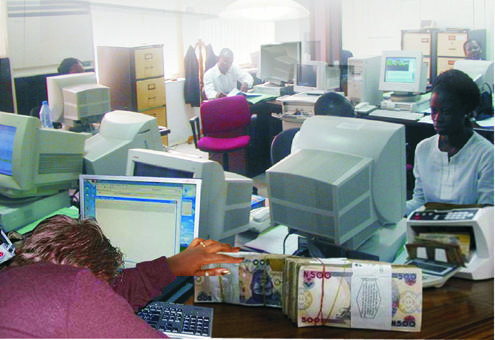
Nigerian banks recorded higher costs per employee in 2015 despite a reduced workforce from layoffs in the sector.
Data from the eight banks which have released Full Year (FY) 2015 audited reports show that average staff cost per head increased by 4.3 percent to N6.9 million, from N6.61 million in 2014.
Personnel costs increased even as total staff strength for the eight firms fell by 680 to 41,749 from 42,429 in 2015.
Cumulative personnel expenses for the eight lenders increased to N288.2 billion in 2015 from N280.68 billion in 2014.

Staff remuneration is the single largest cost item for many banks, making it often one of the starting points for cost efficiencies, foranalysts
say.
“This could have been as a result of banks laying off some junior staff not meeting up to expectation and probably hiring middle to senior staff to drive the business,” said Tajudeen Ibrahim, head of research at Chapel Hill Denham, a Lagos based investment and finance house.
A few lenders such as Tier – One lender’s, Zenith Bank and Guaranty Trust Bank (GTB) bucked the trend as their personnel costs fell or remained flat, even as employee strength increased.
Zenith’s personnel costs fell to N67.5 billion from N72.3 billion recorded in 2014 as total employees at the end of 2015 increased to 7,416 from 7,278 in 2014.
Guaranty Trust Bank on its part had a marginal increase in personnel costs to N27.7 billion from N27.4 billion as total employees at the Group level increased to 5,144 people from 4,929 in 2014.
GTB has the lowest Cost to Income ratio CIR (a measure of a bank’s overheads as a percentage of its revenue) in the industry which was equivalent to 42 percent in 2015.
Nigerian banks were expected to offset the increasingly difficult operating environment with tighter cost controls.

“Non-interest revenue is a potential weak spot in 2016 (for GTB), but we now think steady margins coupled with some higher-yielding naira loan growth and cost control should go a long way towards helping to offset this,” Renaissance Capital analysts led by Adesoji Solanke, said in a March 29 note to investors.
Access Bank had the steepest increase in personnel expenses (among the eight banks) as it moved to N 42.3 billion from N31.2 billion in the period.
Nigeria’s inflation breached the Central Bank’s 6 to 9 percent target in February, while the International Monetary Fund (IMF) has forecast that Africa’s largest economy will grow at the slowest pace since 1999 this year.
In its annual review of Nigeria’s economic situation, the IMF said that gross domestic product growth would slow to 2.3 percent in 2016 from an estimated 2.7 percent in 2015.
Nigeria’s misery index jumped to 21.8 percent last month as inflation and unemployment entered the double digits level of 11.4 and 10.4 percent respectively.
Job losses in the financial services sector will add to the unemployment rate, which is among the highest in emerging markets.
Some banks have been employing technology that may enable them to employ less staff to cut costs, and free up banking halls.