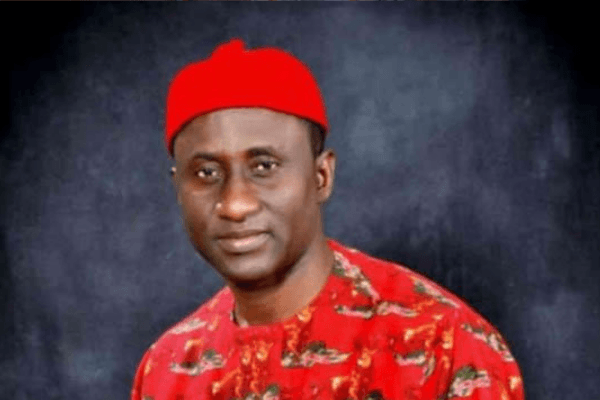
A ministerial nominee, Uchechukwu Ogah has tasked the Ninth National Assembly to carry out the reforms embedded in the Petroleum Industry Governance (PIGB) Bill to unlock its huge potential to economic growth.
The reforms, he explained, were capable of creating more jobs and revenue that would catalyse the country’s economy.
Speaking during his screening in the Senate on Wednesday, Ogah said: “Once the Petroleum Industry Governance Bill is passed, it will help the economy in ensuring that investors will come into the country. And once they have guaranteed crude oil. It is like building a house and nobody comes in there. So it is very difficult for people to put their money when they know that there is no source of crude to use in operating their refineries.”
BusinessDay reports that the bill is one of the oldest in the nation’s legislature, having been first introduced by late President Umaru Yar’Adua to the Sixth National Assembly in 2008.

In 2018, global extractive industry watchdog, Publish What You Pay (PWYP) had disclosed that Nigeria loses N3 trillion annually for failing to put in place a proper legislation for the oil and gas industry.
Coming at a time when Nigeria is tagged the poverty capital of the world, with some 94 million Nigerians living in extreme poverty, according to Brookings Institution and 2,877 firms shutting down in just four years due to weak economy, Ogah, a major player in the oil and gas industry, pointed out that passing the bill would open the window for more jobs for Nigerians.
The proposed law, which was conceived to liberalise the governance structure of Nigeria’s oil industry and passed by the Eighth National Assembly, was rejected by President Muhammadu Buhari on the grounds that, among other reasons, it would whittle down his power as minister of petroleum resources.
On the inability of the nation’s four refineries to function at optimum capacity, Ogah said: “I can assure you that if given the opportunity, the four refineries in Nigeria need to work. Because we have done it in the private sector and I can tell you that it is something that is possible because you get people to do what you want to do. Our refineries can work because what we need is the will power”.
The nominee from Abia State also threw his weight behind the official exchange rate of N305 to $1, even as he called for diversification of the economy, with emphasis on agriculture.

He also made a case for ‘guided deregulation’ of the petroleum downstream sector.
“There is no country that allows its currency to be fixed. Every currency is usually being floated. If you decide to deregulate the Nigerian petroleum sector, especially the downstream, it must be a guided deregulation. In the since that you don’t allow everybody to dump on us because there will be an impact on our foreign exchange. So, we must guide our currency because our ability to guide it is what makes it go up and go down. If we had in the past grew our foreign reserve, I can tell you our currency wouldn’t have gone the way it is today. I believe that with what is going on, the Nigerian naira at the price which it is today, is okay for the nation,” he added.