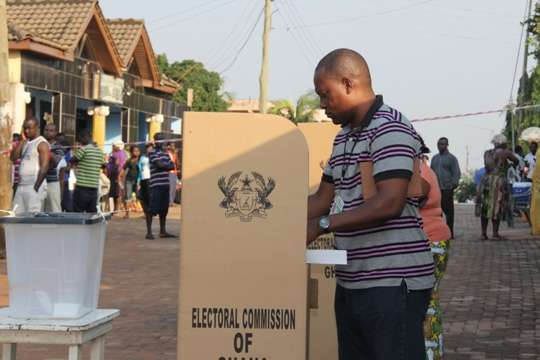
Ghanaians went to the polls this week Wednesday to elect a new president or re-elect John Dramani Mahama for a second term excluding his completion of the term of John Attah Mills who died in office in 2012. Parliamentarians would also be elected.
This election is special in some sense. There has been issue-based but intense campaigning and hitherto considered smaller political parties are gradually gaining grounds. In other words the political space is getting more open and wider by the day. It is going to be the most keenly contested in recent times, especially between the two leading political parties, the ruling National Democratic Congress (NDC) and the major opposition party, the New Patriotic Party (NPP) which candidate, Nana Addo Danquah Akufo-Addo is having a third shot at the Flagstaff House. There are other political parties such as the Progressive People’s Party (PPP), National Democratic Party (NDP), Convention People’s Party (CPP) and the People’s National Convention (PNC). There is also an independent candidate, Mr. Jacob Osei Yeboah.
Of interest is the candidacy of Nana Konadu Agyemang Rawlings, the wife of former president Jerry Rawlings who is the candidate of the NDP. This is not the first time she’s running, though. Her message is clear and simple: “It is time for women to rule Ghana.” No woman has ever governed Ghana since the country’s independence in 1957. “Women have a vital role to play in promoting peace in the family, the country and the world at large” she said. “I will empower women and children and emancipate them through effective mobilization.”
The mantra of change and ant-corruption resonates with the candidate of PPP, Dr Papa Kwesi Nduom.”Corruption will be viewed as a life-threatening crime when I am elected as the President of Ghana” he has said. “This is why we are committed to incorruptible leadership and would create jobs for Ghanaians. I am already employing Ghanaians with my own money, so just imagine what I can do with the state’s finances when I have all the state’s resources backing me.” This message is not quite different to the ones of the two other candidates, Mr. Edward Mahama of PNC and Mr. Ivor Kobina Greenstreet of CPP, especially with regard to job creation and cutting down waste.

The incumbent President John Mahama is counting on his achievements in the area of infrastructure development to be victorious at the polls. Projects such as the Kwame Nkrumah Circle Interchange, Kasoa Interchange, the E-school blocks, roads, water, hospitals and the provision of electricity in rural areas have become reference points in his administration. But his opponents are promising to do better with even greater transparency and accountability.
The quality of exchanges in these campaigns is something Africa should be proud of. As has been pointed out, the campaign has been largely issue-based and efforts have been made to dig into the candidates’ past to ascertain or verify the strength of their moral launching pads for the presidency. There also have been concerted efforts to deemphasize tribalism; religion is practically a non-issue.
It should be noted that Ghana was the very first country in West Africa to become independent through agitation in modern times. Liberia which became independent in 1847 was never really colonized. It is also noteworthy that it was the collaboration between the first democratically-elected president of Ghana, Kwame Nkrumah with his CPP and his counterpart, President Sekou Toure of Guinea, which became independent in 1958 that influenced in no small measure the independence of other French-speaking countries in West Africa in the early 1960s. As far as politics and/or agitation for self-rule was concerned in the 1950s, West Africa was the bastion in Africa and Ghana was the leading light.
Admirable is the speed and ease with which Ghana has continued to consolidate democracy and expand the public space. Also worthy of emulation is the role the civil society has continued to play in Ghana’s democracy and national development. With the discovery of oil in Ghana in the last decade, civil society groups in the country have been working in tandem with government agencies to ensure equity and justice, transparency and other forms of global best practice and drawing lessons from countries that have frittered away proceeds from their natural resources.
There is an interesting story behind the growth of democracy in Ghana which would underscore the imperative of consolidating democratic culture with its inherent freedoms and stability to drive development.

While Ghana cannot be said to be a great economy in Africa today, even with the recent discovery of petroleum in the country, there is need to promote the role of the civil society in the growth of democracy and political stability in Ghana. The inclusiveness underscored by the involvement of the civil society in political and economic development should be emulated by other countries in Africa despite the internal economic shocks occasioned by recent regional and global economic dynamics including low commodity prices.
Ghanaians, like many Africans were witnesses to the brutal consequences of military rule. Theirs included an economic downturn that hit rock-bottom with myriad social consequences. But like in Nigeria and some other African countries, there was deep involvement of the civil society in the return and consolidation of democratic culture in that country. The only difference is that in Ghana the presence of the civil societies has been better felt in reining in the excesses of politicians since the return to democracy. Also, democracy has been capitalized upon to record significant economic gains in the last decade.
The effective and consensual management of the electoral process and the promotion of transparency and the ever growing belief in the existing democratic institutions have contributed in no small measure to strengthening democracy in Ghana. There is also the rising profile of the judiciary which the state has done so much to protect and insulate from external influences. This is further buttressed by the ability of the stakeholders to agree to the rules that should guide the quest or contest for political offices.
Consensus has been the hallmark of the political process in Ghana over the years. The consensual resolution of all issues pertaining to elections has contributed immensely to defuse such tensions that have characterized elections in many countries in West Africa. The country has demonstrated the ability to successfully mediate conflicting and divergent societal interests that had the potential to polarize the country along ethnic and religious lines as is the case in many countries in the region. All these have served to consolidate democracy in the country.
And so, the stakes are high both for the political gladiators and the country in general. The seven presidential candidates on Thursday last week signed a peace declaration at the Movenpick Ambassador Hotel in Accra. Known as the “Accra Declaration”, the signing was supervised by The Chief Justice, Mrs Justice Georgina Theodora Wood. The event was the brainchild of the National Peace Council (NPC) and the National House of Chiefs (NHC) with the endorsement of many international organizations including, the Economic Community of West African States (ECOWAS), the African Union (AU) and the United Nations (UN).
The Chairperson of the Electoral Commission, Mrs Charlotte Kesson-Smith Osei has reaffirmed the preparedness of her team for the task ahead and enjoined on them the need to exercise “neutrality, civility and patriotism in all that they do before, during and after the election.” According Mrs. Osei, the Commission has deployed more than 148,000 personnel while 64,000 security agents, more than 400 international observers as well as 10,000 local observers would be at work during the election.
Paddy Ezeala