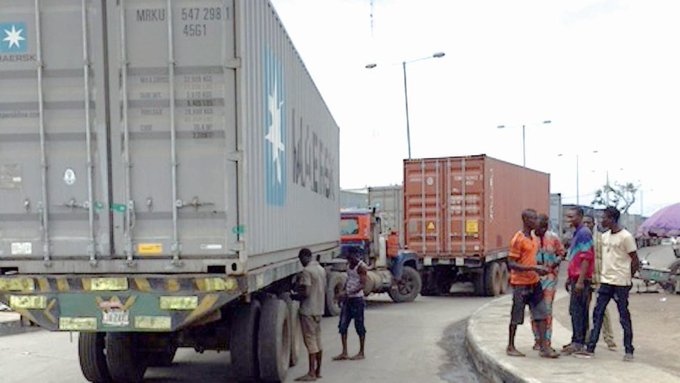
Despite the determination of the Presidential Task Team (PTT) on Apapa Gridlock to end the congestion, chaos and gridlock on Apapa roads and bridges, the gridlock has persisted due to the action and inaction of the Nigerian Ports Authority (NPA), truck owners and drivers have said.
NPA is a federal government agency that governs and operates the ports in Nigeria. The major ports controlled by the NPA include the Lagos Port Complex and Tin Can Island Port, Calabar Port, Delta Port, Rivers Port in Port Harcourt, and Onne Port.
The PTT which was set up by the federal government under the chairmanship of the vice president, Yemi Osinbajo, has done well so far in taming the monster called gridlock in Apapa. But sustaining this good record has become a big challenge for them in recent time.
Gradually, the gridlock which had eased in the last six months is returning to the surprise and anger of many, especially motorists, Apapa residents and business owners in the premier port city.

The presidential task team had alleged that their efforts were being sabotaged by security agencies including the army, navy, policies and others who were part of earlier discredited and disbanded task forces on the Apapa gridlock.
But a cross section of truck owners and drivers who spoke to BusinessDay Tuesday evening on Apapa-Wharf Road pointed accusing fingers to NPA and one of the terminal operators, AP Moller.
“We don’t have problem anymore coming to the ports because the roads are free. But entering the port is a huge challenge. NPA is not doing enough to make the port work. AP Moller is not just attending to trucks because they prefer to attend to barging agencies first,” said a truck owner who identified himself simply as Hafis.
AP Moller is one of the terminal operators in Apapa ports. The operator has been severally qand variously accused of frustrating efforts at improving ease of doing business at the ports with its stringent and exploitative mode of operation.
An official of BUA Group, who refused to give out his name said pointedly that AP Moller was a big problem as it sometimes shuts down its terminal and no truck would be allowed to enter for hours.

“The call up system is working; once you have your papers, you can easily come out of your truck park which does not take up to one hour anymore; but to enter the ports is where there are issues,and this is why you see some trucks on the roads sometimes,” the official said.
A truck driver who also spoke to BusinessDay noted that going out of Apapa has also become very difficult because of Nigerian Customs who have mounted another check point near the foot of the Ijora Bridge, stopping trucks and other vehicles and doing another round of examination.
“Both NPA and the customs are agencies of the federal government and they are the ones sabotaging the work of the presidential task team which was set up the government. Why are they doing that?” wondered the driver who identified himself as Saheed.
Tayo Aboyeji, Southwest Zonal spokesperson of Petroleum Tanker Drivers (PTD) branch of Nigeria Union of Petroleum and Natural Gas Workers (NUPENG), had told BusinessDay on phone that tanker drivers were not to blame in the fresh traffic build-up.
“We no longer have many tankers going to Apapa for petroleum products like before. This is because products are now being distributed by both the NNPC and private depots in places other than Apapa and Lagos,” Aboyeji said, stressing that the resurgence of gridlock is a direct consequence of failure of NPA to effectively supervise operations within the Apapa port.
Adams Jatto, general manager, corporate and strategic communications of the NPA, had said that the ports authority would not join issues with anybody until they found out that the allegations made against them were true, especially the statement made by the task team, which was appointed by the Federal Government to work with the NPA in addressing the Apapa problem.
Kayode Okpeifa, the executive vice chairman of the task team, assured BusinessDay that his team would continue to do its best to ensure that no trucks were seen parked stationary on the roads and bridges.
“We must endeavour to see that trucks on call up have unhindered access to the ports just as we will continue to ensure that other road users are not subjected to undue suffering. The truckers want to be on queue in a single file on the bridges, but that is unacceptable; we will not allow that,” he said.
CHUKA UROKO