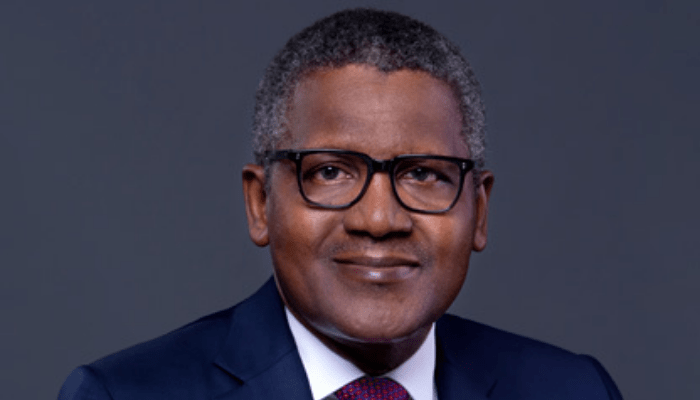
Wednesday, June 19, 2013, makes it one year since Africa’s richest person Aliko Dangote assumed office as the 17th president of the Nigerian Stock Exchange (NSE). His reinstatement followed an Appeal Court ruling in Lagos on June 15, 2012.
One year into his tenure, market operators and shareholders say Mr Dangote has succeeded in steering the hitherto sinking ship out of the tumultuous tidal waves.
Stocks that were moving southwards suddenly changed course as the bulls chased away the erstwhile rampaging bears from the country’s bourse.
When Mr Dangote held his first meeting with the National Council of the Exchange on June 19, 2012, the NSE All-Share Index (ASI) was around 21, 184.58 basis points. Today it stood in the region of 39,737.79 basis points.

Market operators say the one year astronomical leap in liquidity is unprecedented in the history of the bourse.
The Exchange’s capitalization that was N6.7trillion has under Mr. Dangote hit an all time high of N12.8trillion compared to a peak of N12.6trillion recorded in 2008. This was before the market nose-dived and the bubble started bursting.
Experts say Dangote’s team at the NSE did not achieve this feat on a platter of gold but through careful selections of priorities and the introduction of innovative ideas in tandem with global best practices.
As a private sector man, they say Mr. Dangote has a record of achievements exemplified by the conglomerate he heads. His cement company which controls about two third of the stock market’s capitalization is the biggest in Africa’s south of the Sahara.
With the market now on the upward swing, economists say it is an indication that the economic fundamentals of the country are gradually being buoyed using the capital market as a parameter.

Dangote is not only a good administrator, they say, he has ensured that his companies are also playing vital roles in the change that he so desire for the Exchange.
Corroborating the new feat, one of Nigeria’s leading experts on stock market operation and Managing Director of APT Securities and Funds Limited, Mr. Kasimu Kurfi, was quoted as saying that the performance of market capitalization was due to the stocks of Dangote Cement Plc.
Read also: Nigeria CSR awards: 32 companies beat submission deadline
He said Dangote Cement alone controls about 30 per cent of the market capitalization.
“That is why the market moves upward whenever Dangote Cement gains and goes down when it loses. Dangote Cement alone has gained over 50 per cent since January,” he said.
On resumption of office, Mr. Dangote had assured investors when he said, “I have no doubt that my tenure as the President of the NSE will be tough and challenging especially because of the global economy its effect on our economy and our capital market. However, I believe that these challenges will provide the opportunity for us to reposition our Stock Exchange and capital market to become the leading stock exchange in Africa for capital formation driven by transparency, innovation, efficiency and liquidity.”
Earlier, Mr. Dangote had rolled out a five-point plan to reverse the bearish trend of the stock market.
These are: Transparency and improved governance of the market; improving the liquidity, turnover and size of the market; enhancing efficiency by ensuring clearer and updated rules; processes and procedures; provision of world class infrastructure and technology; massive capacity building of the staff of the Stock Exchange.
A stock broker and Managing Director of Partnership Investment Company Limited Mr. Victor Ogienwonyi said he was confidence in Dangote because he is a doer and not a talker.
“You know Dangote is a doer and not a talker. I have confidence in him,” he said.
Experts say the bourse’s president and his team have indeed performed creditably well by growing the capitalization and All Share Index by about 80 per cent.
For instance they make reference to total value of transactions of stocks which stood at N510.1bn at the end of the first quarter this year.
The amount, they say, represents an increase of N152bn or 42.4 per cent over the N358.16bn recorded at the end of February 2012.
The value of N510.1bn comprised both foreign portfolios and domestic investments.
Market pundits say the data reflects increased interest of investors who were participating minimally before the reinstatement of Mr. Aliko Dangote last year.
They say the various reforms put in place by the Dangote-led council and those of the regulators are paying off.
The Nigerian Exchange was among the best performing markets in 2012 and in the first quarter of 2013, observers say.
Having closed as the third best performing emerging market on the global scale with a growth of 34.5 per cent in 2012, the Nigerian bourse also recorded a growth of 13.4 per cent to occupy the first position in Africa in January this year.
Kenya, which hitherto posted the best growth in 2012, positioned second at 8.3 per cent. Mauritius posted 4.1 per cent, while South Africa and Egypt ended the month with 2.8 per cent and 2.6 per cent respectively.